Did you know LARB is a reader-supported nonprofit?
LARB publishes daily without a paywall as part of our mission to make rigorous, incisive, and engaging writing on every aspect of literature, culture, and the arts freely accessible to the public. Help us continue this work with your tax-deductible donation today!
WHEN THE ABBASID caliph Abū Jaʿfar al-Manṣūr (754–75) set out to establish a new capital, his eyes settled on the banks of the Tigris. “The City of Peace” was to be surrounded by fertile lands and irrigated by ancient canals flowing into the heart of Mesopotamia. There he would oversee a sprawling empire reaching far beyond the Persian territories of the Sasanians. “Only a place like this will support the army and the general populace,” al-Manṣūr said before laying the foundations for his fabled “Round City.” Baghdad was to sit in seclusion from the influence of Umayyad loyalists and their former seat of power in Damascus, free from the potential dissent of older Arab settlements in Basra and Kufa. As historian Albert Hourani writes, “In accordance with a long tradition by which Near Eastern rulers kept themselves apart from those they ruled, the city was planned to express the splendour and distance of the ruler.” This tradition lives on. The making of Egyptian president Abdel Fattah el-Sisi’s new administrative capital outside Cairo is just one contemporary example of how urbanism allows militarized capitalism, in the ever-relevant words of Guy Debord, to affect separation and maintain class domination, making the center of governance untouchable by future protests from disgruntled street rabble. Baghdad has its own version of the story.
Centuries after caliph al-Manṣūr established his emerald city and the Mongols sacked it in 1258, and years after the Americans destroyed it in 2003, I went for a ride on a sunny afternoon in early May through the arteries of modern-day Baghdad to see how it was faring during a momentary lull in the latest US-Israeli war against the Islamic Republic. Baghdad is divided up into two halves: al-Karkh, with its gentrified leafy suburbs on the western bank of the Tigris; and al-Rusafa, home to the older downtown and some of the city’s historic neighborhoods, to the east. I began my journey in al-Karkh and its gentrified avenues, crossing an ailing bridge lined with black militia flags stamped with the silhouette of Ayatollah Ali Khamenei’s visage. Although the leading religious authority in Iraq, Sayyid Ali al-Sistani, is still alive and based in Najaf, the assassination of Iran’s Khamenei enraged segments of Iraq’s Shia population, particularly in light of the scenes of carnage from the deathscape in Gaza. A motley of Shia factions soon decided to join their allies in Tehran, partly fearing for their own survival. Soon after Khamenei’s assassination, they launched hundreds of drones and rockets at NATO forces and foreign consulates in Baghdad, Kurdistan, and elsewhere in the region, killing a NATO member, an Iraqi intelligence officer, and Iraqi civilians along the way. In response, the United States and Israel conducted air strikes as deep in Iraq’s territory as Baghdad’s residential neighborhoods. As I drove through, the city lingered in a penumbra between two wars.
Shadowing the bridge was an abandoned concrete watchtower, a relic from the sectarian war that engulfed Iraq between 2006 and 2008, and whose afterlives refuse confinement to the past. I took an exit lane to the highway below, where I had a rendezvous with a ghostly image from childhood, most of which was spent in the years of sanctions and the shadow of US military campaigns. In the midst of the sectarian mayhem, someone in an orange jumpsuit was hanged from the railing by Sunni insurgents. I was 15 years old or so at the time and heard the story from my brother. We looked on from a nearby dump as motorists sped down the asphalt just below his feet. Two decades on, his lifeless body still flickered and swayed before my eyes.
I headed toward the downtown, through a succession of former commercial and administrative neighborhoods with high-rises, major souks, and public squares, including al-Tahrir, a historic site of contestation. There, glimpses of an older city remain untouched by destruction. Eventually, I reached the Green Zone, the seat of the Iraqi government, which was now sealed off because drones had recently been shot down over the Tigris and the US Embassy was the site of an aerial attack. This mammoth garrison occupies a large swath of the 10-square-kilometer area. It sits between the bourgeois neighborhood of al-Harthiyah to the west and the riverine Karadat Maryam to the north. A graceful bend in the Tigris flanks its east and south ends. After a 2004 visit, Naomi Klein offered a description that would prove enduring: “It feels […] like a giant fortified Carnival Cruise Ship parked in the middle of a sea of violence and despair.”
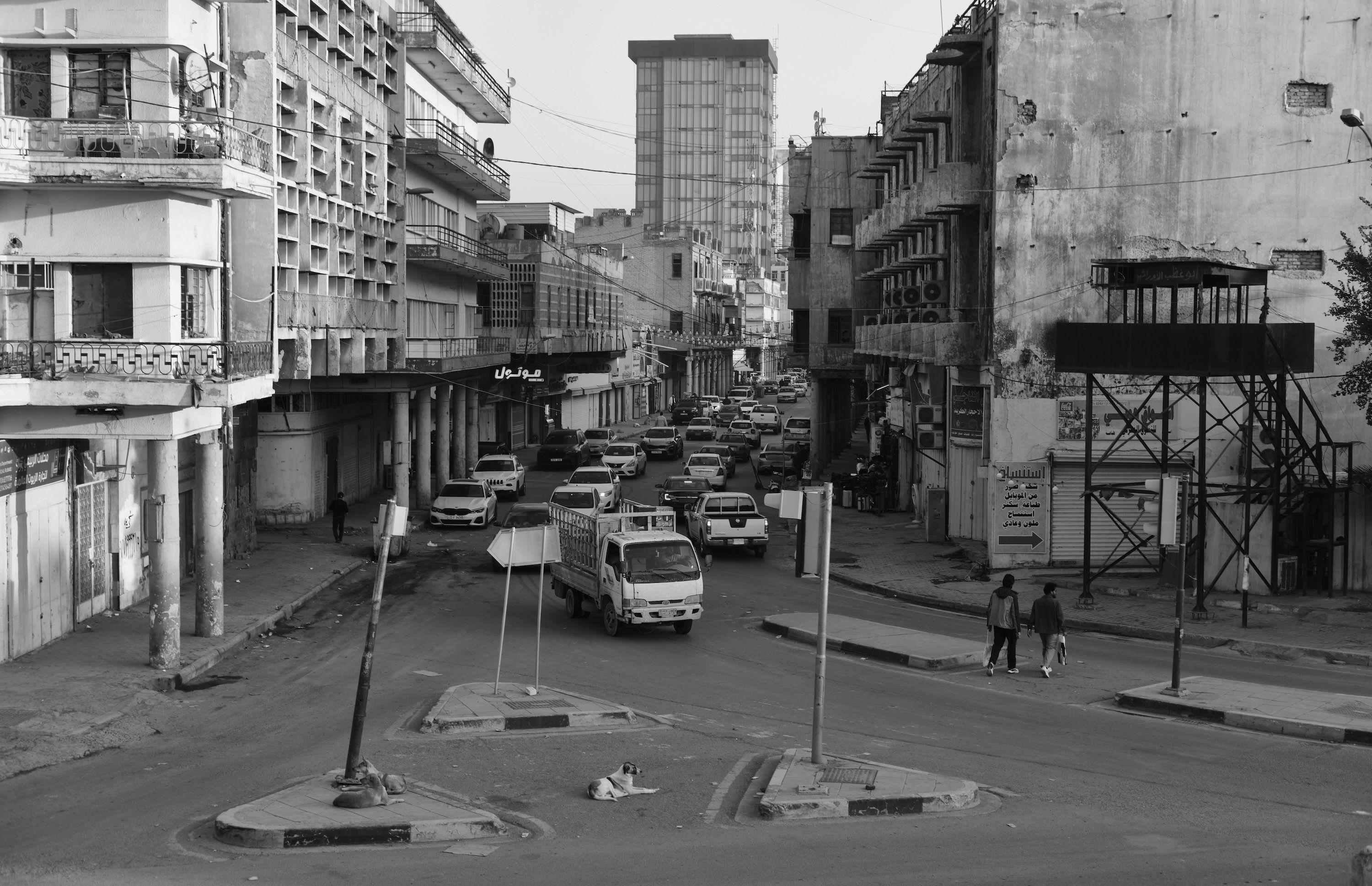
Al-Rashid Street in Baghdad, January 14, 2025. Photo by Nabil Salih.
The Shia are an aggrieved sect. Originally, the Shia population was clustered around the twin holy cities of Najaf and Karbala, where the Prophet Muhammad’s grandson, Hussein, was buried after he and his family were massacred by the Umayyads in a battle in 680 AD. His blood, writes Palestinian historian Hanna Batatu, was “the real seed of religious Shīʿīsm.” The two cities would enjoy lasting socioeconomic ties with the Shia Persian dynasties, whose legitimacy depended on the ulama, the Shia scholars in Iraq. They were at odds with the Ottoman Empire, which went to war against the Persians and looked askance at the rise of Shiism in 19th-century Iraq, trying to reverse conversions to Sunnism and gilding shrine minarets at times, as well as restricting mourning rituals and prohibiting marriage to Persians at others. The ulama were later disparaged by the British, who sought unimpeded endorsement of their mandate, an imperial project some ulama had opposed before, during, and after the 1920 revolt, facing deportation for their stance.
In Republican Iraq, the Ba’ath Party would purge some vocal ulama, most notably Muhammad Baqir al-Sadr, who co-founded underground collectives and politicized their faith. Thousands of ordinary people would later be deported for their perceived Iranian descent as the regime fought an all-out war against Iran in 1980. After 2003, Shia dissidents returned from exile with a vengeance. The United States dismantled the former apparatus, and instead of building an equitable future, its native lackeys instrumentalized and institutionalized sectarianism to monopolize and ransack the new state. The Green Zone has become a symbol of their neo-authoritarian and corrupt rule.
That afternoon, the sliding gates of the Green Zone, all painted black, were closed shut. Armed men were stationed at every entrance; the zone was in part ringed with concrete T-walls and barbed wire. Here and there loomed a dome fractured under bombing or a bullet-scarred edifice, remnants from the “shock and awe” campaign that have yet to be excised in the state’s unspoken mission to sanitize Baghdad from the traces of undesirable histories. A Palestinian acquaintance in New York, upon seeing a photo of these fortifications, remarked that I didn’t even have to visit the West Bank to see what an apartheid wall looked like (he should have seen Baghdad in 2008).
On the other side of the divide, a quarter of the population is believed to be in poverty. A million are still displaced after the war with ISIS, and thousands of Yazidis are still sheltering in camps, maintaining an existence on the periphery. In central Baghdad, millions are priced out as the nouveaux riches carouse in gaudy restaurants and private clubs. Power is often cut and private diesel generators hum at a costly economic and ecological price. Electric wires dangle from dead lampposts carrying portraits of yesteryear’s martyrs. Children hawk bottled water and flatbread on potholed streets amid a sea of traffic. As military operations started across the Persian Gulf, the prices of tomatoes soared, and people lined up in queues for cooking gas. Another closure of the Strait of Hormuz will likely further their agony. Iraq’s rentier economy depends on oil exports, and millions of pensioners and state workers fear being left without pay.
I made my way towards the Tigris past the fortified enclave, which is hemmed in from one side by al-Qadisiyah expressway, a remnant from the developmentalism of Saddam Hussein’s murderous regime, whose name haunts today’s political order. The name alludes to Maʿrakat al-Qādisīyah, a decisive battle in early Arab conquests against the Sasanian Empire. Hussein, the deposed dictator who presented himself as an heir to great Arabian knights in his fight with modern-day Persians, called his war with the ayatollahs “Qādisiyyat-Ṣaddām.” Two arches of Arab sabers held by enlarged castings of his hands were designed by Khaled al-Rahal in the early 1980s to commemorate this struggle. Alongside the brutalist Unknown Soldier Monument, also designed by al-Rahal, the arches remain a dominant monument in Baghdad today.
Downtown, I found the domesticated modernism of Iraqi architects like Hisham Munir, Rifat al-Chadirji, and Qahtan al-Madfaʿi aged but still elegant, with their elaborate facades of intricate brickwork and brise-soleil, blue tiles alluding to Babylon’s Ishtar Gate, and the concrete reinterpretations of traditional lattice wood windows, the shanasheel. While most of them sat in desuetude, scarred with bullet holes and shrapnel, they still fared better than the villas and traditional shanasheel abodes in the suburbs and blue-collar alleys, razed or commercialized en masse after the invasion and the years of ensuing sectarian cleansing and real estate corruption that followed. Over the past 10 years, Baghdad has been defamiliarized beyond recognition.
Led by Prime Minister Mohammed al-Sudani (succeeded by Ali al-Zaidi in May), Iraq’s Shia government, part of the Coordination Framework coalition, actively tried to exorcise the ghosts of Saddam Hussein. In an ostentatious attempt to materialize the changes the government has promised since 2003, its leaders implemented their own haphazard infrastructural rehaul. The state allowed residential towers to soar above a claustrophobic skyline. It erected bridges and reengineered sites of dissent with tunnel networks to preempt future demonstrations, presiding over the commodification of the city’s heritage by handing over historic buildings near the famed book market of al-Mutanabbi to investors. But this dubious attempt at revitalizing the city and stoking national pride erased open and green spaces and allowed real estate fraud among political elite and militiamen to boom.
Outside the walls of the Green Zone, the state functions almost like a “nervous system,” casting any expression of dissent as deviation from the norm. A state of latent emergency is part of the normal order. The threat of legal violence hovers over every mundane act like an omen. The security apparatus is sleepless, always on the lookout for the sins of the “abnormal” individual. The good citizen-consumer drives his car, dines in overpriced restaurants, and delegates his pent-up worldly grievances to the divine. Meanwhile, hundreds of people have been murdered by security forces and Shia militias for desiring something different: a life unmarred by corruption and free from the foreign influence of Washington, DC, and Tehran. In the October uprising of 2019, some 800 youths were butchered on the streets. Protesters are still on the streets today.
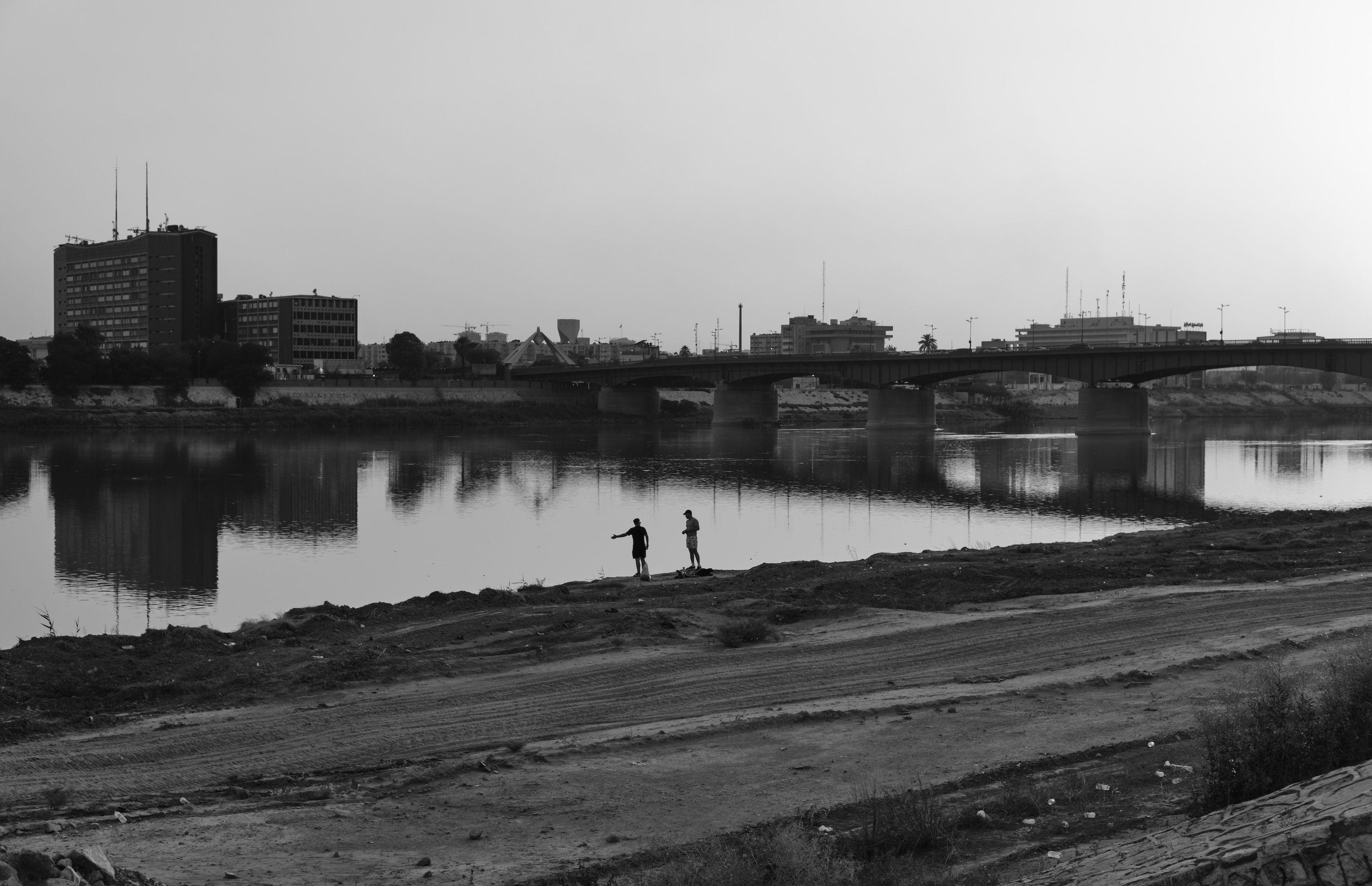
Two men on the Tigris in Baghdad, June 13, 2024. Photo by Nabil Salih.
On the other bank of the Tigris, militia flags and billboards elegized Khamenei and promised an eternal clash with the enemy. The slogans seemed harmless, but they were largely directed toward a domestic audience. Some of Iraq’s militias belong to older parties like Islamic Supreme Council of Iraq, others splintered from Sayyid Muqtada al-Sadr’s Jaysh al-Mahdi, which joined forces with Sunnis to fight the coalition occupation before the country descended into an all-out sectarian conflict. After 2014, al-Sistani issued a decree allowing the faithful to fight ISIS, and dozens of these groups were later institutionalized, forming political wings that claimed considerable parliamentary representation. The rewards of oil rent and the Green Zone politics were too lucrative to forgo; the pleas coming from Gaza went unanswered. The factions still fighting on the side of Iran today are the ones who stand to lose from Iran’s weakening. The government doesn’t name them but alludes to attacks by “outlaws.” All of this leaves ordinary Iraqis in the shadows. The government has also dismissed irrefragable reports that the Israelis have constructed outposts in Iraq’s own desert during the current Iran war. This is a damning setback for a nation that has repeatedly sent its armies to the defense of Palestinians and their lands.
On Abu Nuwas, a famous avenue along the Tigris, a small stretch of the corniche had been renewed, but I mostly found quiet homes from which signs of life have long departed. Their windows had been boarded up, though I still expected someone to peer from behind the curtains. With the doors no longer open, the side streets were silent. Closer to dusk, not even the drunkards who often frequented the riverside gardens appeared with their carefully concealed arak quarters. They’d been chased away by police officers and the bulldozers of private investors. Here and there, a dead swing or a colorful slide disrupted the islets of litter and debris. No children played. Only the stray dogs remained, disoriented and thin. Next to the Institut Français, where a narrow clique of postwar pseudo-intellectuals often speak ambiguously of resilience and hope, a wooden gate chained by a rusted link was the sole standing piece of a house destroyed in its entirety. The door stood like a barzakh between me and the debris of the past. The house was voided, like an unwanted entry effaced from a history book. In its plot, concrete barriers were laid over a bed of waste like toppled sentinels from a defunct civilization, no different from the sentences once spoken here before the walls came down: obsolete.
¤
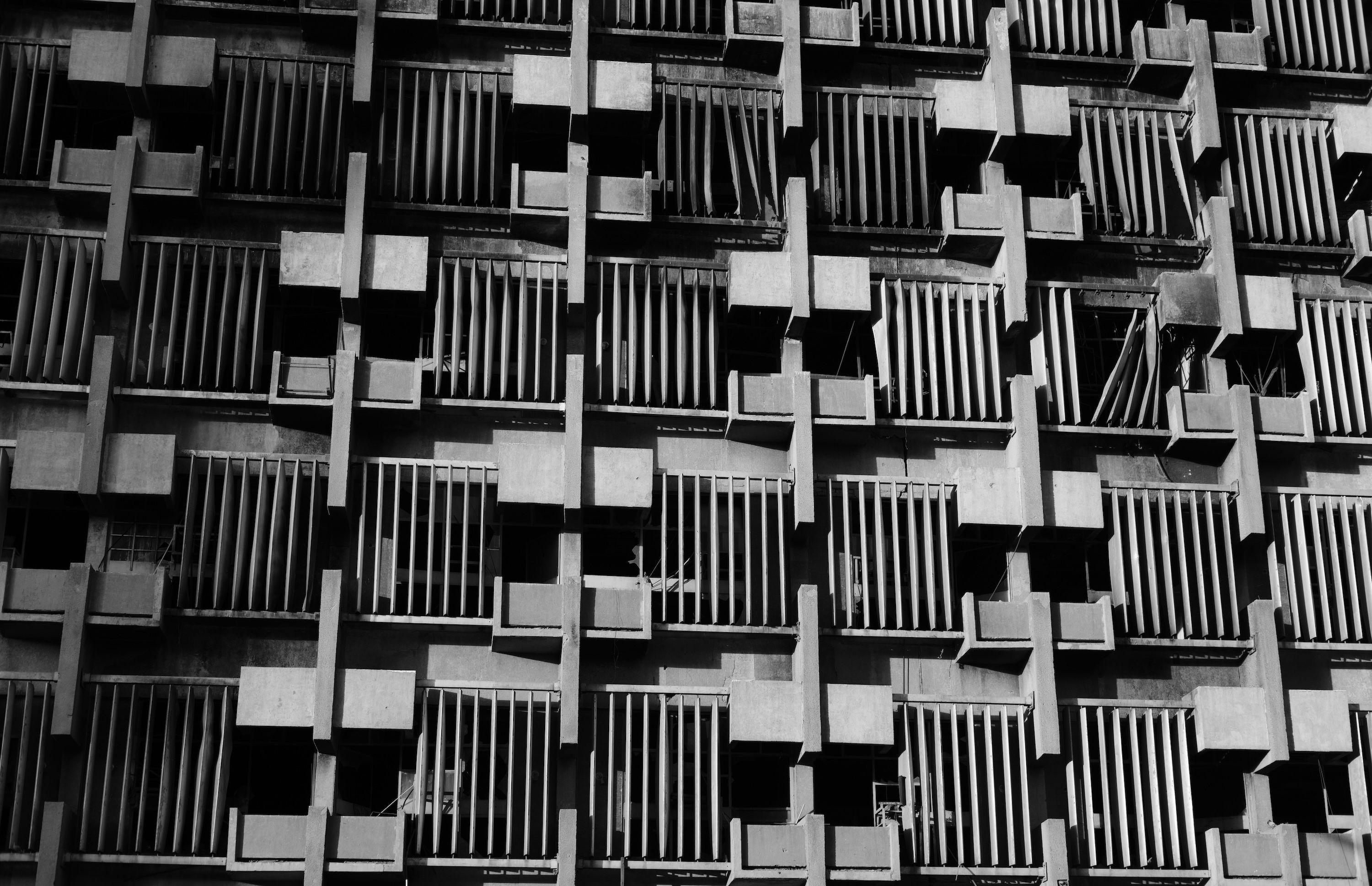
Featured image: The National Insurance Company in Baghdad, designed by Abdullah Ihsan Kamil and Rifat al-Chadirji and damaged during the 2019 protests, June 27, 2024. Photo by Nabil Salih.
LARB Contributor
Nabil Salih is a writer and photographer from Baghdad. He has written for the London Review of Books, New York Review of Books, Boston Review, and other publications, and is a PhD candidate at the Geneva Graduate Institute.
LARB Staff Recommendations
Indirect Victims of Savagery
Chip Rossetti reviews “Baghdad Noir,” edited by Samuel Shimon and featuring writing by Ahmed Saadawi, Ali Bader, and Roy Scranton.
Fiction of Dystopian Times: Ahmed Saadawi’s “Frankenstein in Baghdad”
Rather than dystopian fiction, it’s more apt to call Ahmed Saadawi’s “Frankenstein in Baghdad” fiction of dystopian times.