J. D. Vance’s Straussian Moment
The US vice president wrote his new book without citing his source—Peter Thiel.
By Elizabeth HarperAugust 12, 2026
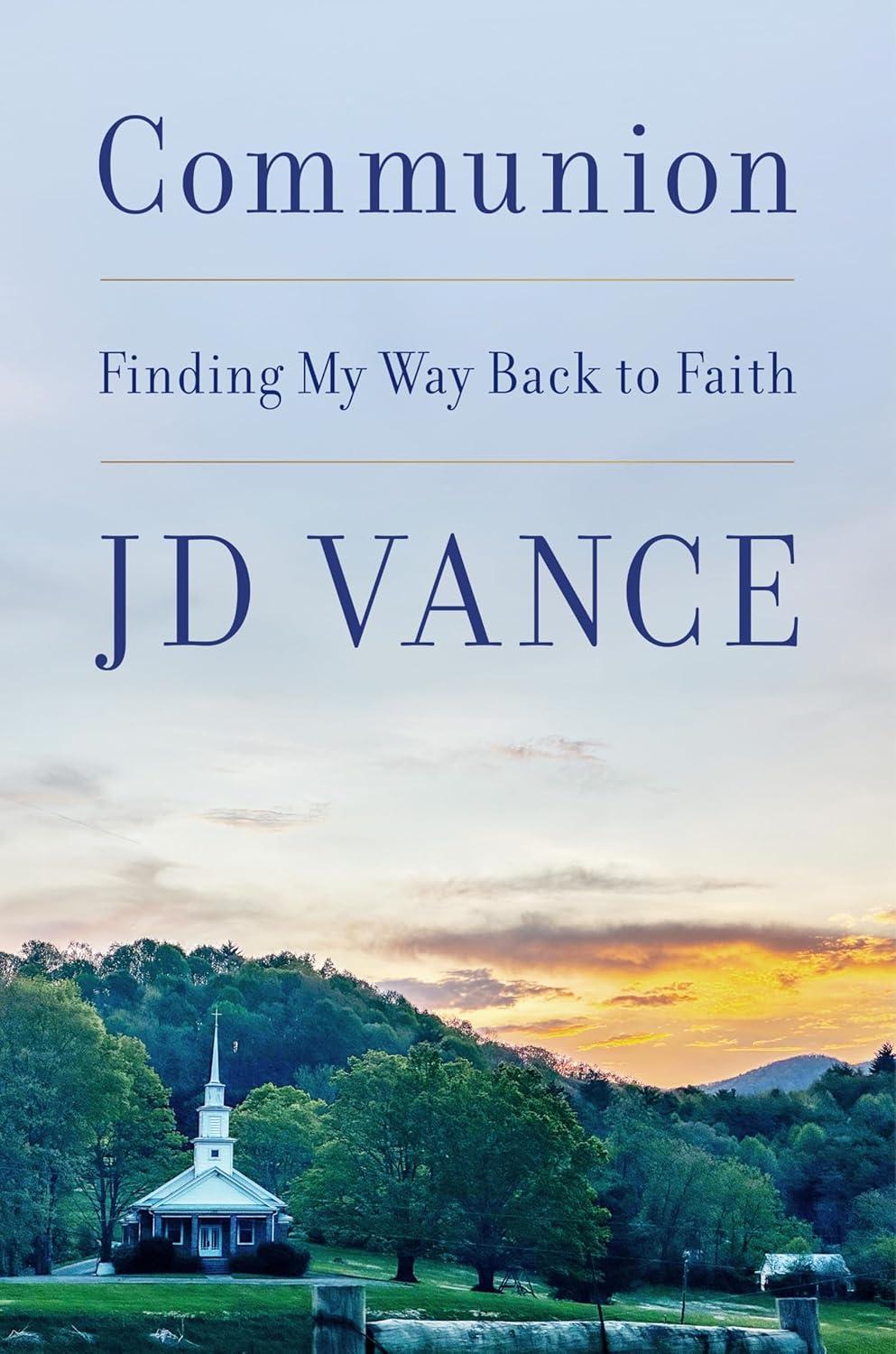
Communion: Finding My Way Back to Faith by J. D. Vance. Harper, 2026. 304 pages.
Did you know LARB is a reader-supported nonprofit?
LARB publishes daily without a paywall as part of our mission to make rigorous, incisive, and engaging writing on every aspect of literature, culture, and the arts freely accessible to the public. Help us continue this work with your tax-deductible donation today!
SOMETHING IS OFF in J. D. Vance’s new memoir, Communion: Finding My Way Back to Faith. To begin with, there seems to be some confusion over what faith we’re talking about. The book is presumably about Vance’s conversion to Catholicism but, as many have pointed out, there’s a Methodist church on the dust jacket. Finding a “way back” is also an unusual way to talk about conversion, which is typically framed as discovering a way forward.
Initially, I chalked these choices up to carelessness, the kind of missteps you’d expect of a book that’s meant to be written about more than read, but on the first page I realized these issues were coming from inside the house. Vance writes: “About half the time these days, we attend Mass at home.” Anyone with a passing knowledge of Catholicism will cock their head: Mass is not something one celebrates at home. I don’t particularly care if Vance does or doesn’t meet his Sunday obligation; it’s just that the book is called Communion, a sacrament performed at Mass that must be witnessed in community. Throughout the introduction, there are similarly strange choices. The word “Catholic” is used once on the first page to describe what Vance’s wife is not, but it is then substituted with “Christian.” He’ll bring back the term “Catholic” to note that Protestants “really don’t like the Catholic practice of praying to saints” or “consulting dead people.” This is not an ecumenical way of speaking; it’s unserious. If I’m being charitable, I’ll grant that Vance says his book is not sectarian or even a work of Christian apologetics. That’s clear. But what is it?
If we believe Vance, Communion is a simple journey of personal faith—he is raised in various Protestant denominations, dabbles in atheism, and eventually becomes a Catholic. He never strays far from Christianity, and there’s not one big revelation that brings him back: it’s a slow realization. My own realization came as I read Vance’s description of his time at Yale Law School, when he and his classmates were vying for Supreme Court clerkships, all trying to become members of what he calls “the elect.” Ultimately, he will not be admitted to this club, but that’s fine, he says; neither was Peter Thiel. What an odd thing to say.
In any case, it turns out that not securing a clerkship was for the best. Vance later understands that the elect are brainwashed members of a “quasi-religion” who worship the gods of status and power. He narrowly avoids their fate thanks to French philosopher René Girard’s work and his concept of “mimetic desire.” The thing is, Vance realized, he didn’t really want to clerk. He didn’t even know why he wanted to be a lawyer or go to Yale. He simply wanted the same things everyone else did. This is what Girard calls mimetic desire. For Girard, this desire is intrinsic to the human condition. Moving through life with purpose means learning what is valuable through socialization, but it leads to the formation of cliques of people who desire the same things—even though no one is able to articulate why those things hold value.
I paused here. There are many ways to explain this concept. For someone like Vance, who describes himself as relating to the lyrics of Lynyrd Skynyrd’s “Simple Man” and looking up “cathartic” in the dictionary as a grown man, one might expect him to use a term like “peer pressure.” But he doesn’t. It turns out Vance isn’t just quoting Girard—he’s quoting Peter Thiel quoting Girard. There are a few immediate tells. For one thing, half of the concept of mimetic desire is missing. Girard believed mimesis was not only destructive but was also “the basis of heroism, and devotion to others, and everything.” Thiel was a student of Girard and has folded his mentor’s work into his own philosophical writings. When he does, he lops off the same half.
Vance later ties his introduction to Girard explicitly to Thiel, but he fails to disclose the extent of their relationship. No other mention will be made of the tech titan—not Vance’s job at his investment firm, not Thiel’s backing of Vance’s own firm, not Thiel’s record-breaking $15 million donation to Vance’s Senate race, and not the peace Thiel brokered between Vance and former president Donald Trump that led to Vance’s place on the 2024 ticket. To hear Vance tell it, Thiel was a kind of Christian motivational speaker who gave a lecture he happened to attend at Yale. In other interviews, Vance calls that lecture the single most impactful event during his time there. This might be true, and yet it is not that lecture that shapes Communion. Instead, it’s Thiel’s other lecture, “The Straussian Moment,” that provides a critical framework for Vance’s otherwise puzzling book.
Thiel originally delivered “The Straussian Moment” at his 2004 self-funded conference Politics and the Apocalypse, and later published it as an essay. Ostensibly, it’s a response to the terrorist attacks on 9/11, but more accurately, it’s a series of philosophical loop the loops that weaves the work of René Girard, Leo Strauss, and Carl Schmitt into an argument for transforming the United States into an authoritarian Christian nation-state. Thiel begins by asking how the US, with all its resources, could be brought to its knees by the Taliban, failing to “deter a handful of crazy, determined, and suicidal persons.” He concludes that it’s because “the new science of economics and the practice of capitalism filled the vacuum created by the abandonment of the older tradition.” This older tradition, according to him, is straightforward Christian nationalism dragged through a fever dream of the Middle Ages.
To put it plainly, Thiel thinks that the United States has abandoned religion and the Enlightenment has failed. The world has become a globalized, godless place where all choices are equally valid and we have fallen into a live-and-let-live passivity. This has brought an empty-headed peace, fanatically protected by liberals under the guise of multiculturalism, though in reality they’re dazzled by cheap consumer goods and driven by envy to protect the system that supplied them. In this anti-society, intellectuals are punished for even mentioning that cultures used to have distinct differences and, in his opinion, echelons. In Thiel’s mind, the Christian West must remember who they are if they are to defeat Muslims from the Middle East. They must realize their culture and religion are superior in order to reinvigorate themselves to fight for it.
The title of Thiel’s lecture is never mentioned in Communion, but a professor would be within her rights to mark it as uncited source material. Early on, Vance introduces the exact same societal problem as Thiel with the same question about terrorism, attributing it to an unnamed Iraqi during his deployment as a US marine: “You’re the most powerful country in the world, but you can’t keep a crazy man from blowing up a market? What’s wrong with you?” And Vance will come to the same conclusion, beat for beat: the West “forgot what it stood for. In the vacuum, we saw a new creed take form: a secular global liberalism that maintained the vocabulary of rights while shedding the religious foundation that gave them meaning.”
There are a startling number of other instances where Communion and “The Straussian Moment” use nearly identical language. A passage in which Thiel connects the philosophies of Locke and Hobbes to the blended works of Aristotle and Aquinas is summarized in Vance’s book, though he implies he learned it at some sage professor’s office hours. They both reference Latin mottos associated with the Crusades: “Dieu le veult!” or “God wills it!” for Thiel; “In hoc signo vinces,” or “By this sign, you shall conquer,” for Vance. Both note the similar roles the myth of Romulus and Remus and the book of Genesis play in the births of civilizations. They mention the danger of a future where video games replace reality, and both discuss similarities between Girard and Darwin’s thought. In fact, when it comes to Girard, Vance doesn’t present a single concept that doesn’t already appear in “The Straussian Moment.” The only quote he pulls from Girard’s vast body of work is “things hidden since the foundation of the world.” Those eight words are in Thiel’s text too.
Still, I found myself wondering if I was making too much of a mediocre book by a guy who should be busy being vice president. Communion often reads like a series of disjointed vignettes that skip between subjects without meaningful transitions. But if you read Vance’s book in relation to “The Straussian Moment,” it becomes clear that this is by design. In Thiel’s essay, after he has made the case that asking questions about the superiority of different cultures is both dangerous and necessary, he borrows an idea from the titular philosopher Leo Strauss, who suggests that these topics should be discussed in an “esoteric mode.” Thiel is interested in the way that Strauss advocates for a kind of writing that can simultaneously serve two purposes, texts that appear to be addressing a wide audience while sneaking in messages to a select few—as he quotes, “trustworthy and intelligent readers only.” Strauss proposes a few ways to smuggle in the hidden message: authors could include “three or four sentences in that terse and lively style which is apt to arrest the attention of young men who love to think.” Kind of like Vance’s dog whistle similarities to Thiel’s work. Or they could use a “disreputable character” as a mouthpiece, like a “beggar” or a “buffoon.” Vance gets plenty of mileage out of this second method, putting his ideas in the crude words of his Appalachian grandma or Trump. And yet, the biggest buffoon is the character he calls J. D. Vance. In a hapless, aw-shucks tone, he tries to slip Thiel’s Christian nationalist playbook into his narrative of Catholic(-ish) conversion.
In character, Vance says Communion is “one man’s story. No more, no less.” This is the memoirist’s emergency exit; they describe themselves and let the reader fill in the rest of the characters (but only in the space they’ve allowed). Vance did this to bipartisan acclaim in Hillbilly Elegy: A Memoir of a Family and Culture in Crisis (2016), where he blamed the downfall of the United States on poor whites whose faults just happened to match anti-Black tropes. In Communion, he attacks from the opposite end of the spectrum, blaming the erosion of Western civilization on the privileged, liberal class whose “zealous enforcement of social rules rival[s] any religious tyranny” he’s seen. Throughout Communion, he wants to make it clear that it was dangerous living among them. Should that sound overblown, he returns to Thiel’s “Straussian Moment” interpretation of Girard, this time to what Girard called the “scapegoat mechanism,” which builds on the concept of mimesis. In Vance’s—and, obviously, Thiel’s—reading of Girard, societies who suppress freethinkers such as themselves are no more than a primal mob who covet the same things. To keep the peace, they find a pariah to pin their societal problems on: a scapegoat who they will eventually kill in an attempt to cast out the problems inherent in their society. Afterward, they bond over the murder carried out for their common good. In ancient pagan societies, this could be anything labeled an “evil force,” like a witch, but today the mob knows, deep down, that the scapegoat is innocent. Girard uses Jesus Christ to describe the ultimate scapegoat. Vance uses J. D. Vance. By embracing Christianity, Vance accepts the social death sentence of the crowd—exclusion from Georgetown cocktail parties. (His metaphor, page 97, not mine.)
Vance finds himself in the same predicament at Yale too. Rejected by his peers, he wanders the streets of New Haven alone, admiring the “halls of learning, meant to look like cathedrals.” These remind him of other Christian alumni, particularly Nathan Hale, a spy who went undercover during the Revolutionary War but was discovered and hanged by the British. Vance, too, has volunteered to go behind enemy lines knowing the danger but willing to risk it all like Hale, who “died at the British gallows in the same year the Founders birthed a new nation.” As the book wears on, the enemy’s death threats become less metaphorical. Toward the end, Vance notes, “a particular belief can cause real pain or suffering. Yes, it can even get you killed.” He’s once again echoing Thiel’s quoting of Strauss, who warns that forbidden thoughts can lead to “capital punishment for the author.”
To Vance and Thiel, the fight they are engaged in is not only for the heterodox thinker’s survival but also for the preservation of the ideals that undergird Western Christian civilization. In this light, the Taliban and American liberals are equally genocidal. What, then, is the best way to fight this consequential war? Thiel turns to the philosopher and literal Nazi Carl Schmitt for answers. Thiel suggests that when wars are fought over fundamental truths such as religion, the rules of engagement must be suspended to mount a winner-take-all defense on par with a Crusade “in the medieval Catholic tradition.” Peace through agreeing to disagree is not possible—either people are with Christ or against. Jews, Muslims, and atheists collapse into “infidel.” To win, one must identify each side as quickly as possible and not be squeamish about naming the traits that distinguish them. Generally, Thiel finds this idea palatable, but he knows a literal crusade is no longer practical. Instead, “politics is the field of battle in which th[is] division takes place.”
This is the war Vance believes he is fighting. In the first half of Communion, it surfaces as the familiar culture war largely focused on people he’s met who have rejected him for his conservative beliefs. After he converts, the second half presents the same conflict on a global scale. He decides to run for senate as “a quirky intellectual project,” and in the space of a page, he becomes a “Christian statesman,” another term lifted from Thiel’s essay (the latter also always adds “or stateswoman,” while Vance spends pages upon pages insisting that even the most ambitious women would be better off at home with children). Vance borrows a bit more of Thiel’s structure as well. In “The Straussian Moment,” Thiel pulls a particularly Straussian maneuver (attention young men!) and buries the lede in a block of untranslated German and Latin. Vance uses the same technique and conceals his point in this jarring pivot between personal and political.
The chapter in question is called “Another Munich.” In it, we find Vance at the Munich Security Conference during his first year as a senator. Once again, he’s been ostracized, this time by establishment politicians on both sides, and once again, he’s wandering the streets alone wondering where the West went wrong. His answer is familiar, the same as Thiel’s: modern peace is not true peace; it’s merely a necessity for free trade. True peace comes from the “older tradition”—vanquishing an enemy, leaving only the superior society behind. Our current society produces strip malls; the older, the medieval churches Vance is admiring abroad. Vance quotes Matthew 7:17, “[E]very good tree bringeth forth good fruit; but a corrupt tree bringeth forth evil fruit.” He uses this passage relentlessly, block quoting it in full twice, referencing it directly half a dozen times, and including too-clever-by-half nods to Froot Loops, Fruity Pebbles, and strawberries in Japan. In every case, it’s safe to substitute racially homogeneous Christian nationalism for “good fruit.” While the idea has radical implications, this chapter makes it sound as anodyne as possible, laundering it through dated international politics even Vance admits are irrelevant.
This is where he buries the book’s entire project in an obscure piece of history that’s easy to miss unless you fire up Wikipedia. The story he uses is one of a father and son, Ewald and Ewald-Heinrich von Kleist-Schmenzin, respectively. They were devout Christians, and the elder was a Christian nationalist politician. Both became heroes in World War II when, like Vance himself (and Nathan Hale before him), they volunteered to spy on the enemy, joining a plot to assassinate Hitler. The father was caught and executed by the Nazis; the son’s plan never came to fruition. The details go unmentioned, but he intended to be a suicide bomber. Any right-thinking person would agree that this was admirable, and Vance is counting on this reflexive response to invert how most would feel about Thiel’s Middle Eastern suicide bombers.
Both Vance and Thiel have asked how a small number of underresourced individuals could terrorize a country as powerful as the United States. Their answer is that those who are willing to fight to the death are true believers in the virtues that uphold their culture. The Kleist-Schmenzins fought to uphold a widely shared virtue, and Vance uses the moral consensus of World War II to name what he believes that virtue is. In his words (emphasis mine), it is “not ‘liberalism,’ not ‘freedom,’ not even ‘democracy.’ It was Western Christian civilization.” He is not simply making the case that this culture must be defended. He is saying that it must be defended at the expense of the Enlightenment ideals we consider intrinsic to the United States. If you pop Thiel’s German text from “The Straussian Moment” into Google Translate, you’ll find that he agrees. He believes our neoliberal society is at the root of our own destruction, which comes at a time when “money celebrates its final triumphs and its heir, Caesarism, quietly and inexorably approaches.” What they’re both saying is, in the necessary fight for the survival of the West, it is fine to have some kings.
In titling the chapter “Another Munich,” Vance implies there is more than one. Perhaps it is meant to recall the last time he participated in the Munich Security Conference and nearly upended international relations by painting immigrants worldwide as criminals and cozying up to the AfD (Alternative für Deutschland), Germany’s xenophobic nationalist party. Perhaps the story about World War II is meant to evoke the Munich Agreement, when the Allies willingly gave their territory to the Axis powers. In the following chapter, Vance jumps forward to his 2025 trip to Rome. While the juxtaposition feels particularly disjointed, the chapters on Munich and Rome mirror what “The Straussian Moment” calls the “gulf” between “Athens and Jerusalem”: cities that represent the powers of church and state, powers that are unable to create a cohesive society when separated. For Vance and Thiel, the only way a great society can be rebuilt from the ashes of the West is (by now obviously) through Christian nationalism.
Through this lens, one can start to see why Vance, who had been Catholic for six years, began a feud with Pope Francis over immigration that he’s intensified under Pope Leo XIV. Vance sees the Vatican’s calls to end violence as, at best, naive platitudes, and at worst as actively abetting the enemy at the gates. When he surveys the battlefield, he can see only invaders: “If you look at majority-Christian societies in the advanced world, every single one has been set on fire by the immigration issue.” If the Pope will not lead, then Vance will do what has to be done—even if the act of saving Christianity seems un-Christian. It is an idea that is, well, Straussian. Thiel again invokes Strauss’s words: “What a decent society will do during war ‘will depend to a certain extent on what the enemy—possibly an absolutely unscrupulous and savage enemy—forces it to do.”’ Vance says there must be certain “trade-offs.” State violence cannot be completely avoided because a “person will sometimes resist arrest.” He doesn’t follow that thought to the point where he would have to justify the murder of detainees and protesters, but he allows the reader to walk down the path he’s laid. Upon reaching the end, they might believe that it is Vance, not the Pope, who has taken the Christians’ side.
Eventually, Vance identifies each faction in his Axis of Evil: immigrants and academics, globalists, the media, and assorted capitalist elites whose liberal views allow billionaires to avoid being categorized as such. It also includes his ally’s path to victory—what Thiel calls “strange new thoughts.” And they are strange. Vance is willing to do away with formerly self-evident truths: men are not created equal—to him, cultures other than Western Christianity ought to “di[e] off like an animal ill-equipped to thrive in a new environment.” He scoffs at democracy, even winking at Thiel’s impending Caesarism by substituting one king for another when he closes his final chapter with, “Caesar was dead. Christ still lived.” He justifies suspending liberty. The stories of spies are no accident. To quote Thiel quoting Strauss, ‘“The most just society cannot survive without “intelligence,” i.e., espionage,’ even though ‘[e]spionage is impossible without a suspension of certain rules of natural right.’” He even prepares the reader for curtailing their right to happiness, admitting that while having children can sometimes cause measurable unhappiness, doing so is a reasonable trade-off for the good of society. Or as Thiel writes, prior to the Enlightenment, “the pursuit of happiness would have seemed inferior to (and certainly much more subjective than) the virtuous life.” In exchange, Vance offers a theocratic company town where manufacturing jobs support national isolationism. Here, labor unions (which Vance endorses) won’t protect workers’ rights but promote “social cohesion.” They will lower household incomes to free workers from the “tyranny of consumption” and lessen hours to encourage higher fertility rates. He believes the people he systematically erases will be replaced.
To put it in a way he will not, the society Vance describes is as narrow and violent as the one he attributes to his enemies. Should any faction of them rise up and resist his vision, he has hidden an intellectual poison pill. The United States he describes is what the United States already is. To fight for a vision of the country based on the ideals of the Enlightenment is to deny the truth—what birthed this nation was not its inalienable rights but the nascent country’s willingness to suspend them. Vance speaks of how “Christianity has long brought people together” in “the intermarriage of the Spanish and native populations in Mexico,” an oddly jubilant celebration of genocide. Thiel, more abhorrent though more honest, says that “perhaps ‘America owes her greatness not only to her habitual adherence to the principles of freedom and justice, but also to her occasional deviation from them.’ […] there exists a ‘mischievous interpretation of the Louisiana Purchase and of the fate of the Red Indians.’” Vance will tell you there are no inalienable rights to fight for. They never existed at all.
In Communion’s introduction, Vance refers to the apocalypse as the unknown hour when “God will unify His children.” Believing I was reading a conversion memoir, I thought that was a vague and theologically unsound way of putting it. I didn’t know yet who “His children” were or what would unite them. I soon caught on that, like so much of the book, his meaning was pulled from “The Straussian Moment.” There, “apocalypse” is used in the original sense of the word—an “unveiling.” Eventually, Vance and his ilk will no longer be able to use esoteric ways of speaking. Vance will have to come out and say it without hiding behind parables of lawyers, rednecks, and priests. He will have to act to bring about salvation through destruction. He thinks his time is coming. The rest of us should be prepared.
LARB Contributor
Elizabeth Harper’s essays and photographs have appeared in Slate, Lapham’s Quarterly, Hazlitt, and the Metropolitan Museum of Art’s catalog for Like Life: Sculpture, Color, and the Body (2018).
LARB Staff Recommendations
Rebel Yale: Reading and Feeling “Hillbilly Elegy”
An article from 2018 illustrates how his refusal to speak directly about “issues” made J. D. Vance, now Donald Trump’s running mate, the new pundit for white people.
Reactionary Futurism 2025
Jordan S. Carroll reviews recent scholarship on the alt-right.