Why Didn’t India Build Its Own Silicon Valley?
Dwaipayan Banerjee’s new book investigates India’s role in the history of 20th-century tech development, and what caused it always to seem a step behind the West.
By Angela SainiAugust 5, 2026
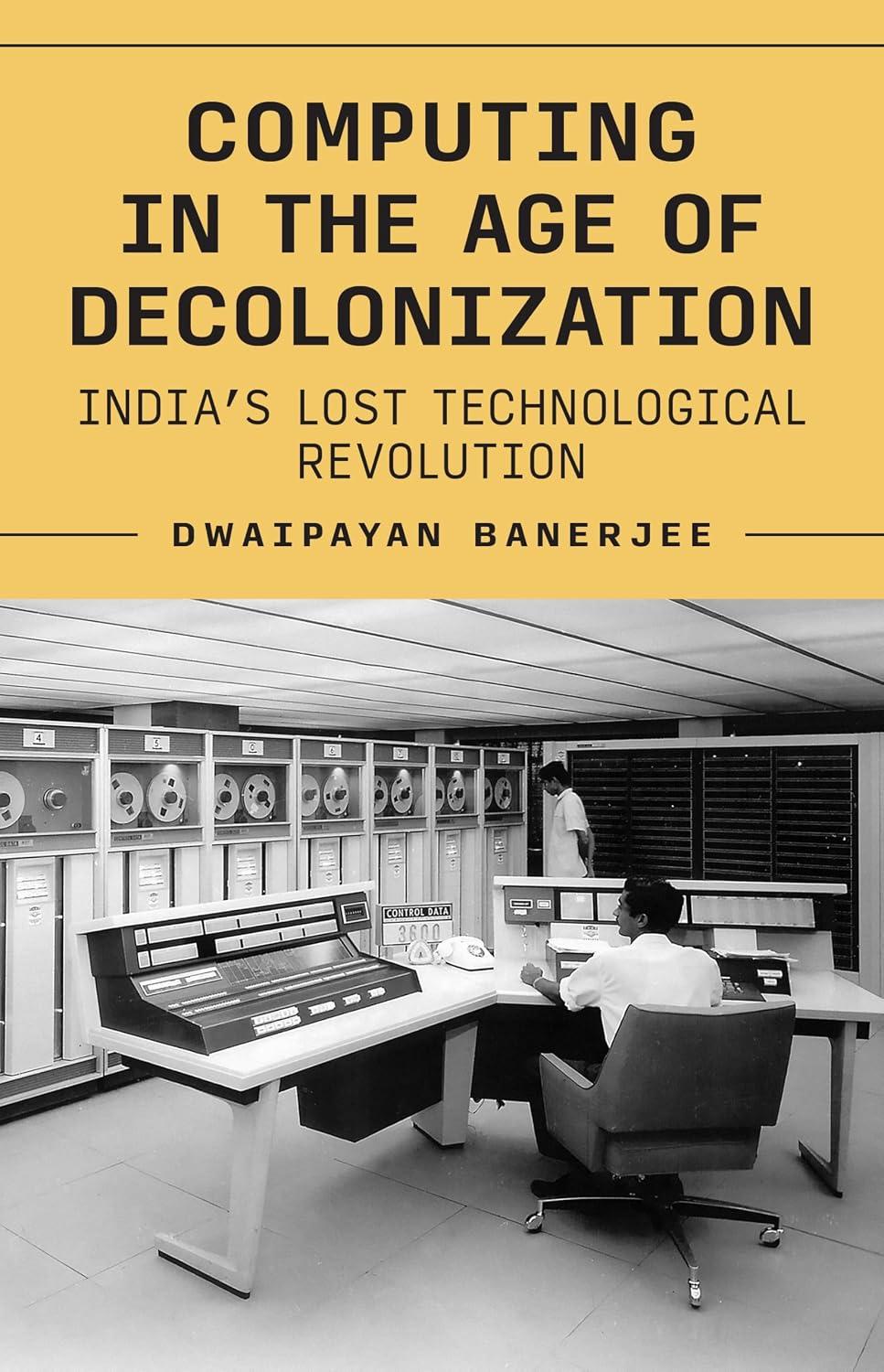
Computing in the Age of Decolonization: India’s Lost Technological Revolution by Dwaipayan Banerjee. Princeton University Press, 2026. 296 pages.
Did you know LARB is a reader-supported nonprofit?
LARB publishes daily without a paywall as part of our mission to make rigorous, incisive, and engaging writing on every aspect of literature, culture, and the arts freely accessible to the public. Help us continue this work with your tax-deductible donation today!
IN THE 1970S, my father was among thousands of science and engineering graduates who left India for the West. The United States and Britain had flung open their doors to Asian immigrants. Leaving India made sense for the superfluously educated, whom India was ambitious enough to train even while lacking the infrastructure to employ them. The West, however, wasn’t always what they had hoped for. Like my dad, many ended up running small businesses or finding quiet jobs in research or manufacturing, hitting glass ceilings if they tried to move any higher. But as their numbers grew and discrimination softened, Indian-born engineers would eventually take over the biggest technology firms in the world, from Google (Sundar Pichai) to Microsoft (Satya Nadella) and Adobe (Shantanu Narayen). In Fremont, the closest major East Bay city to California’s Silicon Valley, nearly a third of residents are Indian Americans.
Their success leaves us to ask why India never built a Silicon Valley of its own.
It is more of a puzzle than it seems. While it’s true that India is best known for backend IT services, it lags so far behind China and the United States in scientific research that it’s scarcely mentioned in the same breath anymore. For decades, however, the outcome of the global technological arms race was far from certain. For a while, India was a contender. After wresting independence from the British in 1947 (when my father was two years old), Prime Minister Jawaharlal Nehru bet big on science and technology, nurturing what he termed India’s “scientific temper,” a quality that in late antiquity had led its thinkers to discover “the zero,” a foundational concept in modern mathematics. India started its own space program as early as 1962. It launched its first satellite in 1975. It established the Indian Institutes of Technology to rival the technical colleges of the West.
“In the 1950s, 1960s, and 1970s, policymakers across the Global South adopted these radical economic ideas,” writes MIT anthropologist Dwaipayan Banerjee in his new book Computing in the Age of Decolonization: India’s Lost Technological Revolution, which traces the nation’s early computing successes and failures. For some Asian nations, these bets paid off. South Korea and Taiwan bolstered their manufacturing bases and offered incentives to companies that carried out innovative research. Today, the two countries together are the world’s largest net exporters of computer chips. In India, the ingredients were present, but somehow the bread didn’t rise. India retreated into low-cost outsourcing and offshoring services, becoming more of a servant than a competitor to Silicon Valley. Unlike South Korea and Taiwan, India imports far more computer chips than it makes.
“This was not the future that Indian policymakers hoped for,” Banerjee observes. The postindependence dream had been to harness high technology to repair the damage of colonial underdevelopment, perhaps even to leapfrog the nations that had once ruled the country. As the historian S. Irfan Habib has noted, “for Nehru, the solution to India’s problems lay in a combination of socialism and science, of technology and heavy industrialisation.” Instead, notes Banerjee, “India provides the raw labor that drives Global North research and manufacturing.”
Indeed, he adds, American computing dominance is premised on underdevelopment elsewhere. If it had not depressed the technological ascent of countries like India and absorbed their engineering talent, the United States would never have become the computing power it is now.
This is more than a story of bad decisions and lost opportunities. For Banerjee, it’s a cautionary tale about the enduring effects of empire: the long psychological reach of providing cheap labor and raw materials for two centuries while the colonizers reaped the real profits. In the 18th century, India had been one of the world’s biggest exporters of fine cotton textiles. By the early 19th century, its own cotton was being processed at an industrial scale by English textile mills, making Britain unimaginably rich while India languished.
“Computing has become the new cotton,” he argues.
Banerjee’s case study comes by way of a single machine: the Tata Institute of Fundamental Research (TIFR) Automatic Calculator. Developed in Bombay in the 1950s, it was India’s first homegrown digital computer. Having witnessed how foreign powers kept India industrially stagnant by rationing access to technology, scientists and engineers at TIFR resolved to build a device sans foreign parts or input. In this way, they hoped to show that they could be self-reliant, in true Gandhian style.
The internationally celebrated physicist Homi J. Bhabha, who was the founding director of TIFR and the driving force behind India’s nuclear program, recognized that Indian science would be lost in a backwater without fast computers. Paper and pencil were no longer enough to get Nobel Prize–winning research done. The future lay in processing power. The ENIAC at the University of Pennsylvania (the first general-purpose electronic computer, announced in 1946), mathematician John von Neumann’s IAS machine at Princeton (operational by 1952), and the IBM 701 (the company’s first commercial digital electronic computer, introduced in 1952) were turning the United States into the center of the scientific world.
Bhabha became a power broker, furiously working to ensure that scientists at TIFR had the equipment they needed. Leveraging his personal contacts and considerable charisma, he earned both the government’s backing and the support of left-leaning Western researchers who felt that formerly colonized countries had been deliberately overshadowed by “a kind of apartheid in global scientific expertise,” Banerjee writes. Although India was officially nonaligned, the Cold War played out behind the scenes.
Still, the challenges for TIFR were immense. By the time work started on the Automatic Calculator, it had been only a decade since the Bengal famine of 1943. India was beset by poverty, malnutrition, and illiteracy. Agricultural scientists were desperately trying to boost crop yields to stop the country from having to import food. This was the era in which a single computer was the size of a large room and cost millions of dollars. Indian researchers would have to build theirs on the tightest of budgets, and without a space of their own; initially, they were operating out of temporary quarters in the Bombay Yacht Club. Their plan was all the more remarkable, adds Banerjee, because no other Asian country at the time, with the possible exception of Japan, had yet established a viable national computing program.
Their ideological commitment to self-sufficiency was admirable, but it also slowed them down. It was rare for a university or private company anywhere in the world to build a computer using only its own parts and sourcing everything locally. The in-house workshop at TIFR nevertheless “assembled 2700 vacuum tubes, 1700 germanium diodes, and 12,500 resistors,” Banerjee writes.
This spirit of making do with what they had, known in Hindi as “jugaad,” has since become a hallmark of Indian technology. The country is infamous for its low-cost work-arounds, crafty reverse engineering, and hacks that somehow get things done with much less than others seem to need. One legendary example is India’s 2023 lunar lander mission, Chandrayaan-3, successfully executed with only 75 million dollars of funding (reporters were quick to point out at the time that the recent Hollywood movies Gravity and Interstellar each had bigger budgets).
We root for the underdog, and the tale of the TIFR Automatic Calculator is the quintessential underdog story. In the 1960s, India did what even many developed nations were not brave enough to do. It saw the future with more clarity than any nation, save the United States, and it chased its dream in defiance of critics at home and abroad who accused it of wasting money. More importantly, it proved that it had the expertise to build a world-class computer on a relative shoestring.
The machine, one of the fastest in the world, was officially unveiled in 1962. Indian researchers complained, however, that its speed had come at the price of memory, thereby sowing critical programming problems. It had the same main memory capacity as the IBM 701, which was by then a decade old, and an order of magnitude smaller than IBM’s newest computer, the 709, which didn’t need to make any trade-offs between speed and memory at all.
By 1965, the year after Nehru died of a heart attack, the TIFR Automatic Calculator had been disassembled for parts. In the archives, Banerjee finds “a sense of disillusionment with the entire experience.”
Bhabha, too, died the following year in a plane crash. In hindsight, the entire project was an object lesson in the difficulties of postcolonial development. Skilled as the scientists at TIFR were, their MacGyvering could get them only so far. As “a direct result of British colonialism,” Banerjee explains, India’s postindependence economy was fragile, and high technology required capital. There was just no escaping it, and it is even truer now than it was then. Today’s race to artificial general intelligence, for instance, is turning out to be a matter of who can throw the most money at it. The likely success of companies like OpenAI and Anthropic is measured less by their actual products than by how close each is to a trillion-dollar valuation. By falling back on what could be done quickly and cheaply, by copying what others were doing just to prove they could do it themselves, India relegated itself to precisely where visionary leaders like Nehru did not want it to be—it became a follower.
IBM emerged in the 1960s as the undisputed winner. And it was capital that got it there. Its computers were so powerful that Bhabha himself was convinced that TIFR would need to import one even as his institute labored feverishly to produce its own. In the end, TIFR bought a computer from another American firm, but it was too late by then to prevent IBM from establishing a near-monopoly in India.
“By the mid-1960s,” writes Banerjee, “IBM’s dominance of Indian computing was nearly absolute.” Universities across the country installed its systems. If this weren’t embarrassing enough, many of these IBM machines were reconditioned older models, discarded by customers in the United States or Europe in favor of newer ones. American firms saw the Indian market as a lucrative dumping ground, a chance to make extra profit on obsolete machines. Even by 1972, “106 of India’s 145 active computers” were still produced by IBM.
This is not to say that nothing useful came out of TIFR manufacturing its own device. As Banerjee notes, the act of making a computer was itself instructive, effectively preparing a generation of Indian researchers for the digital age. Even the scientists who knew that their computer was unlikely to rival IBM’s understood that it provided proof of concept, establishing India as a technological power to be reckoned with. The underdog did win, kind of.
The stranger part of this story, though, is why India is still the underdog 60 years later. At a recent film screening for a documentary about one of Silicon Valley’s earliest Indian immigrant success stories—the computer networking pioneer Kanwal Rekhi, once described by Fortune as the “Godfather of Silicon Valley’s Indian Mafia”—India was described in much the same terms as before. It remains a work in progress, stuck in a perpetual race with its own ambitions, never quite crossing the finish line. Expectations remain low even as other Asian countries surge ahead.
For Banerjee, at least some of this failure can be explained by IBM’s unfair early business practices. The machines it sold in India were not just flagrantly overpriced and shamefully outdated (sometimes four years older than the latest models marketed in the United States); they also didn’t allow anyone to tinker with the hardware. As a result, students and researchers were forced to work on software development, since “this was the only aspect of the machine that was accessible for experimentation and learning.” Concomitantly, President Lyndon Johnson’s immigration reforms in 1965 invited skilled workers to move to the United States and bring their families. When they saw the limitations they faced at home in India, young engineers knew they had to leave. These graduates, explains Banerjee, “became integral to US computing.”
In 1978, the exasperated Indian government finally forced IBM out of India. The country went on to find its strength in software. Designers created new operating systems and applications. The government introduced special economic zones for foreign companies that wanted to develop software in India, and it also offered generous incentives to Indian firms exporting software to the US. These policies brought in much-needed dollars, but they also caused problems. Western firms began soaking up Indian programming talent. Everything became geared toward serving lucrative international markets rather than domestic ones. Regretfully, as Banerjee notes, “service provision had become an end in itself.”
The rest is history. As they became more focused on services, Indian technology firms turned away from basic research and development and continued importing hardware. They left valuable manufacturing capability, including the production of semiconductors, to others. I visited the sprawling Bengaluru campus of the Indian IT services company Infosys back in 2010. On the surface, it was a landscaped city within a city, with giant food courts and sports grounds, resembling Google’s headquarters in Silicon Valley. But as I learned, much of this was a smoke screen. As Banerjee also observes, “the hardware running its servers is designed abroad; the innovations powering its software are patented elsewhere.”
But then, the race for technological supremacy never really ends. The fact that India has not yet built its own Silicon Valley doesn’t mean it never will. My father died this year, taking with him memories of a time when there was no grander ambition for an Indian engineer than to work for a big American or European corporation. In his final days this past spring, that era was already fading. The Trump administration’s shortsighted immigration policy has made the United States a far less attractive prospect for highly skilled workers. Paired with the vicious anti-immigration turn across Britain and the rest of Europe, the drip feed of brains from east to west is slowing.
Western nations may not realize it, but this will hasten their decline. In the 15th century, astronomers would travel from Kandahar to Samarkand to sit at the beating heart of scientific progress, hoping to see the stars at the observatory of the great mathematician Ulugh Beg. In the 19th and 20th centuries, the best minds flocked to Europe and the United States. Seeing the writing on the wall, my 13-year-old son tells me that he wants to go to college in China or Singapore. The race continues.
LARB Contributor
Angela Saini is an author and assistant professor of science writing at MIT. Her new book Other: Race, Sex, and the Hidden Harms of Human Categories, on the limits of human classification, will be published by Grove Atlantic in January 2027.
LARB Staff Recommendations
From Domination to Derision
W. Patrick McCray surveys Matthew Wisnioski’s description of the United States’ evolution—and devolution—into a nation obsessed with innovation.
The Bargaining Chips Are … Chips: On Chris Miller’s “Chip War”
Historian of technology Patrick McCray describes Chris Miller’s “Chip War” as “an account of how chips became a strategically vital resource whose importance is overlooked at our peril.” Miller has placed his own chips on this point. His bet has largely paid off, according to McCray.