A Reign of Silence
The first novel to appear in English from a Swedish modern master.
By Benjamin LytalJuly 25, 2026
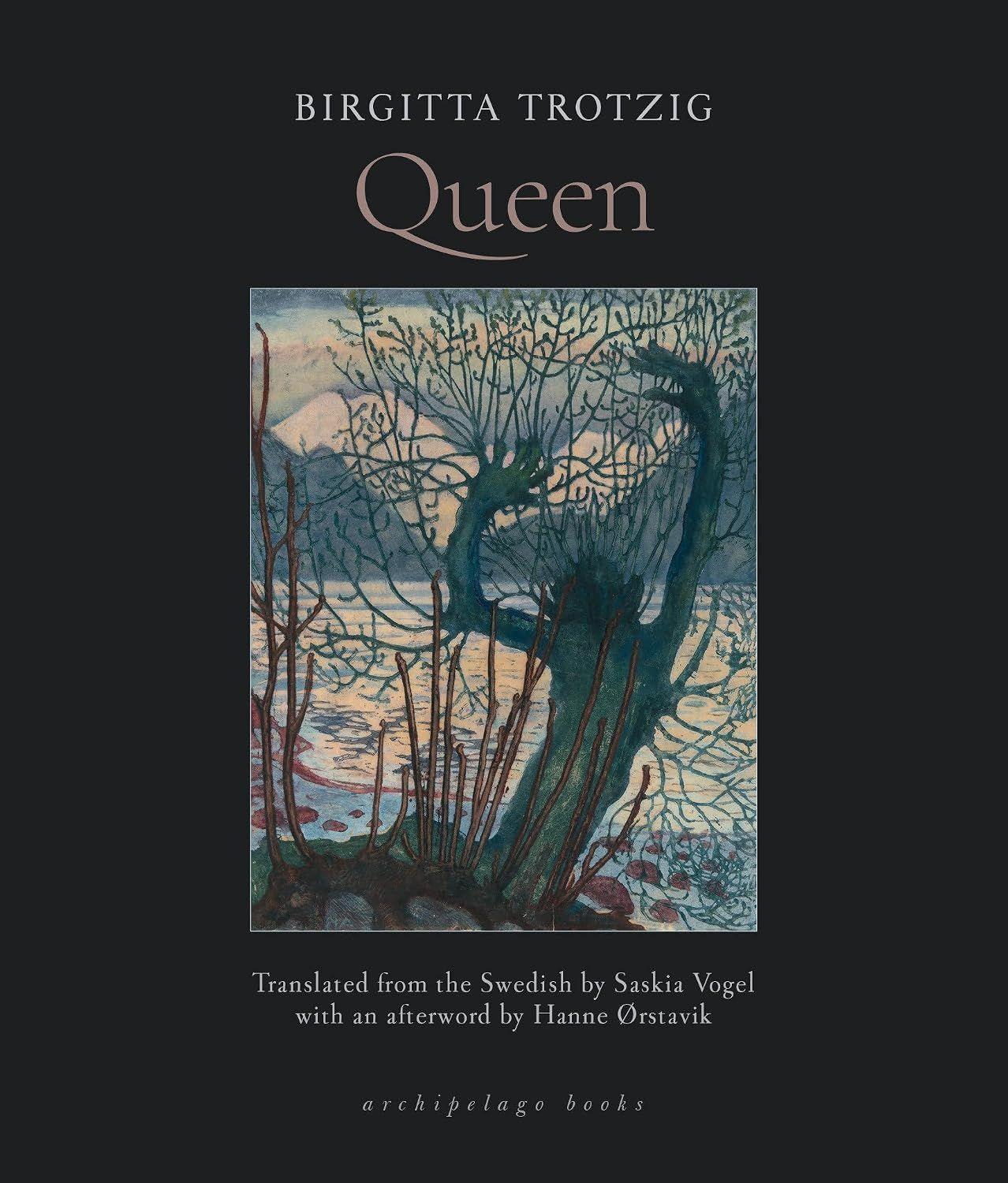
Queen by Birgitta Trotzig. Translated by Saskia Vogel. Archipelago Books, 2026. 168 pages.
Did you know LARB is a reader-supported nonprofit?
LARB publishes daily without a paywall as part of our mission to make rigorous, incisive, and engaging writing on every aspect of literature, culture, and the arts freely accessible to the public. Help us continue this work with your tax-deductible donation today!
IN 1954, SWEDISH WRITER Birgitta Trotzig, aged 25, arrived in Paris just as the Algerian Revolution was igniting. Bored with neutral Sweden’s stifling Cold War culture, she was impressed with the crowded possibilities of French politics—among them “a whole world of religious radicalism that seethed with ideas.” She read Simone Weil and converted to Catholicism. She found inspiration in the radical worker-priest movement, recently suppressed by the church. Her first novel, Ur de älskandes liv (“Out of the Loving Lives”), published in 1951, had been, as she would describe it in the 1975 essay “Poetry and Ideology,” “furiously and programmatically aesthetic,” a book from which she had “removed everything” but images. Galvanized by political life in France, she turned to studies of poverty, such as Oscar Lewis’s 1961 ethnography, The Children of Sanchez: Autobiography of a Mexican Family, as a new literary model. She wanted to pursue documentary literature, writing on places and cultures. But it never happened: “Poetry as a fact, a fact of life—that was what I crashed into; and it threw me off the track I had hoped to follow.” Published in 1964, Queen is indeed poetic, but its long, uncompromising, and rich sentences pulse with what Trotzig called “a solidarity born of love.”
Queen is the first of four Trotzig books slated to be published by Archipelago Books, and the first to be translated (by Saskia Vogel) into English, 62 years after its publication. This long delay is a scandal (a familiar one), but the time for Trotzig in English may be ripe. If in the 1970s Trotzig felt compelled to defend her commitment to “poetry,” to abstraction and linguistic rigor, a similar literature—numinous and headlong, exemplified by authors like Solvej Balle and Jon Fosse—seems to meet our moment. It doesn’t hurt that at the heart of Queen is a story of great contemporary political resonance: the arrival of a deportee to whom the heroine fails to act charitably—a failure to recognize the stranger.
“I always feel very aggressive when I write,” Trotzig told Le Monde in a 1977 interview. That aggression, on the opening page of Queen, takes the form of landscape imagery, an overwhelming descriptive sentence that seems to end the novel almost before it can begin. We have been told, briefly, that a Polish deportee is being sent to Sweden at the expense of the American government, to Skåne, to a coastal farm, in a district where the barn doors are oriented to face out over the wetlands and toward the sea:
In the summer the doors are for the most part left open and one can look right through the barn, as if it were a massive gateway, upon the pastures and the sea—the still gray sea beneath the white sky gives off a light like nothing else in this world; mild, sick; a misty white light, as mute as the blind milk of membrane around an extinguished eye; in this silent white light rest meadows so green, and the sound of steps or hoofbeats vanishes without echo in the soft greensward, there reigns the silence, the birds, the scent of grass, the scent of broom, and between the people too a membrane-like silence: the white soft light upon the meadows, between the buildings, inside the buildings—words drown, the fate of the word is to drown, is it not?
This is the poetry that Trotzig crashed into. Anglophone readers of the above passage may think of D. H. Lawrence, who in The Rainbow (1915), a book likewise concerned with a Polish refugee arriving at a farm, also noticed the blindness and silence of the agricultural landscape, “the drowse of blood-intimacy […] the heated, blind intercourse of farm-life,” where chore-tied women might look “to the spoken world beyond.” But where in Lawrence everything is also always about sex, and the rhapsodic, pulsing writing itself seems to be the end and purpose of all observation, Trotzig is more searching.
Throughout Queen, as in the opening image where light is a form of blindness and the silence of the fields drowns human speech, Trotzig uses landscape to narrate the blind and mute passages of unexplored inner lives. Human crises are geologic: people are stones that break or go cold or, too miraculously, catch fire. We read about repressed weeping that “bores itself ever deeper downward, inward, vanishing undermost in the deadest layer of earth underneath hidden crumblings, through stone chips down in the desiccated rock-hard packed stratum of the ground.”
Poetry is a “fact of life” for Trotzig because her characters are almost mute. They speak little, and their lives unfold not in dramatic scenes but in the inarticulate weathering of years. Trotzig’s prose seeks a fidelity that differs from that of The Children of Sanchez—a fidelity to jagged experience. She is at once rough and supremely literary. Prose is even occasionally enjambed. A carriage return snaps a sentence in two; verbs refuse to agree; prepositions cluster like twigs on a pollarded tree. Often, close third-person narration encounters a lyric (not psychic) break. A young boy observes a starving beggar: “She was tall and dark. Her face was white. Her hunger was dark. Death was dark. The snow was white.”
Saskia Vogel’s translation of Queen succeeds, to compare it with the scraps of Trotzig translations that appeared in Anglophone journals over the decades, in part because she lets these oddities be, and in part because Vogel’s cadences so persuasively convey the confidence that must have quickened Trotzig’s own typing. The English feels almost tactile. Metaphor, always teasing our sense of touch, means a great deal in Trotzig: “In the tangible world there are contradictions that the theologians can gloss over,” she said in an interview, “[but] which must be maintained—described.” Vogel again and again brings off Trotzig’s yoking of the material and the transcendent. The Polish deportee “was an empty box: playing across its plundered deep interior was an eternally flickering reflection.”
Perhaps the most curious moves that Trotzig makes obtain at the level of narrative itself, the way she handles her protagonists, and these require some plot summary to explain. The novel’s hero is not the deportee but the eponymous Queen, who runs the farm to which the deportee is sent. Her real name is Judit, and the community calls her “the Queen” for various reasons: because she is “distant and unyielding”; because “she had good sense, she knew to differentiate between bad and good”; and, ironically, because, though she works hard, the farm is always failing, and so she is the “queen of rags, of sagging moldering roofs.” When she was still a girl, she was mocked for her nickname on the schoolyard when her father’s farm began to fail. It is a pet name and yet it is also “a secret she kept—caressed like a gemstone”—the secret being that she really believes, at some level, that she is royal. She “ruled” over her two younger brothers: Albert, who is weak, “a bit dishonest, quick to tears,” and the much younger Viktor, whom the Queen is extremely proud of but cannot control. He is her “crown,” later lost when Viktor gets the lighthouse keeper’s daughter pregnant and leaves for America. There he works as a driver and then, in the first throes of the Great Depression, in the literal crush of an unemployment line, he meets a Polish woman whom he eventually marries. After Viktor dies in a tenement fire near Astor Place, the US government ships this Polish woman to Sweden, to the Queen, who is now her next of kin.
In the scant critical writing on Trotzig in English prior to this translation, the Queen is sometimes praised as a straightforwardly heroic figure, an “Amazon,” like one of Willa Cather’s Swedes, something out of a regionalist farm novel, where tenacity is triumph. But Trotzig is less interested in triumph than in Christian love. She humiliates her protagonist in a way that I found genuinely challenging.
The Queen’s father becomes devout in the face of his failing farm; he reads the scriptures every evening and, unlike most who read them, follows their instructions. He begins to invite the poor and needy to his table. Migrants from Germany and Poland, beggars, people who stink. The father is an ambiguous figure: he beats the uncontrollable Viktor, repents, and reads the Bible while the farm goes to ruin. The Queen judges him severely: “His life is wrong, said her life.” She regards the poor at their table, each “shadowrag with [a] human face,” as the family’s own possible future, and “she felt her will flex like a muscle: this would not be their fate.”
In the bourgeois family novel, entropy is the enemy. But Trotzig—who actually disavowed the word “roman,” or novel, and called her books “berättelser” (tales) or “barnhistoria” (children’s stories)—does not put generational wealth at the center of her plot. If in a work like Thomas Mann’s Buddenbrooks (1901) a family faces extinction in a final, decadent generation, in Queen it is the middle generation that wastes the inheritance, tempting the last generation, the Queen’s, to summon the will to hold the family together. And that willfulness is how things truly go wrong.
Simone Weil, from whom Trotzig confessed to have derived her own “ideology,” contrasted active will with reflective attention. If will—the hero’s journey—is the typical engine of narrative, Trotzig’s narration operates almost entirely through passive summary (as opposed to instantaneous scene), creating a kind of narrative jelly in which gradual, rotting changes rule her characters. “[T]he years settled in his limbs like an impurity,” Trotzig writes of the Queen’s weaker brother, Albert, a lifelong virgin. Like his father, Albert finds solace in scripture. He eventually concludes that, because of his virginity, “he could truly count himself among the one hundred and forty-four thousand who follow the Lamb,” and “suddenly he was traveling around the region, in all types of farm, pious and impious, he made his eccentricity known.” Albert’s hilariously human folly gathers slowly and then all at once.
Conventional drama arrives with the Polish deportee. The Queen makes her sleep in the barn. No fire is allowed: the deportee will have only the heat of cows, through the wall, to keep her warm. “[I]t was not because the Queen was cruel, she simply did not want this woman in the house, how was one to sleep peacefully at night?” Events unfold rapidly now: Albert falls in love with the Polish woman (never named); a child is born; the woman, allowed in the house, is permanently confined to bed; she attempts suicide; she is institutionalized. The fingernail of the novel that remains narrates the Queen’s repentance, the reversal of all her domineering instincts. She remembers her father’s charity. A quick, dramatic ending: The fatalistic drift of her characters’ inner landscapes must come to a Calvary.
This careful, thrilling novel is apparently a minor work in Trotzig’s bibliography. Queen was originally bundled with two other “tales” in a book about failures to love. It’s a tiny keyhole through which we can see a large, dark room where, here and there, something catches the light.
LARB Contributor
Benjamin Lytal teaches at the University of Chicago. His first novel, A Map of Tulsa, was published by Penguin in 2013. He has written for The Wall Street Journal, London Review of Books, Los Angeles Times, The Believer, McSweeney’s, Fence, The Daily Beast, and The Nation, and for four years, he wrote The New York Sun’s Recent Fiction column.
LARB Staff Recommendations
You Can Go Home Again, and Again, and Again
Cory Oldweiler reviews the new translation of Danish author Solvej Balle’s “On the Calculation of Volume (Book III).”
A Second, Silent Language: A Conversation with Jon Fosse
Remo Verdickt and Emiel Roothooft speak with Norwegian author Jon Fosse about his novel collection “Septology I-VII.”