Bending the Arc of History
A new biography of Howard Zinn functions less as a detailed portrait of a man than as an inspirational manual for contemporary endurance.
By Tim RileyAugust 4, 2026
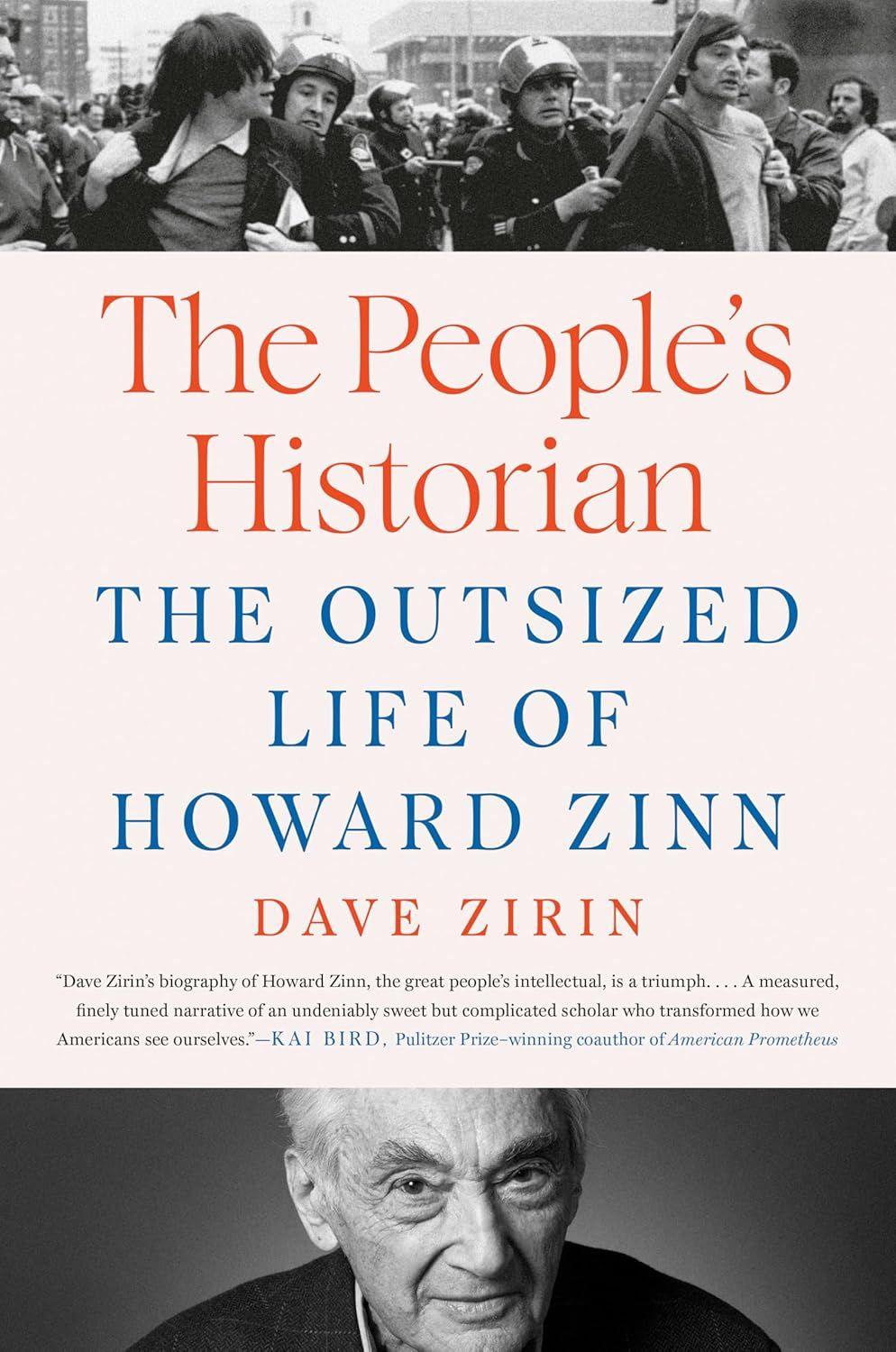
The People’s Historian: The Outsized Life of Howard Zinn by Dave Zirin. Dutton, 2026. 320 pages.
Did you know LARB is a reader-supported nonprofit?
LARB publishes daily without a paywall as part of our mission to make rigorous, incisive, and engaging writing on every aspect of literature, culture, and the arts freely accessible to the public. Help us continue this work with your tax-deductible donation today!
REVIEWING THE LEGACY of popular historian Howard Zinn remaps a battleground as much as it reevaluates the author’s work. Zinn’s blockbuster A People’s History of the United States (1980) revisited the country’s past as it entered the modern era, carving out a new platform for marginalized voices. The book has now sold over four million copies. Academics argue about how seriously to take Zinn’s scholarship, but he scoped out what we now call an “intersectional” approach, mapping how social identities shape individual experience within systemic power structures. He did this just as the right-wing reaction to the US defeat in Vietnam was spawning monstrosities like Rambo to sanitize a generation of trauma. Zinn moved history forward by exposing structural abuses of power, an angle that traditional academics had largely ignored.
These days, the academic parsing of Zinn’s flaws feels like misspent effort. Dave Zirin, sportswriter for The Nation and a longtime Zinn enthusiast, offers instead a new biography, The People’s Historian: The Outsized Life of Howard Zinn, written with access to Zinn’s letters and journals. Zirin’s book earns its place alongside Martin Duberman’s adroit 2012 biography, Howard Zinn: A Life on the Left, even as it veers into sentimentality. A People’s History, which remains a standard text used in countless classrooms, gained pop culture prestige through mentions in Good Will Hunting (1997) and The Sopranos (1999–2007). Meanwhile, the Zinn Education Project’s Teaching People’s History program helps teachers with lesson plans that emphasize the historical roles of women, workers, and people of color.
The original publication of A People’s History coincided with a ruthless conservative realignment, a moment Zirin ties to the symbolic violence of the 1980 presidential election. Zinn recoiled at how Ronald Reagan gave a campaign speech from Neshoba County, Mississippi, a mere 16 years after the local Ku Klux Klan brutally had murdered three civil rights workers there: James Chaney, a Black Mississippian, and Andrew Goodman and Michael Schwerner, two Jewish Northerners. Reagan did not have to defend Jim Crow; simply standing in that location signaled a perverse vindication. As Zirin observes, Reagan traveled “a few short miles from the swamp where Chaney’s, Goodman’s, and Schwerner’s lynched, mutilated bodies had been found” to announce to a rapturous crowd that “the South will rise again.” In Zirin’s formulation, “it was an amnesty for anyone who felt shame over having relatives in the Klan, being a spectator at a lynching, or throwing a bottle at a child trying to go to school.”
Today’s Confederate flag–waving Christian nationalists go even further, wielding raw executive power to shutter archives, defund museums, and censor public school lessons. This right-wing resurgence makes Zinn’s counternarrative all the more essential. His ambitious history provided a heroic lineage for an opposition suddenly locked out of power, offering a sober reminder of how long certain fights have lasted. When we read the expansive, narrative-driven histories of Jill Lepore, we see an author exploring the spaces Zinn helped to open—a testament to how thoroughly his counternarrative altered the discipline’s boundaries. Historians can no longer ignore, or simply gesture toward, marginalized perspectives; instead, they are recognized as the central engine of the American story, threatening those desperate to mandate a whitewashed historical consensus.
History mattered intensely to Zinn’s family of Brooklyn immigrants. Before World War I broke out, Zinn’s father, Eddie, and uncle Samuel relocated from Austria-Hungary to the United States. Zinn’s mother, Jenny Rabinowitz, carried memories of Eastern Siberia’s Irkutsk—a region synonymous with political exile—to the factory floors of New York, where she met Eddie. Together they launched a candy store, and Eddie later worked as a waiter and joined a union. His parents labored to feed their four sons, a struggle that spawned Zinn’s underclass sympathies. As he later reflected, “I always feel some rage when I hear the voice of the arrogant and affluent: We have a wonderful system; if you work hard you will make it. How hard my parents worked. How brave they were just to keep four sons alive in the cold-water tenements of Brooklyn.”
At 18, Zinn became an apprentice shipfitter at the Brooklyn Navy Yard, interacting with early Black machinists like Clarence Irving and doing the hardcore industrial labor he would soon write about. In the previous generation, unions had fought hard to win eight-hour days and five-day workweeks, and Zinn’s early experience with these integrated crews affirmed an abiding leftist orientation. During this period, he met Roslyn “Roz” Shechter, who remained his life partner for over 63 years until her death.
As a bombardier in the US Army Air Forces during World War II, Zinn participated in the assault on the resort town of Royan, one of the last remaining German pockets on the French Atlantic coast where the American military deployed napalm with a criminal indifference to the occupied civilian population below. The mission left a permanent scar on Zinn’s conscience, a trauma that fixed his opposition to state-sanctioned violence. Decades later, following President Reagan’s 1986 bombing of Libya, Zinn dropped his now famous anti-war dictum: “There is no flag large enough to cover the shame of killing innocent people for a purpose which is unattainable.”
Zinn pursued graduate study at Columbia University on the G.I. Bill, only to find out how little the academy cared about working-class struggles. He focused on labor militancy, writing on the railroad strikes of the Gilded Age, the Ludlow Massacre, and New York City mayor Fiorello La Guardia’s New Deal template. His teachers included Richard Hofstadter, author of the classic 1964 essay “The Paranoid Style in American Politics.” In 1956, Zinn was appointed chair of history at Atlanta’s Spelman College, relocating his young family to the Jim Crow South. With the Civil Rights Movement spilling onto campus, Zinn turned his pedagogy into a direct mode of resistance. He renamed his constitutional law course Civil Liberties, linking legal advances with tactical, on-the-ground activism. For Zinn, the Supreme Court’s landmark 1954 decision in Brown v. Board of Education was less a historical inflection point than a fragile foothold—a ruling won by agitators that required even greater effort to achieve desegregation at the street level.
Zinn served alongside Ella Baker as an adviser on the executive committee of the newly created Student Nonviolent Coordinating Committee (SNCC). He marched with his students—including future Children’s Defense Fund founder Marian Wright Edelman and future novelist Alice Walker—and joined their lunch counter sit-ins. His 1960 Nation article “Finishing School for Pickets” eventually led to his firing in 1963 for “insubordination” by Spelman’s autocratic Black president Albert Manley—which itself led to a contract for Zinn’s second book, SNCC: The New Abolitionists (1964).
That same year, Zinn joined the Department of Political Science at Boston University, where he remained until 1988. At BU, he frequently called out and confronted university president John Silber. Zinn’s decades-long warfare against administrators provided spectacular public theater while targeting the early architects of the modern corporate university. Fresh from the civil rights marches, Zinn became a leading voice against the Vietnam War, publishing Vietnam: The Logic of Withdrawal in 1967. In early 1968, after the Tet Offensive shattered US policymakers’ delusions of military supremacy, Zinn traveled to Hanoi with the Reverend Daniel Berrigan to take the Vietcong up on their offer to free three POWs to a civilian delegation. The US military, antagonized by Hanoi’s plan, disrupted the mission, wresting the prisoners into custody before Zinn and Berrigan could bring them home. Zinn also bonded with military analyst Daniel Ellsberg after the two spoke at an anti-war demonstration in 1969. When Ellsberg went underground to evade the FBI, Zinn helped funnel his xeroxed Pentagon Papers, later co-editing an unredacted edition with Noam Chomsky and testifying as an expert witness at Ellsberg’s 1973 trial for espionage.
Zinn gets credit for toppling the triumphalist, top-down histories that dominated so many postwar classrooms. But he was not alone in his activism. Like Tom Hayden, who drafted the 1962 Port Huron Statement for the Students for a Democratic Society, and comics such as Dick Gregory, Zinn belonged to a dissident cohort that grasped the immensity of the moment. The Cold War, in their view, was a massive fraud, and they refused to buy the state’s official line long before the growing opposition to the war in Vietnam.
As a historical researcher, Zinn uncovered the suffering and resistance of the many marginalized groups he had grown up with as a child of migrants. Indeed, he considered them the best voices to animate a new narrative about “America.” He was more interested in reaching readers than impressing other academics, and his work conveyed moral fervor in an accessible style that gripped students with its emphasis on fairness and social justice. The enduring commercial success of A People’s History remains a measure of his capacity to democratize historical understanding.
Yet it was precisely this populist mandate—the desire to take a partisan stand rather than “dispassionately” record the past—that professional historians have often claimed fundamentally compromises his scholarship. Stanford’s Sam Wineburg notes that Zinn relied heavily on secondary sources, cherry-picking anecdotal evidence to claim widespread Black “indifference” to World War II while ignoring contradictory statistical data that showed exceptionally low draft evasion rates among Black men. Another scholar, Michael Kazin, famously called Zinn’s history an epic “Manichean fable” of a perpetual, insatiable elite suppressing the masses. To these critics, Zinn overromanticized precolonial societies while glossing over their imperfections and presented a deeply one-dimensional view of complex moral figures. By framing Abraham Lincoln’s Emancipation Proclamation as a cynical military maneuver dictated by wartime desperation and the North’s immediate need for manpower, Zinn minimizes Lincoln’s profound capacity for intellectual growth.
Columbia historian Eric Foner pointed out that Zinn’s framework ultimately leads to an unintended pessimism. For all of his focus on grassroots activism, few of his stirring protests, strikes, and rebellions ever accomplished any permanent, lasting change. Because Zinn portrays “the Establishment” as an omnipotent, monolithic machine that inevitably crushes the masses, the book paradoxically fails to offer modern protesters a usable history, in which messy political compromises and incremental victories might actually lead to greater freedoms.
These critiques suggest that Zinn wrote his book in a scholarly void, but he joined a sixties throng of dissident intellectuals who distrusted institutional euphemism and forced stark choices. By 1968, as the assassinations of Martin Luther King Jr. and Robert F. Kennedy added to the spiraling crisis of Vietnam, the sheer scale of reactionary backlash and official betrayal required an equally strong counterweight. Dismissing Zinn as “unsubtle” misses the point, much like calling Muhammad Ali merely “entertaining.” His work was frankly aggressive and moralizing as it sought to push the boundaries of the national imagination. Beside his clear success in permanently shifting the historical consensus, standard academic gripes about his methodology seem empty and largely irrelevant.
Zirin obviously admires Zinn, and as a result, he filters out some of the personal flaws Duberman insisted upon, such as his extramarital affairs. But Zirin makes up for this with his unprecedented access to private letters, diaries, and testimony from Zinn’s children. The People’s Historian provides a warm, behind-the-scenes portrait of a man whose students adored him. A letter Zinn sent to Alice Walker following his wife’s cancer diagnosis exposes his vulnerability, while quotes from family friends provide an inside view of his marriage. To those who knew the Zinns, like Boston Globe columnist James Carroll, Roz’s biting verve made radical politics “seem like the most natural thing in the world […] She took the threat away.” Moreover, Zinn’s death in 2010 at the age of 87 thankfully spared him two major disillusionments: seeing his friend Walker descend into noxious antisemitic conspiracy theories, or witnessing the election of a right-wing extremist who makes Ronald Reagan look like Vladimir Lenin.
Where Duberman was willing to candidly address Zinn’s flaws—his self-absorption, his professionally lopsided marriage, and a work ethic that seemed to feed on notoriety—Zirin largely shields his subject from critical scrutiny. More importantly, he fails to rigorously engage with the more credible scholarly critiques of Zinn’s work, treating his subject as almost beyond reproach. As a result, Zirin’s biography functions less as a detailed portrait of a man than as an inspirational manual for contemporary endurance. He reminds the reader that “Howard never thought of the arc of history bending naturally toward justice. It had to be bent.” To survive requires adopting organizer Mariame Kaba’s famous dictum: “Hope isn’t an emotion. […] Hope is a discipline […] we have to practice […] every single day.” Or as Zinn himself once put it, rather more pugnaciously: “You can’t be neutral on a moving train.”
LARB Contributor
Tim Riley’s latest book is What Goes On: The Beatles, Their Music, and Their Time (2019), co-written with Walter Everett, from Oxford University Press. He writes the free riley rock report on Substack.
LARB Staff Recommendations
The Insubordinate Historian: The Life and Legacy of Howard Zinn
What Makes “A People’s History”?
Hannah Zeavin examines the critical possibilities of the “people’s history.”