The Uncommitted Man
A new translation of Ivan Turgenev’s 1867 novel ‘Smoke’ explores the main concerns of the author’s life.
By Eric VanderwallAugust 3, 2026
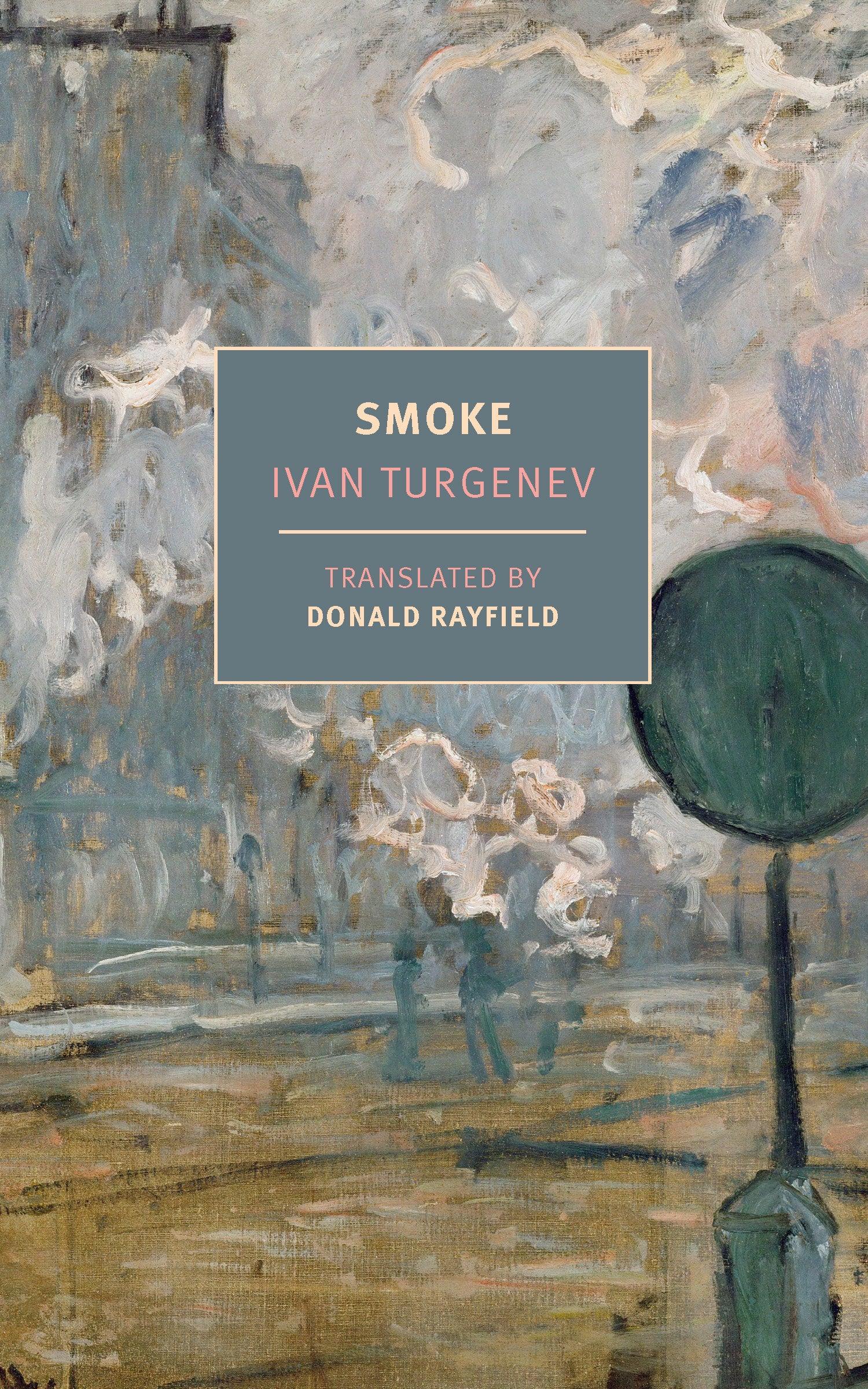
Smoke by Ivan Turgenev. Translated by Donald Rayfield. NYRB Classics, 2026. 208 pages.
Did you know LARB is a reader-supported nonprofit?
LARB publishes daily without a paywall as part of our mission to make rigorous, incisive, and engaging writing on every aspect of literature, culture, and the arts freely accessible to the public. Help us continue this work with your tax-deductible donation today!
IT IS AUGUST 10, 1862, in Baden-Baden, a German resort town in the Black Forest region popular for gambling and the supposedly salubrious effects of taking the waters (that is, bathing in or drinking from the local springs). The town is packed with travelers from across Europe—well-to-do, down-at-the-heels, and everything in between—including a large contingent of Russians: generals, cadets, aristocrats (some flush, others broke), retired civil servants, schemers, gamblers, tipplers, exiles, radicals, reactionaries, gossipmongers, self-proclaimed geniuses, surly poets, and garden-variety windbags. Amid this babble sits Grigori Mikhailovich Litvinov, a young man not quite 30, on his way back to Russia after some years abroad in Western Europe, with plans to reform the family estate, “confident of his abilities and prospects, and of the benefits for his neighbors, even for the whole district.” He has stopped in Baden-Baden to meet with his fiancée Tatiana (or Tania) and her aunt, who will arrive in a few days. All appears well—until a bouquet of heliotropes and a chance encounter with someone from the past change everything.
Such is the opening of Smoke, Ivan Turgenev’s 1867 novel, now available from NYRB Classics in a new English translation by Donald Rayfield. Smoke is, in the estimation of Leonard Schapiro (translator of the Penguin edition of Turgenev’s 1872 novel Spring Torrents), “one of the most perfect of all Turgenev’s works,” expert in its symphonic treatment of “the four themes which dominated Turgenev’s life and work: the destructive force of the sexual passion; the unattainable illusion or ideal of happy lasting mutual love; the homage paid by the uncommitted to the committed, by the weakling to the strong; and the fear of enthusiasm.” It is a set of concerns that dominated Turgenev’s personal life as much as his literary work.
Ivan Sergeyevich Turgenev was born in Russia’s Oryol province in 1818 (making him three years Dostoyevsky’s elder and 10 years older than Tolstoy, both of whom he later knew and quarreled with). His mother was a wealthy landowner and his father, Sergey Nikolayevich Turgenev, an impecunious descendant of an old, respected Russian family who married for the money (and made no secret of that or his many affairs). Although he lived only to 40 (at which point Turgenev was 16), the father inspired in his son admiration for a man “who was in everything different from himself”—the awe of “one who lets life happen to him for the one who seizes life by the throat.” Schapiro and other scholars consider the character of the father in Turgenev’s 1860 novella First Love to be a portrait of his father: “He had little time for me or for family life: he loved something else, and had taken his fill of delight in it. ‘Take everything you can yourself and never let anyone get a hold of you. The whole trick of living is to belong to yourself.’” This willful nature left a lasting impression on Turgenev, whose works are often concerned with the contrast between the resolute and the irresolute.
Turgenev spent much of his youth and young manhood studying abroad in Western Europe. It was during this period, in 1843, that Turgenev met and began a relationship with opera singer Pauline Viardot (who was already married to Louis Viardot). Whether Turgenev and Viardot’s was a sexual relationship (a subject of some scholarly debate over the years), what is certain is that, with the exception of a few brief estrangements, he remained closely associated with, and often lived in proximity to, the Viardots for the next 40 years. And after the strong, largely negative critical reaction to his 1862 novel Fathers and Sons, Turgenev rarely returned to Russia. (There is a possibly apocryphal story of Dostoyevsky suggesting that Turgenev buy a telescope so he could see what was actually going on in his native country.) In those years abroad, Turgenev befriended major Western authors, among them Gustave Flaubert and Henry James, each of whom remarked on Turgenev’s paradoxical nature. Flaubert observed in Turgenev a “timid and restrained” man with “the gestures of a child,” a man “who had travelled far and wide, had known all the great men of his age, had read everything that it is possible for a human being to read, and who spoke all European languages as well as he spoke his own,” and yet remained so “incredibly innocent” as to show “surprise, stupefaction even, when confronted with things which would have appeared simple to a Paris schoolboy.” James sounds a similar note in his recollection of Turgenev’s “expansive softness” and “comprehensive indecision,” traits that often characterized Turgenev’s principal male characters, Litvinov among them.
In contrast to this passivity of both Litvinov and his creator, a woman from Litvinov’s past reenters his life and disrupts his plans. Ten years before, in Moscow, Litvinov had courted Irina Osinina, daughter of a prince from “a ‘run-down’ family of paupers” occupying “one of those antediluvian Muscovite posts, which had a small salary, a strange title, and absolutely nothing to do,” and a former lady-in-waiting, “a sick, embittered woman, constantly obsessed with petty squabbles.” Irina’s appearance at a ball turns enough heads to also turn around the family fortunes, with Irina sent off to St. Petersburg to live with well-connected relatives. When she meets Litvinov by chance (if it is chance) in Baden-Baden in 1862, she is now Irina Ratmirova, remarkable for her “pale, tender, malicious, and charming face,” the wife of General Valerian Vladimirovich Ratmirov, a man with “no morals, completely uninformed” but possessed of “a relentless and firm desire for personal benefit.” Irina has risen in the world and joined high society, but it is a world she finds unsatisfying. She and Litvinov renew their acquaintance, begin an affair (the physical extent of which can be hard to discern through the conventions of propriety in 19th-century literature), and plan to forsake everything to begin a new life together—though things don’t quite work out, and worse for Litvinov than for Irina.
Litvinov and Irina’s love tangle plays out in the midst of Baden-Baden’s Russian expatriate milieux (bilious, choleric, and phlegmatic, plus other humors, most of them unpleasant). There are, at least in Smoke, basically two circles of Russians: Irina’s upper-crust set and the motley group Litvinov knows. Among the former are Irina’s high-society people—including Madam X, “once a well-known beauty and famous all over Russia for her wit, but who had long ago been transformed into an unprepossessing fungus emitting a smell of vegetable oil and expired poison”; Countess S, a “well-known dictator of fashion” known, behind her back, as “The Queen of Wasps”; and a spiritualist who attempts to hypnotize a crayfish—a group whose conversation manages to touch on many things while “carefully [avoiding] anything in the least bit interesting.” Then there are those hanging around Litvinov: Bindasov, “a tightfisted rogue” with a habit of “talking like a terrorist” and borrowing money to gamble; Bambayev, “not a bad man but a typical time waster” who “roamed the face of our long-suffering earth, yelling pointlessly”; Pishchalkin, unmatched in “the art of spreading cold, relentless, soul-destroying, and hopeless tedium”; and the unofficial leader of the group, Gubarev, who speaks in “curt fragments of meaningless words […] as if they were utterances of the highest wisdom.”
From this chaos emerges one Sozont Ivanych Potugin, a man with “a soft, slightly hoarse, weak voice” and a tendency to “arous[e] respect, sympathy, and involuntary pity,” who acts as something of a guide to Litvinov and, of the two main male characters, is the stronger presence in the novel. Turgenev’s foreword to the original edition (included in the NYRB volume after the main text and before the endnotes) mentions Potugin for having provoked “the very various negative comments to which the tale Smoke has been subjected,” and for “apparently ha[ving] insulted, more than any other character, the public’s patriotic feelings.” In a period rife with all manner of controversies—from the recent emancipation of the serfs to the proper relation of Russia to Western Europe to what was then called the “woman question”—partisans and critics expected authors to take a position, which generally meant allying themselves with either the Slavophiles or the Westernizers. Turgenev largely resisted taking sides, in both his life and in Smoke—which, like Fathers and Sons a few years before, managed to anger just about everyone for its withering portrayal of various groups and, perhaps more so, for its refusal to declare allegiance to any of them.
It would be wrong to equate Potugin’s views with those of the author, but his is the dominant voice in the novel, incisive in its observations. Gubarev’s circle, he says, comprises “excellent people, but they add up to zero. The ingredients are first class, but the cooked dish is inedible.” He sees in them the same problems that plague Russians generally—their tendency to “keep chewing over this miserable question” of the meaning and future of Russia “like children with a mouthful of rubber: no juice, no point”; their need for “a master everywhere and for everything” because “willpower is something we Slavs lack, so we give in to it.” To Potugin, the Slavophiles “live in cloud-cuckoo land,” and the conservative old guard aren’t any better. He is also a keen observer of character, noting of Irina that, when she sets her mind on something, she “is like a stone thrown down a well—she has to drop all the way down to the bottom”—an observation that turns out to be true, though the reader understands this before Litvinov. Potugin’s view of life, which echoes that of Turgenev’s father (and the narrator’s father in “First Love”), seems to be the view of the novel itself, and finds expression in one line that seems a summation of some of Turgenev’s works, including Smoke: “Man is weak, woman is strong, opportunity is omnipotent, resigning oneself to a dull life is hard, forgetting the past completely is impossible.”
At the end of the novel, when Litvinov finds himself on the train back to Russia, with neither Irina nor Tania and no hope of regaining either, he contemplates all he has experienced while watching the engine’s puffs of smoke rush past the window “in an endless procession,” seeming to reach out only to dissipate, all of it “constantly changing and yet [remaining] the same.” Soon “everything, life itself, Russian life, everything human, everything Russian seemed to him to be smoke”—the parties, the arguments, the striving for status, the dogmas, the gossip, all of it so much smoke. There follow a few scenes after this (including an implied reconciliation years later between Litvinov and Tania, which, frankly, is less literarily satisfying and internally consistent than the outright downer that concludes a similar broken-engagement plot in Spring Torrents), but it is Litvinov’s insight on the train that remains with the reader (and rewards the rereader who looks for the smoke motif elsewhere in the book)—the realization that everything “seems to be changing constantly,” everything “in a hurry, rushing somewhere” as “one phenomenon follows another,” and yet it all “vanishes without a trace, without attaining anything.”
LARB Contributor
Eric Vanderwall is a writer and musician. His work has previously appeared in On the Seawall, The Minnesota Star Tribune, World Literature Today, Rain Taxi, and elsewhere.
LARB Staff Recommendations
Melancholic Narratives: On the Bicentennial of Ivan Turgenev
Eileen Battersby remembers the great Russian novelist Ivan Turgenev, on his 200th birthday.
A Genius on the Wrong Side of History: Tolstoy’s Conflicts and Contradictions
Maria Rubins weighs Tolstoy’s complicated legacy, with the help Andrei Zorin’s new biography and Vadim Shneyder’s “Russia’s Capitalist Realism.”