Why Did the Roman Empire Last So Long?
Edward J. Watts’s history of the long Roman Empire is a traditional, top-down political narrative.
By Harry SidebottomAugust 3, 2026
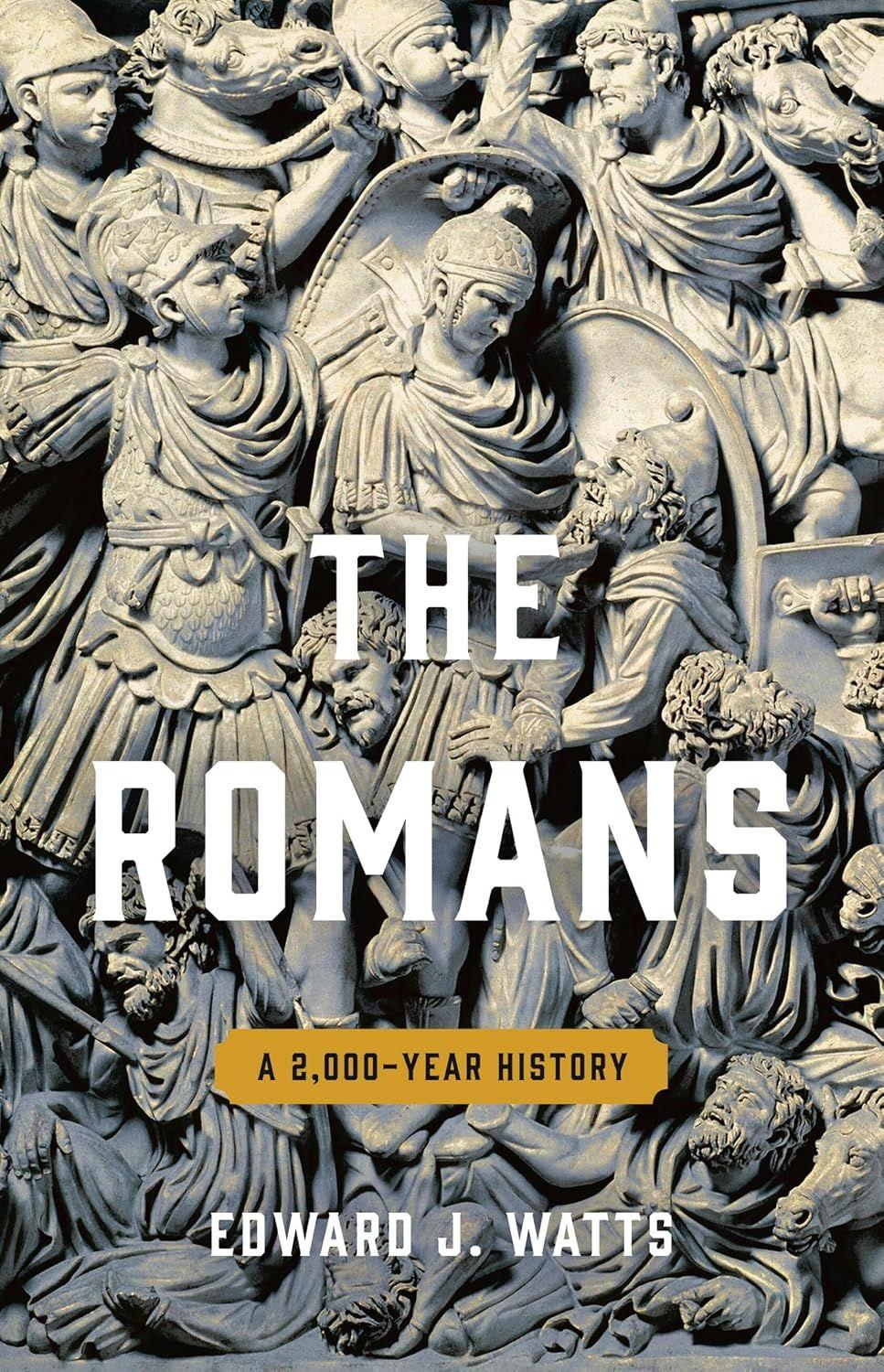
The Romans: A 2,000-Year History by Edward J. Watts. Basic Books, 2025. 736 pages.
Did you know LARB is a reader-supported nonprofit?
LARB publishes daily without a paywall as part of our mission to make rigorous, incisive, and engaging writing on every aspect of literature, culture, and the arts freely accessible to the public. Help us continue this work with your tax-deductible donation today!
ROME WAS EXCEPTIONAL among ancient empires. The Achaemenid Persian empire lasted just over 200 years (ca. 550–330 BCE). The empire created by Alexander the Great was a flash in the pan: just 11 years from his invasion of Persia in 334 BCE to his death in 323. Even if we include the successor states carved out of his conquests, the Macedonian imperial project only extended to about three centuries, ending with the death of Cleopatra, the last of the Ptolemaic dynasty in Egypt in 30 BCE. Carthage, from its mythical foundation in 814 BCE to its all too horribly real destruction by the Romans in 146 BCE, survived for some six and a half centuries. The Roman Empire’s longevity far outstripped them all: almost a millennium and a half from the earliest archaeological evidence on the seven hills (ca. 1000 BCE) to the deposition of Romulus Augustulus, the last emperor of the Western Roman Empire, in 476 CE. This rises to well over two millennia if, like Edward J. Watts, you consider its end to be the conquest of Constantinople, the capital of the Byzantine empire (as the Eastern Roman Empire, after the fall of the West, is now known), by the Fourth Crusade in 1204 CE. Edward Gibbon, of course, added another two and a half centuries by taking the story down to the capture of Constantinople by the Ottoman Turks in 1453.
Rome was exceptional, not just in time but also in geographic space. At its height, as is often commented, it stretched from modern Scotland to the Sahara, and from the Atlantic to Mesopotamia. Less often noted, it was the only empire that ever ruled all the coasts of the entire Mediterranean, as well as most of those of the Black Sea, controlling substantial territory in three continents: Europe, Asia, and Africa.
The scope of the Roman imperium often prompts modern historians to pose big questions. Why did the empire expand so much? Was it “defensive imperialism” (i.e., Rome dragged ever outward as it responded successfully to one threat after another)? Or were “expansion-bearing structures” (military glory, economic gain) hardwired into Roman society and culture? How did Rome conquer so many other peoples? Was it superior military techniques or simply superior manpower? In the last century BCE, why did the free Roman Republic end in a welter of bloodshed, to be replaced by the military autocracy of the emperors? Was the fundamental reason out-of-control generals and their armies abroad or demagogic politicians and economic and social unrest at home? And the big question, since Gibbon—why did the West fall in the fifth century CE while the East survived? Was it due to inherently inferior resources, or more dangerous external threats, or something else? Toward the end of the last century, a German scholar totted up no fewer than 210 explanations for the fall of the Roman Empire. No doubt many others have been proposed since.
In The Romans: A 2,000-Year History (2025), Watts tackles the question of why the Roman Empire lasted so long. He provides three overlapping answers: the Romans’ readiness to admit others into their society, their openness to ideas from outside, and their robust facility for adaptation. This is a challenging book to review. In most universities, these two millennia of history are studied in different departments. After four decades of teaching and writing about Roman history, this reviewer can only claim to be vaguely on top of the material from about 200 BCE to 300 CE—around two and a half of the seven sections of this book, a quarter of the period covered. Three specific examples from within that 500 years give some impression of the immense scope of Watts’s coverage.
In the last century of the Roman Republic (131–31 BCE), two distinct roles emerged for opposed types of senatorial politicians. The “populares,” almost always aristocrats who broke ranks from the elite, claimed to champion the poor and the populace as a whole. They locked horns with the “optimates” (the best men), the majority in the Senate, who favored a more oligarchic interpretation of the republic’s unwritten constitution. All this gets short shrift in this vast book. The two terms are never mentioned. The populares generally get a bad press. They are “malignant,” and their champion Tiberius Gracchus was an opportunist (although his younger brother, Gaius Gracchus, is credited with having principles). Watts depicts their motivation as nothing more than political maneuvering for individual or factional advantage. This is a curiously old-fashioned sort of history, with little space for considerations of ideology. There is no mention of the interpretation—first elucidated in the middle of the last century by the brilliant Israeli scholar Chaim Wirszubski—that the clash between the populares and the optimates was at heart an ideological conflict: both sides subscribed, or at least paid lip service, to the idea that the populace was sovereign, but the populares argued that this sovereignty should be active, while the optimates held that the populace should be quiescent, and guided by their social superiors.
The emperor Claudius is portrayed here in a positive light. The consensus depiction of him in ancient sources as stupid, vicious, and weak, dominated by his wives and freedmen, is reduced by Watts to the emperor proving “much less adept at preventing his tumultuous romantic life from intruding politically.” The meddling of his ex-slaves and the killings by his wives do not feature. In 48 CE, Claudius gave a speech to the Senate urging the admission of leading men from Gaul to that body. This is important in history and historiography. We have both the version Tacitus offers in his Annals and an inscription of Claudius’s original oration. Watts duly notes this, although, oddly, the endnotes provide no reference for the inscription, either in Latin or in any of its modern translations. Watts uses the Tacitean version to intuit three subtle political moves behind the words of Claudius: the emperor was seeking to dilute the influence of old Republican senatorial families; he was trying to ameliorate the opposition of more recently elevated Italian senators by reminding them that they had once been in the position now occupied by the Gauls; and, finally, he was aiming to reconcile existing senators by saying he would grant a number of them patrician status, thus putting them above any new (and plebeian) Gallic additions to their order. This interpretation rather turns Tacitus on his head. The Latin historian included the wordy speech, full of obscure digressions on ancient history, as an example of Claudius’s unfitness for imperial office. Incidentally, Tacitus, a master of Latin prose, could not help but actually improve on the emperor’s rambling and diffuse original words. Rather than part of a joined-up policy of raising provincials into partnership at the center of the empire, as Watts presents it, this whole incident can be interpreted as an idiosyncratic foible—Claudius himself happened to have been born in Gaul.
The third century CE is one of the most intriguing periods of Roman history. The empire enters as the principate—an autocracy in which the ruler is expected to act as if he were first among equals—and then emerges as the dominate, with an elevated monarch before whose throne his subjects are expected to perform obeisance. The processes of this profound change are obscured by the paucity and refractory nature of our literary sources. After the end of Cassius Dio’s history in 229 CE, and that of Herodian in 238 CE, our main text is a collection of biographies of emperors from Hadrian (r. 117–38 CE) to Carinus (r. 283–85 CE), now usually known as the Historia Augusta (or Augustan History). The biographies claim to be written by six different authors around the year 300. Over a century of scholarship has conclusively shown that they are the work of one man about a century later. No one knows why an unknown writer circa 400 CE composed this extraordinary literary fraud. (The playful suggestion of Sir Ronald Syme, the doyen of Augustan History studies, was that the writer was a schoolteacher getting his own back on the world after a lifetime of mockery from his pupils and disparagement by society.)
These biographies can be divided into the major lives—emperors from Hadrian to Elagabalus (r. 218–22 CE), which mainly are in a realistic register, akin to the work of Suetonius—and the minor lives of imperial princes and usurpers up to the reign of Elagabalus, and everyone after that. The minor lives are free historical fiction: almost everything in them is invention, including emperors who never existed. Watts is fully aware of this, acknowledging that many of the ancient historians’ assertions (e.g., that the Romans’ daily diet consisted of “a Capitoline amphora of wine [almost seven gallons] and […] forty pounds of meat”) are not “likely to be true—or, in most cases, even possible.” Yet at other times, he cites items from the minor lives, which almost anyone else would categorize as complete fiction, as unproblematic reality. For example, an extravagant list of animals exhibited in the games hosted by Philip the Arab (r. 244–49 CE)—“10 elk, 10 tigers, 60 tame lions, 30 tame leopards, 10 hyenas,” and so on—leads into a discussion of “the changing dynamics of Rome’s relationship to the rest of the empire” in the third century. Yet surely Watts must be aware that the author of the Augustan History was fond of making up lists. More charmingly, the idealized picture of an emperor painted in the creative fiction of the life of Alexander Severus (r. 222–35 CE) is presented as straight reportage:
Alexander worked from dawn to dusk, and when his workday ended, he unwound by reading either Plato’s Republic (in Greek) or Cicero’s On the Republic (in Latin). […] When Alexander really wanted to cut loose, he would let his guests watch puppies and piglets play with each other on the floor.
As these examples indicate, The Romans: A 2,000-Year History tends to flatten its complex sources into a single linear story. This approach edits out the two things that make the study of ancient history so vital—and so enjoyable. Watts’s book contains no close engagement with the literary sources, such as trying to work out their genres, techniques, and agendas, and it features next to nothing on visual images or material culture. Likewise, the reader is simply told how things were, with no space given to the interplay of varying modern interpretations.
It is invidious to criticize a book for not being a different sort of book. It should be judged on its own terms. And on its own terms, Watt’s lengthy volume succeeds. The Romans indeed prided themselves on their unusual willingness to admit foreigners into their society. This openness was embedded in their foundation myths. Yet the rape of the Sabine women reminds us that any inclusion had to be on Roman terms. Watt’s narrative of historical times shows that the inclusion of outsiders was usually controversial, and frequently bitterly contested. Likewise, the Romans often boasted that they adopted the best things from other cultures: Spanish swords, Greek philosophy, nomad cavalry tactics, and so on. Yet these adoptions were extremely selective, and again only on Roman terms. They liked the story that when they conquered Carthage, they gave away the contents of its libraries, except for one practical book on farming. Like killing exotic animals in the Colosseum, taking things from foreign cultures was a way of demonstrating Rome’s domination of the world.
Watts’s stress on the “adaptability” of Rome produces a strangely efficient and benign portrait of empire. For example, under Diocletian and the tetrarchy, “the new provinces and prefectures of the early fourth century required a large bureaucracy to staff offices designed to be aware of and responsive to the needs of citizens across the empire.” Another way of seeing this transformation is an autocracy seeking to impose new and tighter controls over its subjects. The “tremendous competence of the expanding Roman government” can also be doubted. Not only did the increased bureaucracy have to be paid, leading to massive tax hikes, but it also opened new avenues for corruption, which often diverted the ever-increasing taxes from reaching the army they mainly existed to fund. Watts’s whole concept of Roman “adaptability” seems overplayed. About the inhabitants of the empire in 800 CE, we are told that “their political project was the same one that Appius Claudius Caecus, Cicero, Marcus Aurelius, and Justinian had all taken turns leading.” But the contemporaries of Cicero (the earliest genuinely historical figure) were Latin-speaking pagans living in a republic, while those who called themselves Romans at the start of the ninth century CE were Greek-speaking Christians subject to a theocratic monarchy. Almost everything had changed: art, architecture, literature, clothes, entertainment, and sexual morality. To see them as, in a meaningful sense, the same people is to take the claim of those living in 800 CE and later at their word. Not all changes are explained by adaptability; sometimes they are just changes.
The Romans: A 2,000-Year History is a traditional, top-down political narrative, interspersed with occasional passages of analysis. It is a work of enviably broad scholarship, written in a clear and accessible style. For many general readers, it will spark an interest in the ancient world. And those already into the Romans will be prompted to think about our ways of understanding the past.
LARB Contributor
Harry Sidebottom is a British author and historian, known for the best-selling historical novel series Warrior of Rome and Throne of the Caesars, and a Fellow in Ancient History at Oxford. His fiction—praised for blending scholarship with vivid storytelling—has sold over half a million copies worldwide.
LARB Staff Recommendations
The “Decline and Fall” of Rome — A Dangerous Idea?
Ronald Mellor reviews "The Eternal Decline and Fall of Rome: The History of a Dangerous Idea" by Edward J. Watts.
The Crisis of Classical Studies: On Mary Beard’s “Emperor of Rome”
Edward Watts reviews Mary Beard’s “Emperor of Rome: Ruling the Ancient Roman World.”