The Fate of China’s Muslims
Two recent books track the history of China’s Muslim minority during a period of suspicion and suppression.
By Benno Weiner, Qianyu MaJuly 30, 2026
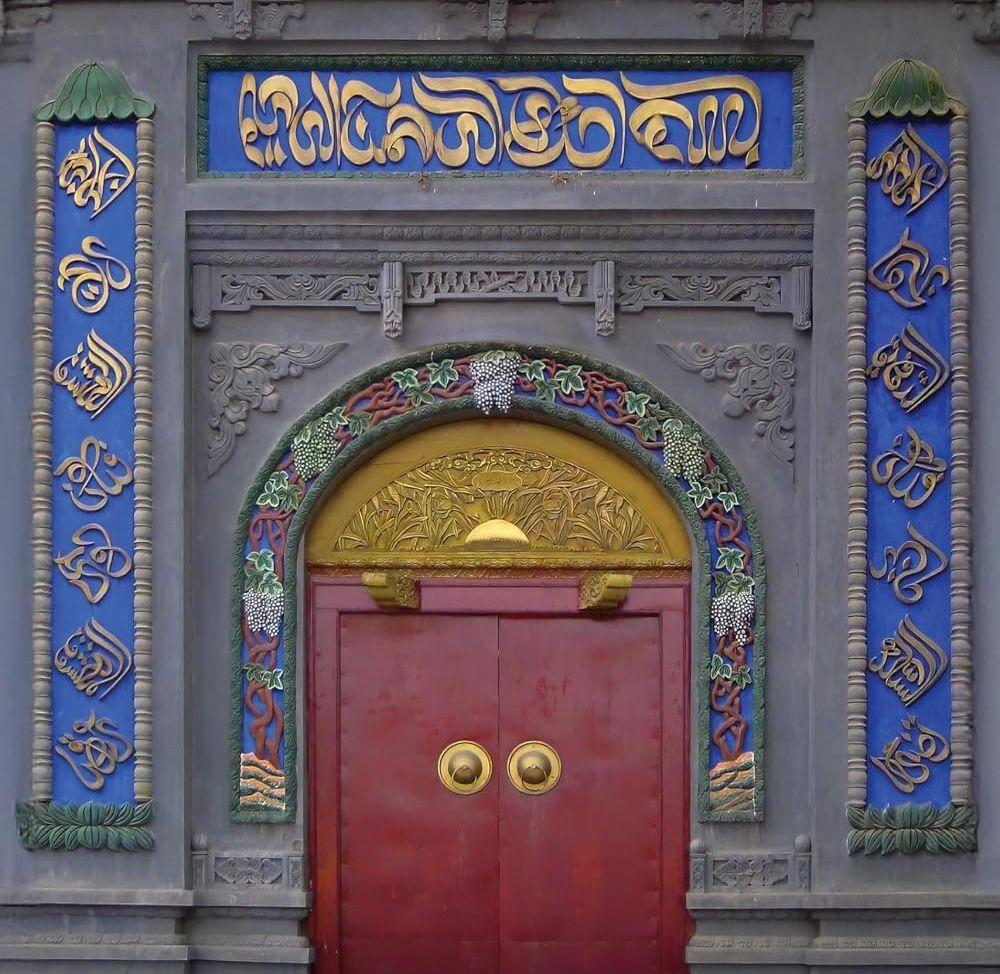
Muslim Transnationalism in Modern China: Debates on Hui Identity and Islamic Reform by Hale Eroğlu. Columbia University Press, 2025. 352 pages.
Islamic China: An Asian History by Rian Thum. Harvard University Press, 2025. 304 pages.
Did you know LARB is a reader-supported nonprofit?
LARB publishes daily without a paywall as part of our mission to make rigorous, incisive, and engaging writing on every aspect of literature, culture, and the arts freely accessible to the public. Help us continue this work with your tax-deductible donation today!
WHEN EITHER OF US speak publicly about Chinese Muslims, we are often asked if we are referring to the Uyghurs. This is for good reason. The Chinese state’s ongoing and relatively well publicized campaign against Uyghur religion, culture, and identity—which some experts have labeled cultural genocide—has brought long-overdue attention to the plight of Turkic Muslims in Chinese Central Asia (an area administrated today as the Xinjiang Uyghur Autonomous Region). Yet many are surprised to learn that one of the largest and, depending on how one counts, also the oldest Muslim population in China, known today as the Hui, is in many respects—linguistically, culturally, and even physically—largely indistinguishable from the Han Chinese majority. Often referred to as Chinese Muslims or Sino-Muslims to distinguish them from the Turkic-speaking Muslims of Xinjiang (which include Uyghurs, Kazakhs, Uzbeks, and Kyrgyz), the Hui number more than 11 million and are dispersed across every province of the People’s Republic of China (PRC), with the largest concentrations in its western regions. They descend from Arab and Persian merchants who arrived in China via maritime routes (and later overland across the Silk Road) and from soldiers and administrators relocated to China under the Mongol Empire.
The absence of Chinese Muslims from our consciousness is curious but, as two new books show, neither new nor unexpected. In Islamic China: An Asian History (2025), historian Rian Thum notes that “people who were at once Muslim and Chinese” are not often included in general histories of either Islam or of China. This is despite the continuous presence of Islam in China since the Tang period (618–907 CE), which makes China’s engagement with Islam nearly as old as Islam itself. Admittedly, it would take several centuries after the first transmission of Islam into China for a distinct Chinese-speaking Muslim community to coalesce. In Muslim Transnationalism in Modern China: Debates on Hui Identity and Islamic Reform (2025), historian Hale Eroğlu writes that it was during the Ming period (1368–1644 CE) that “linguistically diverse Muslim communities of multiple foreign origins in China became fused and acculturated” so that Islam emerged as the primary marker of distinction between Chinese Muslims and their non-Muslim neighbors.
Today, the Hui are unique among China’s 55 officially designated minority groups in that it is their religion—rather than their language or territory—that marks them as separate from the Han majority. At the same time, it is their Islamic faith, and their global connections to other Muslim communities and Islamic movements, that, at various times over the past century, has rendered their loyalty suspect in the eyes of the Han-dominated state. There is no better evidence of this than current efforts to “‘Chinafy’ religion.” Launched in 2015 by Xi Jinping, the campaign targets all religious practices deemed too “foreign,” but it has come down particularly hard upon the Hui. It is true that we have yet to see the levels of securitization and mass incarceration that have been directed mainly against Uyghurs and other Turkic-speaking Muslims. Still, Hui mosques have had their “Arabic-style” domes and minarets demolished, the sermons of Hui imams are monitored, Hui Arabic-language libraries (including Qur’ans) have been confiscated, and Hui madrassas (religious schools) are heavily regulated or have been shut down entirely. Outside of mosques, Hui publishing houses have been closed, Hui books have been banned, and many Hui intellectuals and religious leaders have been arrested or have fled into exile. The state also has extended its surveillance apparatus beyond its borders by instructing Chinese diplomatic missions abroad to facilitate the “education and guidance” of overseas Chinese Muslims engaged in religious study. Domestically, even otherwise prosaic markers of Huiness, such as Arabic signs indicating that a restaurant has been certified halal, largely have been erased from public view, leading some Hui to fear that the traditions and practices that provide community cohesion—and make them distinct from the larger Han majority—are being marked for elimination.
Particularly timely, then, are Thum’s and Eroğlu’s pathbreaking new books. Both set their sights on misleading, essentializing presumptions about Islam and about China—notions that assume that Islam and China are either intrinsically at odds (what Thum calls “the myth of incompatibility”) or that their mixing has demanded degrees of negotiation and adaptation that compromise the authenticity of each. As a result, Chinese Muslims have often found themselves judged as an anomaly—neither fully Muslim nor fully Chinese.
Drawing on Arabic, Persian, and Turkic as well as Chinese-language sources, Thum and Eroğlu introduce readers to Chinese Muslim thinkers from the 17th through the 20th centuries whose lives and writings challenge simplistic but common assumptions about Chinese Muslims and about Islam in China. Thum boldly announces his objective at the start of Islamic China: “to reach an understanding of Islamic Chinese history that makes the Muslims of China unsurprising, even ordinary.” While “China and Islam existed as mutually isolated phenomena for only a few decades in the seventh century CE,” he writes, “scholars have continually attempted to disentangle them, interpreting the ensuing millennium of entangled history in light of that brief moment of separateness.”
Thum is responding to mainstream histories in which readers tend to meet Chinese Muslims only in times of crisis and conflict—most often during the great rebellions that struck southwest and northwest China in the 19th century—and thereby erase the mundane, unextraordinary, uninterrupted everydayness of the Muslim experience in China. At the same time, Thum—somewhat controversially—is challenging literature written mostly by Western scholars in recent decades that has admirably argued against the “myth of incompatibility” by nativizing Chinese Islam, most notably through the amplification of a set of Chinese-language Islamic sources, known as the Han Kitab, that seem to have crafted a distinctly “syncretic” Confucian-inflected take on Islam. Yet syncretism, as Thum notes, suggests neither one nor the other but “a hybrid” form of Chinese Islam detached from that which was being practiced elsewhere in the Islamic world, where the Chinese version would appear extraordinary and controversial.
Historians long ago put to rest the old supposition that China was an isolated, insular, unchanging empire until the mid-19th century when it was forced to open up at gunpoint by the West. However, a parallel assumption, that Chinese Muslims spent centuries effectively separated from the larger Islamic world, and therefore produced a form of Islam notably distinct from the orthodoxies emanating from the Middle East and elsewhere, has proven surprisingly stubborn. Foregrounding the Arabic and Persian sources that circulated within Chinese Muslim communities, and which, until the 20th century, greatly outnumbered Chinese-language Han Kitab texts, Islamic China confronts the isolation myth by excavating many of the ways that Chinese Muslims “continuously and repeatedly” interacted with and were embedded within the broader Islamic world from the 17th through the early 20th century.
Thum accomplishes this through what he calls a “biographical approach” that, he argues, “privileges routes over territory.” While territory is “the preserve of states,” Thum instead focuses on movement across well-worn Eurasian networks of circulation and exchange—an approach that, he suggests, “helps us think past the category-making phenomena of states.” As an example, Thum tells the story of “two ordinary books.” The first is a Chinese-language Han Kitab primer written by the Chinese Muslim educator Ma Lianyuan (1841–1903). The second is an Islamic legal commentary published in India by a man named Nūr al-Ḥaqq who was known within Muslim intellectual networks of South Asia for producing annotations on Persian and Arabic religious texts. The two men—as we are surprised to discover (spoiler alert!)—were one and the same. Rejecting hybridity or syncretism, Thum insists that “Ma’s entanglement [with Nūr al-Ḥaqq] was not amalgamation, accommodation, or compromise, but a coherent whole that appeared seamless and unremarkable.”
Throughout Islamic China, travelers like Ma Lianyuan/Nūr al-Ḥaqq and many others, along with ideas and objects, cross boundaries and transcend categories that frustrate the territorial parceling-out of subjectivities and solidarities that would become so central to the sense of boundedness introduced by the nation-state. Thum writes: “Our sense of surprise is a reminder that, no matter how fervently [we] may reject essentialism at an abstract level, it maintains a tight grip on us as we make our own sense of the world’s cultural and intellectual diversity.”
Temporally and thematically, Muslim Transnationalism in Modern China picks up where Islamic China leaves off: in the early 20th century, when the categories Thum dispenses with suddenly become indispensable markers of the modern political subject. As the Qing imperial order collapsed and the Republic of China slowly took shape, Chinese Muslim intellectuals confronted and debated the formidable challenge of transforming Muslim subjects of the “multiethnic and multireligious” dynastic realm “into conscious, active, modern, and equal citizens” of the Han-dominated secular Chinese nation-state. Counterintuitively, rather than shunning the networks that Thum maps out, Eroğlu shows that Chinese Muslim elites addressed the emerging categorical dilemma between China and Islam by “deepening their transnational connections with the broader Muslim world.”
By selectively appropriating and adapting intellectual resources from Islamic centers of learning, including Kemalist Turkey, Colonial India, and competing Islamic movements in Egypt (each of which was engaged in struggles to reconcile Islamic tradition with the imperatives of secular modernism and nationalism), prominent Chinese Muslims debated ways to construct a model of integration that would secure space for Muslims within the Chinese national body while simultaneously preserving autonomy to promote their Muslim identity and religion. Among Eroğlu’s examples is the controversial Ahmadiyya movement, which was founded in colonial Punjab, India, by the self-proclaimed prophet Mirza Ghulam Ahmad (1835–1908). In fact, both Eroğlu’s and Thum’s books uncover largely neglected links between Chinese Muslims and Islamic India. While generally rejecting Ghulam Ahmad’s claim to prophethood, some Chinese Muslims adopted other aspects of Ahmadi reformism that provided “an alternative Islamic perspective that allowed for peaceful coexistence in a non-Muslim dominant context without compromising their moral and religious beliefs.”
The most public dimension of the debates among Chinese Muslims in the first half of the 20th century was over whether Muslims in China encompassed a religious or ethnic minority. Among many prominent Chinese Muslims, the initial preference was to stake racialist and culturalist claims to inclusion. Criticizing those who “conflat[ed] religion with ethnicity,” they argued that Chinese Muslims were essentially Han Chinese who believed in Islam. This was an attractive position in part because it matched Chiang Kai-shek’s own political imaginings of a Chinese state inhabited by a single “Chinese people” (Zhonghua minzu). The balance, however, would change over the course of the Second World War. In a global climate in which ethnicity rather than religion had become the recognized marker of a political community, Chinese Muslim intellectuals leveraged advances by Imperial Japan and by the Chinese Communists—both of which promised to carve out autonomous spaces for Muslims in China’s northwest—to demand representation alongside Tibetans and Mongols in China’s National Assembly. In 1947, the Chinese state took an initial step toward formally recognizing the Hui as a “distinct community” separate from both the Han majority and Turkic-speaking Muslims of Xinjiang, which the Chinese Communist Party would soon codify as the Hui nationality. Eroğlu thus shows that Chinese Muslims were not a lump of ethnoreligious clay to be molded by party bureaucrats. Instead of a “state-imposed category,” she contends, modern Hui identity was “the result of decades of struggle by the Chinese-speaking Muslim elite who fought for cultural and religious autonomy.”
Yet, as the political theorist Saba Mahmood has argued, minorityhood carries within it an “irresolvable tension”:
[O]n the one hand, a minority is supposed to be an equal partner with the majority in the building of the nation; on the other hand, its difference (religious, racial, ethnic) poses an incipient threat to the identity of the nation that is grounded in the religious, linguistic, and cultural norms of the majority.
The PRC had been founded in 1949 with loud promises of ethnic equality, cultural autonomy, and religious tolerance. Within a decade, however, those identified as minority nationalities had come under suspicion for expressions of what the Communist Party termed “local nationalism.” In the case of the Hui, this allegation pointed to their “foreign” religion and its transnational linkages—as expressed, for example, through the everyday slogan “All Muslims under heaven are one family”—which provided evidence of potential disloyalty. Two decades of systematic state repression followed, climaxing in China’s 10-year Cultural Revolution. Mosques were destroyed, religious elites were imprisoned and sometimes executed, Persian and Arabic scholarship and learning were attacked, and ordinary Islamic practices such as daily prayer and fasting were prohibited. One result was to sever, perhaps for the first time, Chinese Muslims’ connections with the broader Islamic world while simultaneously destroying the people and objects that transmitted cultural and religious knowledge from one generation to the next.
After Mao’s death in 1976 and the winding-down of the Cultural Revolution, restrictions were slowly lifted on religious practice and other expressions of cultural difference, which allowed Chinese Muslims the opportunity to reestablish their centuries-old Islamic traditions. This crucially involved the reconstruction of transnational networks through which to revitalize and authenticate Islamic knowledge and practices. Ironically, this was accomplished with the support of the post-Mao regime, which was itself eager to establish economic and strategic relationships with the Islamic world. For a time in the 1980s and 1990s, the Hui were often identified as China’s model minority, particularly when contrasted with ethnic communities such as the Uyghurs and Tibetans, whose loyalty to the Chinese state and nation seemed less assured.
Model minority no more: Over the past two decades, the transnational networks and connections that have reenergized Hui religious and cultural life have again become flashpoints that prompt questions about the Chineseness of Chinese Muslims. In part, this is attributable to the rise in Islamophobia that, since the start of the US-led “War on Terror,” has infected many states and societies with Muslim minorities, including China. However, it is also part of a particular tradition within modern China of viewing Chinese Muslims as not quite Chinese and possibly too Muslim.
In their conclusions, both Thum and Eroğlu reflect on Xi Jinping’s determination to craft a “community of shared destiny” in which China serves not only as the physical home to its various peoples but also as their “spiritual home.” As Thum writes, “The ‘China’ [Xi] refers to is, in its essence, non-Islamic, and Islam is, in its essence, alien to China.” Most recently, in March 2026, the National People’s Congress passed a sweeping law on “ethnic unity” that aggressively promotes a singular Han-centric supraethnic Chinese identity at the expense of what had been constitutionally protected linguistic, cultural, and even geographic expressions of difference. As demonstrated by growing Hui diaspora communities in places as far-flung as Southeast Asia, the Middle East and Turkey, Europe, and North America, Chinese Muslims soon may be forced to choose between two categories that had long been mutually compatible and largely unproblematic: Islam or China.
LARB Contributors
Benno Weiner is an associate professor of history at Carnegie Mellon University. He is the author of The Chinese Revolution on the Tibetan Frontier (2020) and co-editor of Conflicting Memories: Tibetan History Under Mao Retold (2020).
Qianyu Ma is a Hui scholar from Northwest China and a PhD student in history at Carnegie Mellon University. Her research focuses on the history and memory of Chinese Muslims in the 20th century.
LARB Staff Recommendations
Fear and Writing in Xinjiang: On Tahir Hamut Izgil’s “Waiting to Be Arrested at Night” and Perhat Tursun’s “The Backstreets”
Fear and Writing in Xinjiang: On Tahir Hamut Izgil’s “Waiting to Be Arrested at Night: A Uyghur Poet’s Memoir of China’s Genocide” and Perhat Tursun’s “The Backstreets: A Novel from Xinjiang.”
Straining Nation or Expansionist Empire?
Benno Weiner reviews Edward Wong’s “At the Edge of Empire: A Family’s Reckoning with China.”