Did you know LARB is a reader-supported nonprofit?
LARB publishes daily without a paywall as part of our mission to make rigorous, incisive, and engaging writing on every aspect of literature, culture, and the arts freely accessible to the public. Help us continue this work with your tax-deductible donation today!
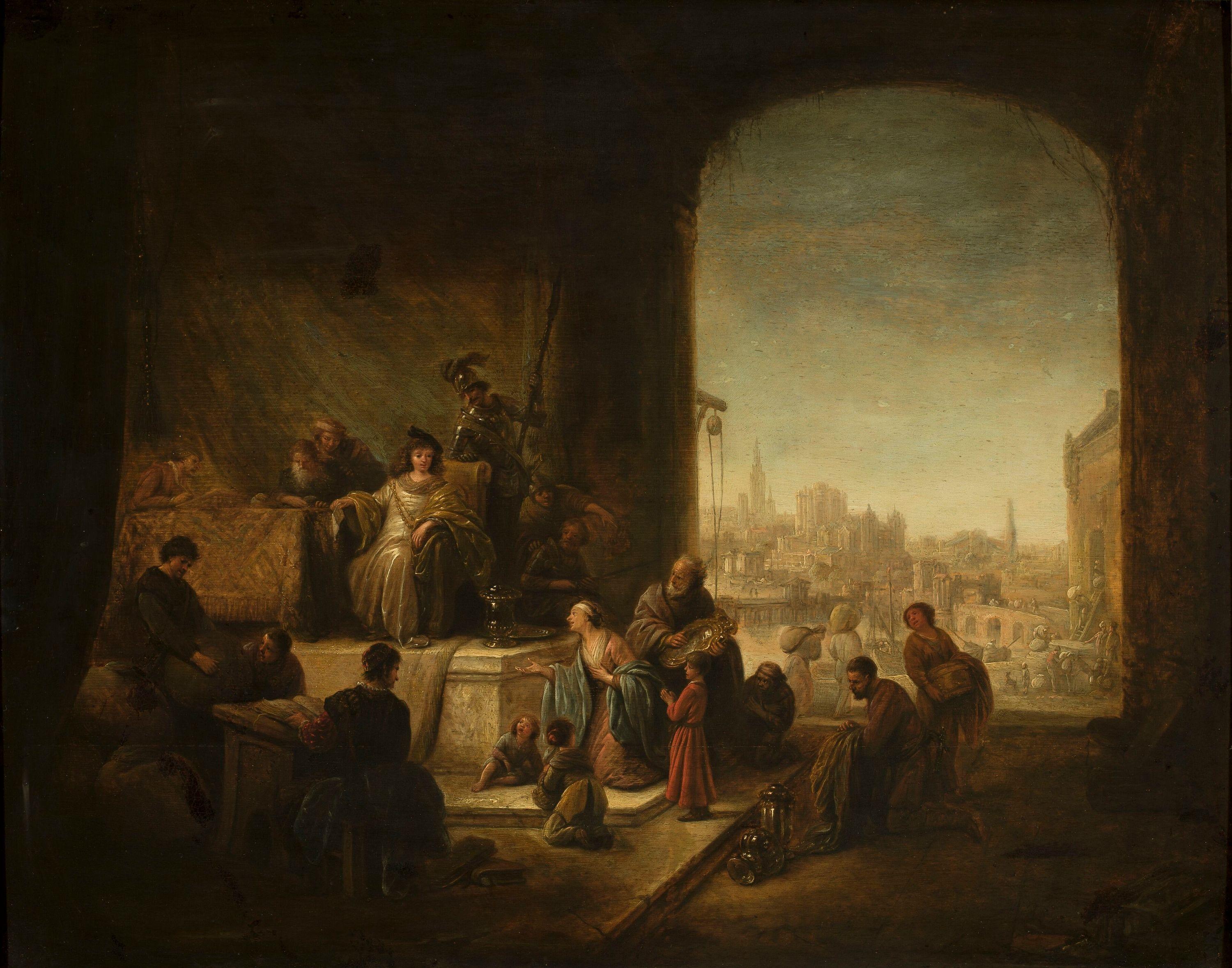
IT WAS RECORDED in the Book of Genesis, before time, that when famine oppressed the land of Egypt, only Joseph, who served Pharaoh, held reserves of grain and corn. He sold it to the people until all the money in the land had come to Pharaoh’s treasuries. When the money was exhausted, he traded corn for cattle, horses, sheep, and oxen. When all the animals of Egypt belonged to Pharaoh, Joseph traded corn for land. At last, with nothing left, Joseph took the people in bondage, making them the Pharaoh’s slaves and servants in exchange for seeds to grow and fields in which to sow them. The people, it is said, were thankful, and glad.
Scripture provides two meanings for the name of Yosef: the first and better known, יוֹסֵף, means to give, to add, to multiply. But the second, from the triliteral א־ס־ף, means to gather up, to take away, to harvest.
It was recorded in the Bellum Judaicum by Yosef ben Matityahu, later Josephus Flavius, in the first century AD, that when Titus and the Romans encircled the walls of Jerusalem, the city began to starve. Stores were burned by rival factions; bodies fell and gathered in the streets with ribs protruding. The people turned to eating grass, then roots, then leather. It was recorded that one wealthy woman, Mary of Bethezuba, was driven mad by hunger and killed and ate her infant son.
It was recorded in the books of Luke and Matthew, in the second century, that when Joseph and Mary came to Bethlehem, they laid Christ in a manger because there was no room for them in the inn. It was noted that shepherds visited, as well as Magi bearing gold, frankincense, and myrrh, but no one is recorded bringing food.
It was recorded in the Book of a Thousand Judgements from the Day of Ohrmazd, in the fourth century, that the elder Yōsēp bar Šimōn received a vision of a journey across the desert through an endless night. After many miles, he saw a great tower arising from the sands, covered in precious stones and bars of jade and silver. When he approached, the tower began to tremble, then collapsed at his feet, and in the dust he found a crimson robe, inlaid with gold, and put it on. When he awoke, he announced that a famine would soon come. He sent messengers to the king, but halfway through their journey to the capital, they were lost.
It was recorded in the Tadhkirat al-awliyā, in the 12th century, that when the Sufi mystic Yusuf Hamadani journeyed east to Merv and Herat, he undertook mujahada, the striving, and denied himself all comforts, fasting for days and weeks on end. In the end, he is said to have known the way to tajalli, the knowledge of things unseen behind the veils.
It was recorded in the Zhamanakagrutyun, in the 12th century, by Matthew of Edessa, and then Gregory the Priest, that when the Turks besieged Harran, it “put the town in danger of famine.” It was also recorded in the Zhamanakagrutyun that when Baldwin I of Jerusalem besieged the town of Tyre, he “harassed the city with famine and continual assaults,” and that when Gazi Gümüshtigin besieged Bohemond I of Antioch at Melitene, he “blockaded the city for six months until it was hard pressed by a severe famine where many died.” It was also recorded in the Zhamanakagrutyun that when Zengi, atabeg of Mosul, took Edessa, “the townspeople suffered from terrible famine” before Matthew himself was slain. The Zhamanakagrutyun does not record that within a generation, Yusuf ibn Ayyub, better known as Saladin, would starve the Crusaders out for good.
It was recorded in the Song Shi, of the Twenty-Four Histories of China, in the 14th century, that on St. Joseph’s Day, 1279, the Mongol Yuan broke the last Song forces in the Battle of Yashan. It was noted that seven days after the battle, a thousand corpses floated to the surface of the sea, including Zhao Bing, the last Song emperor, and that the people of southern China were cursed to famine for a century under the Mongol yoke.
It was recorded in the Annales Londonienses, and in the Chronicle of John Trokelow, and in the Brut Chronicle, and in the Grandes Chroniques de France, and in the Chronicle of Jean de Saint-Victor and in the Chronicle of Johannes de Beka and in the Chronicle of John of Winterthur, and in the Chronicle of Guillaume de Nangis, in 1315 and 1316 and 1317, that a great famine descended upon Europe, and that many thousands of Josephs and Yusufs and Josés and Josefs and Józefs were among the countless dead.
It was recorded in the Maggid Mesharim, in the 16th century, that the Cabalist rabbi Yosef Caro was stymied by a rambam that he could not comprehend. He fasted for three days, and when he was finished, its meaning became clear to him. The next day, he visited a school, where he saw students discussing the same rambam without any difficulty at all. Dismayed by their ease, he returned home and fell asleep, where an angel revealed to him in a dream that it was by his fast that he had opened the lights of holiness upon the bewildering passage and made it comprehensible, not merely for him but for all who sought to learn.
It was recorded in The True and Faithful Relation of Sundry Strange Discoveries Made in the Western Indies, Being a Complete Account of Marvellous Lands and Peoples Encountered Beyond the Ocean Sea, in the 16th century, that Captain José Hernández de Villareal made landfall on an island where the natives had never known of any peoples living anywhere beyond their shores. They partook in neither marriage nor in labor, nor wore any clothing, and subsisted on a golden fruit that fell plentifully from a single tree in the center of the isle. A great feast was thrown for the expeditioners, but when they ate the golden fruit, it did not sate them. As they consumed more, they discovered that each bite made them hungrier than before. One of Villareal’s lieutenants, who had gorged himself and became crazed and ravenous, demanded true food; when a native woman told him that this was the only food that they had ever known, the lieutenant drew his pistol and shot her. Driven back to their boats, the expeditioners departed in a state of wretched famine, leaving behind several silks, three guns, and a copy of the Gospels. They sailed for six days and seven nights before landing on an island where apples and ripe cereals were plenty.
It was recorded in the hagiographies of the confessor Roberto Nuti, in the 17th century, that Saint Joseph of Cupertino “kept seven Lents of forty days each year.” He went so long with nothing, or only a little bread and water, that his superiors in the Franciscan Order became concerned. But then, so light from fasting and deep in prayer, several men looked on as Joseph lifted off the ground and levitated, legs crossed, eyes shut in holy prayer.
It was recorded in the letters of Caleb Baldwin, in 1838, that when Joseph Smith was held in Liberty Jail, Missouri, the food was “very coarse, and so filthy that we could not eat it until we were driven to it by hunger.” When they relented, and ate what they were given, the food caused them to vomit “almost to death,” and it is recorded that many of the prisoners suspected the food was poisoned, or perhaps made of human flesh.
It was recorded in The Denison Review of Iowa, in 1905, that Joseph Smith, age 17, was found “helpless, penniless, and well-nigh starved,” trapped under the wheel of an Illinois Central freight car outside Deloit. He had left his Missouri home three weeks before and walked toward Iowa in search of work until his clothes were torn and his shoes had begun to fall apart. It was speculated that, coming to Deloit, “he either tried to jump from the moving train, or else fell from sheer exhaustion, and falling too near the train he was dragged under,” and the train sheared two fingers from his hand.
It was recorded in The Smyrna Times of Delaware, in 1911, that Joseph Smith, age 20, was found half-starved and frozen inside a boxcar at the station in Altoona, Pennsylvania. He said that he had jumped the train with an accomplice, who stole his hat and coat when he was sleeping and locked him in without anything to eat or drink.
It was recorded in the East Oregonian, in 1906, that Joseph Seely, “tall, gaunt, and emaciated,” walked into a New York City police station and asked to be locked up because he could not find food on the streets. When a court keeper determined that Joseph was really starving, he gave him a double portion of food. “Seely disposed of it ravenously and was very soon taken ill,” the Oregonian notes, and he died before help could arrive. “The hospital doctor who made a post-mortem examination stated that Seely’s stomach was so utterly deranged by starvation that the hearty meal he ate had been the cause.”
It was recorded in the De Queen Bee of Arkansas, in 1912, that Joseph Guerky, age 72, was found locked in a barn where his son-in-law Michael Guera had left him. Guerky was “groveling in the straw like a half starved dog,” almost nude, and had been eating only bones and scraps for years. Guera told police that “he didn’t have time to bother with the old man.” His wife, Joseph’s daughter, told officers she didn’t care.
It was recorded in The Omaha Daily Bee, in 1916, that the escaped convict Joseph Rhodes surrendered himself to Sheriff Cole in Hastings. He was suffering from exposure and “nearly starved.” He told authorities that he would serve the remainder of his 14-year sentence for grand larceny if he could only have some food.
It was recorded in The Wheeling Intelligencer, in 1917, that George Angeorge returned from Syria bearing sad news for fellow immigrants from the old country. Joseph Nassiff, a dry goods dealer, learned that his mother and uncle had starved to death. Joseph Moses, of the Wheeling Stamping Company, learned that his mother, his wife, and his two children had all starved. Joseph Sargis, a peddler, learned that his two children, his wife, and his mother had died too. “Mr. Angeorge declared the Turkish government was starving Syrians,” the article went on, “that flour was $1 a pound and there is little food to be had at any price.”
It was recorded in The Fitzgerald Leader Enterprise and Press, in 1923, that Mrs. Joseph Powers, a widow of 78, was “too proud to ask for charity” and starved.
It was recorded in The Famine in Soviet Russia, 1919–1923: The Operations of the American Relief Administration, in 1927, that the Povolzhye famine claimed at least five million lives. In the 19th century, Иосиф, or Iosef, was among the most popular of Russian names. But it fell out of favor with the revolution.
It was recorded in The New Yorker, in 1942, that the historian Joe Gould, alias Professor Seagull, was often starving. He was “hungry as a bitch wolf.”
It was recorded in The Evening Star, in 1943, that Yusef Haddad, of Algeria, “did not think much of Uncle Sam.” The American soldiers who had driven out the Nazis had not brought supplies enough to share. “Yusef is cold in the mild North African winter because he has no cotton cloth to replace his tattered garments,” The Evening Star reported. “He is hungry. Every day, Yusef and his cousins, Ayoub and Mohammed, have to listen to the complaining of their women—that there is no tea, no thread, no supplies for the baby.”
It was recorded in The Chicago Defender, in 1984, that Joe Louis was born next to a cotton field in Alabama. He was the grandson of a slave, very poor, and always hungry.
It was recorded in The New York Times, in February 2018, that chef José Andrés became so preoccupied while cooking meals for Puerto Rican refugees after Hurricane Maria that he began to starve, losing 25 pounds in just over a month. “[Y]ou were turning out tens of thousands of meals a day. You couldn’t take a couple of those meals for yourself?” asked the Times. “There was no time,” said Andrés.
It was recorded in the New York Post, in November 2024, that Joseph Heben Jr., of Staten Island, had starved to death. He was one month old. The police were investigating the matter as a homicide.
It was recorded by NBC News, in July 2025, that six-week-old Youssef al-Safadi had starved to death in Gaza: “His tiny body crumpled on a cold metal table, [his] clothing was gently removed […] revealing his protruding ribs and hollow stomach.” His father said that they “couldn’t provide any kind of milk for him—no formula, no supplements, no vitamins.” Even when supplies could be found, they “cost at least $100.” It was noted that NBC News “was not immediately able to independently confirm the figures.”
It can be difficult to confirm numbers in Gaza, although many have been recorded. Last year, NBC reported the loss of one of their last stringers, Yousef Al-Khozindar, a 27-year-old father of two, who did not starve, but was in his tent on the southern strip when an airstrike came and Yousef burned alive.
¤
Featured image: Jacob Willemszoon de Wet, Joseph Selling Grain in Egypt, ca. 1645–75. Old Masters Collection, National Museum in Warsaw (M.Ob.554 MNW). CC0, cyfrowe.mnw.art.pl. Accessed April 22, 2026. Image has been cropped.
LARB Contributor
Emmett Rensin is an essayist and academic. He is the author of The Complications: On Going Insane in America (HarperOne, 2024), an essay collection about living with a severe mental illness, and the historical, cultural, and discursive madness around madness itself.
LARB Staff Recommendations
An Apocalypse for Every Epoch
Emmett Rensin writes on eco-grief, the climate dirge, and one Armenian monk in a new hybrid fiction-cum-essay from LARB Quarterly no. 47, “Security.”
The Most Moral Army
Mary Turfah examines Israeli officials’ weaponization of language, particularly that of medicine, in an attempt to reframe their genocide in Gaza.