Poets in the Workplace
Daniel Poppick discusses his new novel, an exploration of ‘the unique absurdism of the gone-but-not-forgotten era of office culture between the Great Recession and the COVID-19 pandemic.’
By Diana HealdAugust 6, 2026
The Copywriter by Daniel Poppick. Scribner, 2026. 224 pages.
Did you know LARB is a reader-supported nonprofit?
LARB publishes daily without a paywall as part of our mission to make rigorous, incisive, and engaging writing on every aspect of literature, culture, and the arts freely accessible to the public. Help us continue this work with your tax-deductible donation today!
WHEN I ASKED Daniel Poppick for a tagline for his debut novel, The Copywriter (Scribner, 2026), he suggested “Poets in the workplace.” Like all good taglines, his offers an apt if reductive description of the book, which documents two years in the life of D__, a poet with a day job writing copy for an online retail company.
In The Copywriter, Poppick provides a close-up view of the coexisting banality and drama of corporate America, which is rare in contemporary fiction. Through a season of professional and personal turmoil, D__ keeps a notebook to chart his evolving feelings about love and community, his identity as a poet, and the frustrations and unexpected delights he finds in salaried work. After losing his job and his girlfriend, D__ attempts to cope by reading Proust and undertaking a cross-country road trip, which is ultimately cut short by a new job offer. All the while, he contends with unanswerable questions about purpose, relationships, and the role of art in times of political and economic upheaval. If D__’s questions about the power of language are mostly theoretical when applied to poetry, they take on palpable importance at his new job, where D__ is asked to write copy endorsing a public appearance of a former war criminal.
Like D__, Poppick himself is both a poet—the author of the collections Fear of Description (Penguin Books, 2019) and The Police (Omnidawn, 2017)—and a copywriter. As a fellow writer with a day job in advertising, I was interested in speaking to him about the fraught relationship between using language to make art and using it to make a living. We met in Brooklyn and discussed his fiction debut, the work of Ben Lerner, a potential tagline for the profession of poetry, and the importance of a good riddle.
¤
DIANA HEALD: At his first job, D__ has very little emotional engagement with his copywriting work. He sees the office in a cynical way, in contrast to his new 24-year-old CEO, who has drunk the corporate Kool-Aid. But Fatima, D__’s colleague, complicates that binary. She’s also a copywriter, but she’s not a poet. Can you tell me about her role here as someone with a different relationship to work? How do you approach writing critically about workplace dynamics without being reductive? Making art, especially poetry, can be seen as this anti-capitalist act, but it’s also a privilege.
DANIEL POPPICK: Fatima gets a sense of purpose from being professional. She wants to do her job well because it allows her to support herself. We only get a very tiny glimpse of that. The joke about D__ and his friends is that whatever they can do well to make a living is always going to be secondary or tertiary to writing poetry—they will always organize their lives around this thing that gives them no meaningful financial gain. When Fatima and D__ find out that their company is probably going to shut down, D__’s initial reaction is to view this as both a practical and spiritual problem: where one problem ends and the other begins is confused for him. On the other hand, Fatima’s reaction is to wonder how she’s going to pay her rent. It’s very simple. She sees a quasi-existential problem and attacks it, while D__ is looking at all the refracted pieces of it. There’s something about this contrast that I find inherently funny.
Not to make it overly serious, but I do think that poetry is a spiritual practice. People who care about it will find a way to do it no matter what, in the same way that people who are religious or devoted to meditation will find time for those things whether they’re employed or not. I don’t know if this notion holds true for novelists. But I think it’s true for poets.
When layoffs loom at D__’s office and he and his colleagues are faced with this uncertain future, he says,
I recognize the dynamics of this moment […] Understanding the unsaid, decoding silence, reaching beyond reason for what Keats called negative capability [an artist’s capacity to exist in uncertainty for the pursuit of their craft]. It isn’t poetry, but poetry has trained me for it.
My initial reaction to this was thinking What a beautiful sentiment, that poetry prepares you for resilience in the face of uncertainty. But in the current context of the tremendous devaluing of the humanities that’s underway in the United States, I wondered if there was a more cynical read here. Could a potential tagline for poetry be “Preparing you to emotionally handle layoffs really well”? [Laughs.]
Practically speaking, I don’t recommend studying poetry to prepare for the economic carnage of late-stage capitalism. [Laughs.] But what poetry can do is give us another way to think about what we value, about time. Capitalism values productivity and efficiency. I don’t know what it means to be a productive or efficient poet. Poetry takes a long time to write. For me, it is more about posing questions than solving problems. It provides an alternate framing for value in life beyond the rat race.
I’ve had this burning question related to the date that D__ goes on toward the end of the book, where he’s asking the woman if he can see her again. She calls him cold, and he’s trying to explain himself, saying: “I think I’ve put too much pressure on poetry and love to give my life meaning. […] There needs to be a third thing.” And her response is “Have you considered money?” She also suggests a riddle. Have you cracked the third thing?
For D__, the tragicomic part of that scene is that he already has a third thing: his friends. He knows that on some level, but I think sometimes we can get so close to a problem that we don’t realize the ways in which we’ve already begun to solve it for ourselves.
It’s not riddles?
A friend of mine did suggest that maybe the thing I was missing in my life was a riddle. And I thought that was so hilarious and true that it had to go in the book. But another way of thinking about the third thing is that it’s the void that work can leave for a lot of people. The idea that we’re supposed to derive meaning from our work is contingent on a lot of things that simply aren’t economically or socially true, particularly for those of us who entered professional life at the beginning of the Great Recession. I think the third thing also stands in for the nothing, the vacuum that the lack of meaningful work has created in our culture.
I was reading another interpretation of this book that said the third thing was work, arguing that work serves as a productive constraint for D__. But I didn’t get the sense that work was depicted in the novel as a meaningful third thing.
Well, it was, and it wasn’t. I think that critic did point out that the purpose work serves for D__ is that he needs to write about it. It drives him forward. And I wouldn’t even say that work is completely defined as a negative thing. There are parts of the experience of work that, even though D__ might consider them meaningless, are not. That’s another one of the ironies of this book. For how disaffected D__ seems, he’s fundamentally interested in other people. Even when we have what David Graeber calls “bullshit jobs,” what keeps them from feeling totally hopeless is that people and office culture are inherently interesting, if you know how to look at them. It’s a productive tension. I don’t think all work is meaningless. D__ is figuring that out for himself. At a reading this past April, I was making jokes about work being meaningless and my girlfriend pointed to a family friend in the audience and said, “That man is a kidney surgeon.”
There’s a moment in the book where D__ and his friends are listing their favorite living poets and Ben Lerner comes up. D__ says Ben Lerner doesn’t count as a poet anymore now that he’s a novelist. This book asks a lot of questions about the nature of the novel, but to me, it felt like it was really asking about poetry. The question of poetry, and who and what it is for, kept slipping in. Is this book a kind of Trojan horse for poetry? Why did you write it as a novel?
If someone thinks it’s a Trojan horse for poetry, I wouldn’t be mad about that. I think that’s a totally fair reading of the book. But it’s not just that. Though I’ve always read novels and I’ve always loved them, I had sworn that I would never write one myself. But as this book was underway, and as I began to realize that I was in the process of writing a novel, I started thinking about the novel in terms of form: the way I would with a poem. The novel has formal qualities that you can embrace or reject. Finding the edges of the form is part of what made this an exciting creative experience. Also, I hope it goes without saying, but I don’t think that Ben Lerner is a sellout. Ben Lerner is one of my favorite novelists.
We love Ben Lerner.
Yeah! [Laughs.] He’s also a fantastic poet. What D__ is figuring out in that moment is that trying to push outside or expand the purview of poetry doesn’t mean that you’re betraying it. In fact, I would argue that this is what it means to inhabit poetry, which is and always has been a laboratory for human language.
At one point in the book, D__ writes a product description for a plastic beach bucket (“Feeling pail? Dig this”) and says: “Within minutes, it is on the website, where it will have more readers than my poems ever will.” These whimsical product descriptions were some of the most delightful parts of this book for me. I’m wondering if they have something to do with Trojan-horsing poetry into places where we might trick more people into caring.
I’ll never tell. [Laughs.]
The business world has its own vernacular, one that’s often used to obscure aims related to profit. The mundane conversations between colleagues, the work emails … they’re kind of thrilling in their banality. Can you talk about found and recorded language as part of this project?
The practice that D__ has of writing down conversations that he overhears, or signage he observes—most of the language isn’t directly from my own life, but the practice of recording it is. There’s a little bell that goes off whenever I hear or see something that tells me, This is worth writing down. It’s a way to bring out the texture of what’s alive in the mundane repetitions of daily life. What’s interesting about recording this language, whether it’s in the signage on a subway or corporate jargon, is the resonances that it didn’t intend. In one of the early scenes, D__ sees text that says “an object lesion in luxury.” I think of that as a kind of corporate Freudian slip. And sometimes if you connect the dots, it can feel like the world is speaking back to you through these little slips, these holes in the veil of received language.
When I started working in advertising, I remember being horrified by the amount of jargon—I didn’t know what anyone was talking about. Language becomes a means to an end, where if you throw a bunch of buzzwords into a presentation, you get out of the office sooner. As a writer, I’m always trying to keep bad habits I’ve picked up in the working world from slipping into my art, where the stakes feel much higher and more personal. Do you have rules related to language in your own copywriting work?
I really am using a different part of my brain when I am copywriting versus when I am writing poetry or fiction or anything else. When I’m copywriting, I’m trying to solve a puzzle, a crossword, because that’s what I’m being paid to do. When I turn to poetry, it’s just blank space; I have to figure out what to do with the blankness. Professional life is often about reading the tea leaves, and the open secret about advertising is that it’s not about communicating something as clearly as possible. Because if you were to communicate the truth about capitalism, whether this person needs this product in every instance, then you would never be able to sell anything. And since we haven’t yet figured out another solution to the problem of how to pay rent short of a massive collective strike, we have to continue solving these puzzles. At the end of the day when I put copywriting away to work on poetry or fiction, it is a profound privilege to stop trying to solve the puzzle and to figure some other stuff out.
¤
Daniel Poppick is a poet and novelist. His debut novel is The Copywriter (Scribner, 2026). He is also the author of the poetry collections Fear of Description (Penguin Books, 2019), selected for the National Poetry Series, and The Police (Omnidawn, 2017). His work appears in The New Yorker, The Paris Review Daily, The Drift, Harper’s, BOMB, The New Republic, Chicago Review, and other journals.
¤
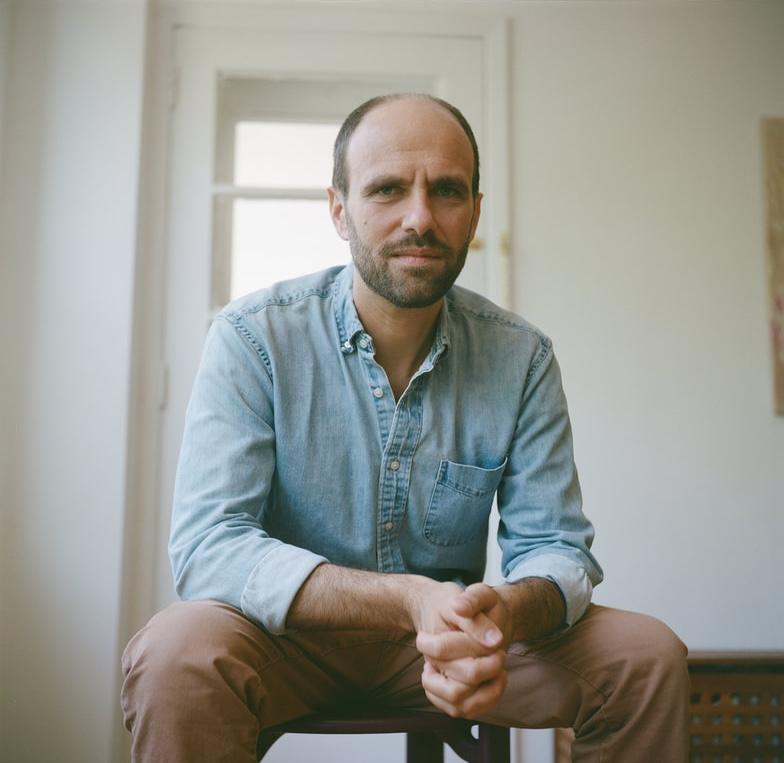
Featured image: Photo of Daniel Poppick by Sarah Friedland.
LARB Contributor
Diana Heald is a Brooklyn-based writer currently at work on a book about the marketing of antidepressants. Her work has appeared in Off Assignment, Panorama Journal, DIAGRAM, and elsewhere.
LARB Staff Recommendations
Corporate Culture as Absurdist Metafiction: On Christine Sneed’s “Please Be Advised”
W. Scott Olsen reviews Christine Sneed’s “Please Be Advised: A Novel in Memos.”
The Revolution Will Not Be Digitized
How employees in the tech sector see the world, themselves, and the (im)possibility of change.