Two Ships in Touch
Maya C. Popa discusses distance, wonder, and the 19th-century love letters explored in her newest collection.
By Elizabeth MetzgerJuly 14, 2026
If You Love That Lady by Maya C. Popa. W. W. Norton & Company, 2026. 80 pages.
Did you know LARB is a reader-supported nonprofit?
LARB publishes daily without a paywall as part of our mission to make rigorous, incisive, and engaging writing on every aspect of literature, culture, and the arts freely accessible to the public. Help us continue this work with your tax-deductible donation today!
THE OPENING POEM of Maya C. Popa’s third collection, If You Love That Lady (2026), ends with the lines “Look how we’ve made / of each other’s likeness a life.” The speaker looks into the face of an absent beloved and finds her own life there. At the threshold of the love poem as genre, Popa’s poems reach back beyond a romantic relationship to foundational love letters such as the courtship letters of Sally McDowell and John Miller. What better way to make legible the universality of love, heartbreak, and love’s refrain than to savor this epistolary tradition?
Popa’s previous collections include Wound Is the Origin of Wonder (2022), named one of The Guardian’s best books of poetry, as well as American Faith (2019), winner of the North American Poetry Book Award in 2020. If You Love That Lady is haunted by a profound sense of rupture, but the music of Popa’s poems insists on creation. After all, two people who have loved each other have also formed each other. Love changes, and love changes us.
In many of the poems, refrains and allusions lead to refractions and surprise. Popa depicts situational and affective opposites, like the shock of hope in the midst of grief, the delight of geography when unmoored, or the relief of belonging when identity is fractured.
If You Love That Lady is a book in which leaving and being left offer new connections. Popa does not sugarcoat or memorialize; instead, she writes poems that feel like letters mailed across time. This is a way of rejecting the idea that love is born or dies. As Keats writes in “On First Looking into Chapman’s Homer,” a reader of poetry does not need to arrive anywhere to have traveled much “in the realms of gold.” No distance is too great for a letter, and every distance holds the intimacy of a letter. It is often said that the “I” is best expressed in the lyric; Popa reveals that the trajectory of a romantic relationship is quintessentially epistolary. I have followed Popa’s writing for nearly two decades. We have shared many muses and have often crossed paths as poets and editors. I traveled through If You Love That Lady at a time in my own life when I needed to correspond with other versions of myself. Navigating this new collection and corresponding with the poet have felt like finding an old letter in a new envelope or a new love in an old letter—I invite you to eavesdrop on Maya C. Popa and “the I that cannot help but tell you this.”
¤
ELIZABETH METZGER: The title of your new collection takes its source from Robert Graves, as we see in the epigraph, but it also becomes a recurring title throughout. Is repetition the truest form of certainty, truer than any answer? There are many other ways in which repetition contributes to the music of this collection. In “One Way or Another,” you use an almost palindromic form. I can’t think of any book other than Maggie Millner’s Couplets that has made form feel so alive … and original! Can you talk about how you think about form, both its purpose and how it figures in your process?
MAYA C. POPA: First, thank you so much for reading the book with your trademark sensitivity and generosity. I’ve admired you as a reader and writer for over two decades. I feel honored to be read closely by you.
I stand by Robert Creeley’s adage about form being an extension of content. Certain subjects seem to naturally reach for shapes familiar to the reader’s eye and ear. If we believe Creeley’s thesis, then there’s something inevitable about form. “One Way or Another” opens with a paraphrase of Heraclitus (“you cannot step into the same river twice”), which is fitting for the shape the poem ended up assuming, a little like a snake swallowing its own tail. That palindromic form wasn’t planned outright. Halfway in, I realized there was nothing left to do but double back on what I’d said already. It was pleasing to recognize it immediately, because there’s very little that’s immediate about my writing process. More often, I am toggling between intuition and acumen, or inspiration and revision, back and forth, until the poem reveals itself enough to pursue a single possibility confidently. This was one of the rare instances where that possibility announced itself outright.
Poems are uniquely fitted to capture internal negotiations and reckoning by making them visually (and sonically) apparent. Through repetition and reversal, you can see just what’s been said and intuit why it has to be said again. That why, the poem’s engine, also becomes its emotional center.
This is a book of thresholds, a place where possibilities often meet impossibilities. The first poem, in fact, begins with a “hesitation.” Is there something about engaging with letters, an antiquated written form, that invites hesitation, or a different approach to boundaries of time and space? Does the epistolary form change your relationship to the lyric?
I once wrote an essay about my many floppy disks of saved AOL Instant Messenger (AIM) conversations. I credit the hundreds of hours I spent agonizing over the tone of my “away messages” (a performance of “away,” since most of the time, we were parked right there watching people enter and leave the chat) with my development as a writer.
That’s where my sense of what it means to have a voice on the page originated, between the hours of 8:00 and 10:00 p.m. with friends and acquaintances. Those AIM conversations existed slightly outside of time—often you’d return to school or camp the next day only to find the intimacies exchanged didn’t translate to a new reality beyond that consuming correspondence.
So, the epistolary form has fascinated me. Reading letters feels—indeed is—a form of eavesdropping (a sensibility at the heart of lyric poetry). A letter offers a remarkably intimate sense of who these individuals were, which naturally includes how they expressed doubt and hesitation.
In the case of Sally McDowell [the ex-wife of the former governor of Baltimore] and John Miller [a pastor], their letters begin in 1854 with her refusal of his offer of marriage. Imagine starting a correspondence there! We know that, by the end of the tome (the collected letters amount to 944 pages over two years), they will end up together. But, as is true of poetry, it’s not what a poem means but how it means that leaves an impact. Their candor and their wit, their mundane recounting and surprises—I found the voice they built together, their how, gripping and affecting, as well as historically complicated (right on the advent of the Civil War).
Miller said something I’ll never forget in those early letters after McDowell’s refusal: that when two ships collide at sea, they should remain in touch, until the extent of the damage is determined. That was at the back of my mind the whole time I wrote the collection. That people should remain close until the extent of the damage is determined. I interpret “damage” loosely—I am most interested in how people are transformed by coming into each other’s lives, and in how chance meetings shape our paths. That seems to me to be one of the chief promises of being alive.
Numerous geographical places are named in this collection (Gunpowder Falls, the Sandwich Islands). Elizabeth Bishop would swoon. Do you see the speaker(s) of these poems as distinctly American? Or what is her relationship to geography?
It’s a fantastic question, and I’m not sure myself how I feel about any of it. On the one hand, I’m undeniably American—I was born and raised in New York. On the other, my first language is Romanian, which is the language I speak at home, and I attended a French school until I was 14. Which means that, for a portion of my life, most of my education had taken place in and through the French language, though I never felt culturally French. My graduate degrees were both in the UK, whose green relief feels closer to me than many American landscapes do. I don’t mean this to sound like unnecessary collegiate cataloging—I just mean that the languages and spaces that have shaped me have not always belonged to America, even though I am American.
I’ve seen more of the United States in the last five years than I had in my entire life prior. As is clear to anyone who has traveled the US widely, there are such regional differences that it can feel like many small nation-states within an impossibly large geography. So the spirit of place matters deeply to me and to the poem’s speaker, but it’s rarely from the point of view of holding an allegiance. In poems like “You Are Here,” there’s real skepticism, a sense of “was it for this?” that I try to situate in my own understanding of belonging to a country that surprises me the moment I experience it in practice rather than in theory.
I asked about presence and absence, but nearness and distance, what is “close enough to touch,” seems essential, almost spiritual, in these poems. I am thinking also of the book’s cover image. Is distance essential for intimacy?
I immediately think of the question Anne Carson poses early in Eros the Bittersweet: “Who ever desires what is not gone? No one. The Greeks were clear on this. They invented eros to express it.”
My last book, Wound Is the Origin of Wonder, was written primarily from a place of longing—for the world shuttered by the pandemic in the months in which I wrote it, and the longing I’d felt at various times in my life. As a subject, it felt like one I could turn over endlessly to reveal new dimensions and angles of approach.
By contrast, there’s some degree of skepticism toward eros and longing in this collection that takes the form of self-interrogation. I naturally arrived at a point of wondering whether literary eros isn’t, to some degree, invented and sustained by the writer for the purposes of generating more writing. If, in fact, writers don’t require the beloved to stay unreachable, at a distance, so that they may draw on the energy to fuel the language—a little like how we need the moon to stay apart, omnipresent, but invisible on some nights, luminous on others. My curiosity about this question is at the heart of “I Was the Beloved.” It’s also what allowed me to return to Keats, Milton, and other writers I love with new eyes and new questions.
You have an almost Romantic appreciation for the natural on all scales, nature both wild and curated. I’m thinking of “London Zoo” right next to “All Points of Light.” One favorite of mine is “Insect Exhibit.” What does the natural, nonhuman world contribute to the reckoning of the speaker’s new relationship to herself and the world?
It is at the heart of what I love most about the world. I am enamored with—endlessly and inexhaustibly interested in—animals, space, geography, and science. It makes up a significant portion of my reading. My dissertation was on the role of wonder in poetry, and I argued that wonder, invited and enacted through the vehicle of the poem, seeks to renew language that is otherwise dulled and spent on daily usage, and reveal life’s inherent mysteries to us anew. That position helps us survive—as Rachel Carson famously argued—by giving us less of an appetite for destruction.
In a letter to Benjamin Bailey, Keats writes: “If a sparrow come before my window, I take part in its existence and pick about the gravel.” It’s not anthropomorphism in the traditional sense: he partakes in the sparrow’s existence—shares in it, becomes it. Imagining a creature so unlike himself becomes a kind of meditative practice.
I think we can all agree that paying attention is the foundation of good writing. The natural world gives us endless chances to fine-tune that instinct, to pay deeper kinds of attention, more surprising kinds of thinking and feeling. Not to mention that the chance to suspend one’s own consciousness and interests to empathize with those of another is a vital orientation for anyone alive today.
By the end of the collection, does the speaker reach an understanding about the relationship between passion and “doubt’s perimeter,” as you call it in “If You Love That Lady (Reprise)”? If you had to write another poem to follow the final poem, would it be another love poem (perhaps to a new “you”)? Is the posture toward love changed by the love that has come and gone (if gone is at all the word)?
Yes, I do feel that way, because my own feelings about love have changed over the last decade. The temperament of eros, of the unattainable, and the yearning gap, the latent frisson, is no longer something I find myself drawn to on the page, nor in my reading. My interest in a kind of nihilistic, sardonic intelligence and my patience for cynicism have all waned alongside it.
These days seem to me too full of pain for so many that I am wary of aestheticizing emotional suffering, of making eros the only poetic subject fueling the poem. It is absolutely part of the human condition (love never comes without the promise of grief, etc.). But there’s also a kind of solipsism or navel-gazing that can set in that I began to recognize in some of my own drafts. I used “grief” eight times in my previous collection, “pain” six times. At some point, I worried I wasn’t putting sufficient pressure on the language or my own thinking, and I might have risked doing that again if I hadn’t paid attention.
By contrast, there are no mentions of “grief” in If You Love That Lady and only one of “pain,” in lines that speak to that chief curiosity about yearning: “I couldn’t tell pain from aliveness / is the truth, since all desire came // at once so close, I was there / before I knew where I’d arrived.”
These days, I am much more interested in writing that locates appreciation and hope as part of its investigation. It’s a hard-earned positioning, because the circumstances of my life are not as I assumed they would need to be for happiness to be as present and as rich as it is. That itself is a blessing—proof that my vision can sometimes be so stubborn, so small, much smaller than what writing and life have, in the end, to offer me.
¤
Maya C. Popa is most recently the author of Wound Is the Origin of Wonder (2022). She is the founder of Conscious Writers Collective, an online community for writers. The poetry reviews editor at Publishers Weekly, she lives in New York City.
¤
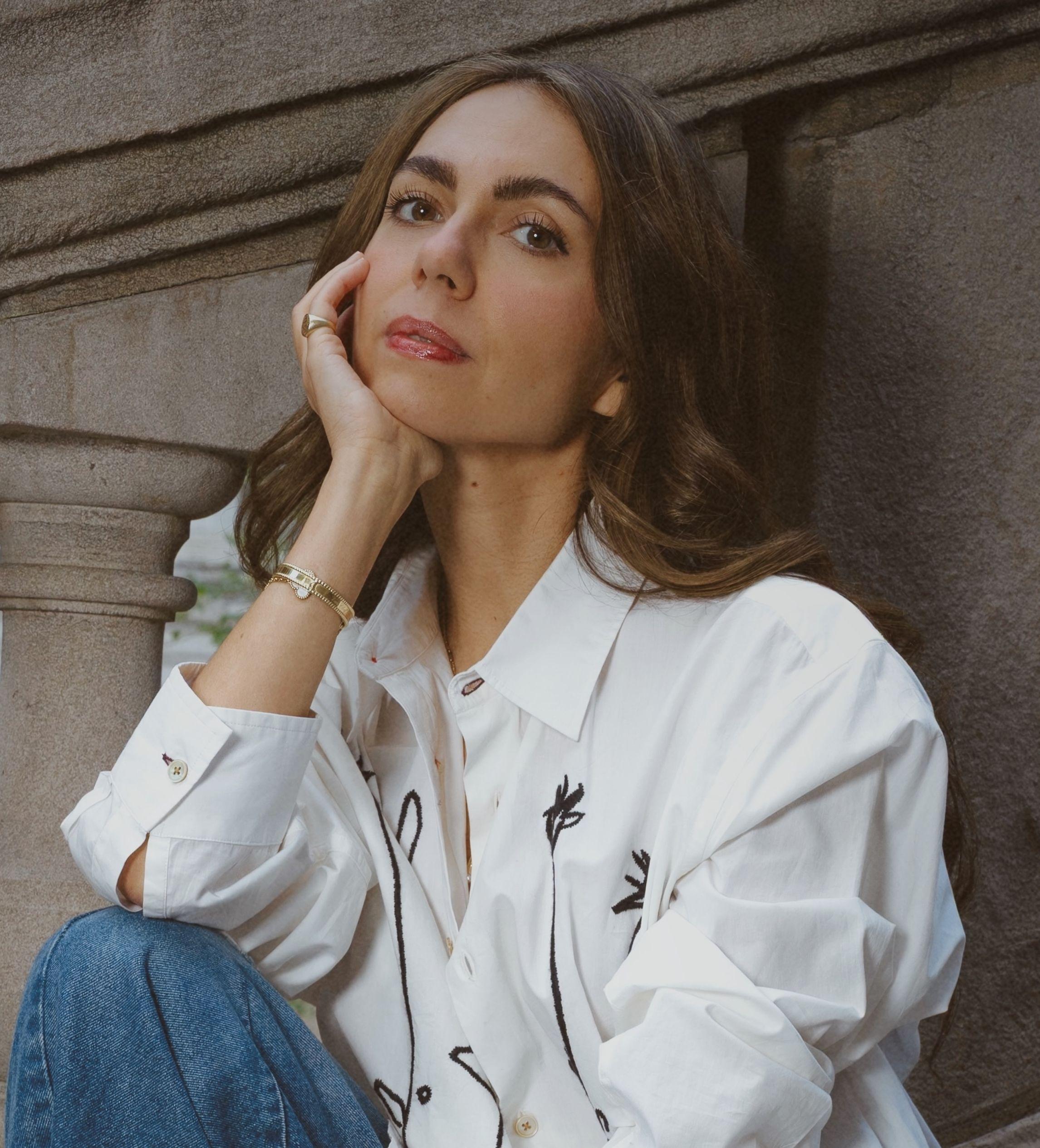
Featured image: Photo of Maya C. Popa by Diana Solís.
LARB Contributor
Elizabeth Metzger is the author of The Going Is Forever (2026) and Lying In (2023), as well as The Spirit Papers (2017), winner of the Juniper Prize for Poetry. She is a poetry editor at the Los Angeles Review of Books and teaches poetry at 92NY and Columbia University.
LARB Staff Recommendations
Scrolling Through Poetry: A Conversation with @poetryisnotaluxury
Elizabeth Metzger interviews anonymous Instagram poetry curator @poetryisnotaluxury.
Draw the Black Straw: On Jean Valentine’s “Light Me Down”
Elizabeth Metzger reviews Jean Valentine’s “Light Me Down: The New & Collected Poems of Jean Valentine.”