A Room Inside Another Room
Alexis Almeida discusses her debut poetry collection ‘Caetano,’ a meditation on family, memory, and language.
By Mónica de la TorreJuly 9, 2026
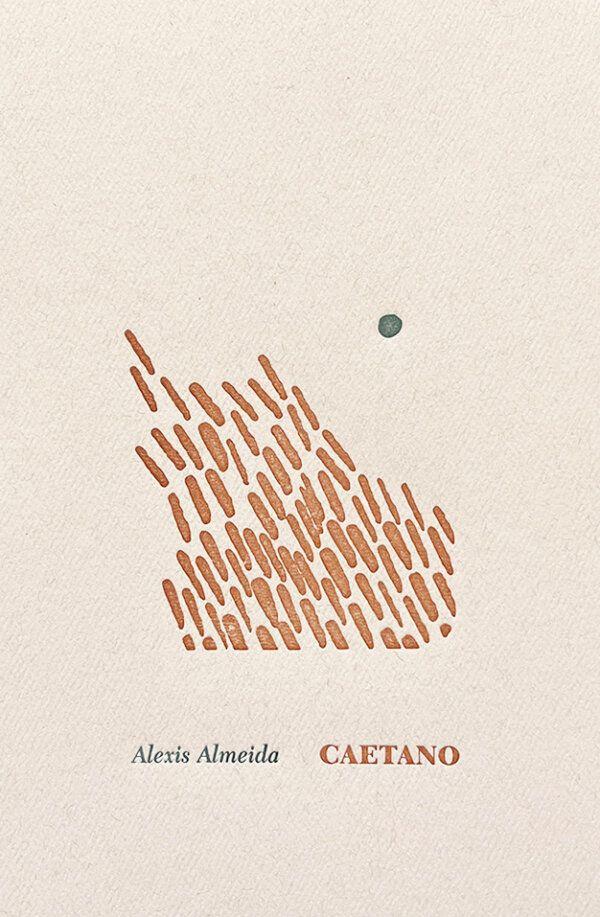
Caetano by Alexis Almeida. Ugly Duckling Presse, 2026. 96 pages.
Did you know LARB is a reader-supported nonprofit?
LARB publishes daily without a paywall as part of our mission to make rigorous, incisive, and engaging writing on every aspect of literature, culture, and the arts freely accessible to the public. Help us continue this work with your tax-deductible donation today!
ALEXIS ALMEIDA’s gorgeous new book, Caetano, published in May by Ugly Duckling Presse, is an ode to repetition and lists that invariably add up to something larger and more mysterious than the sum of their parts. Their straightforward, descriptive titles, such as “Poem in Which You Become the Hands on My Stomach,” “Some Nightmares,” “Some Fantasies,” or “Some Things I Can’t Prove,” never preempt the surprises that follow. In fact, reading Alexis’s poems is like watching a magician tell you what she’s about to do and how she’s going to do it, and then being awed by the trick performed before your very eyes. The poems fold in on themselves and blur the lines between the desire to write and the writing of desire. They collect remnants of experience, dreams, and inner life, and trace how memory and the process of writing conspire to shape them into something different.
“In times of crisis, we must all decide again and again whom we love,” writes Frank O’Hara in one of the poems in Meditations in an Emergency (1957). Caetano shares a similar impulse to reassess the objects of the speaker’s affection, here synonymous with the objects of her attention, and to spell them out for us in poems that celebrate the endless ways of feeling alive.
Alexis and I first met in 2017, back when I was teaching at Brown University. She had just returned to Providence, Rhode Island after spending a year and a half in Buenos Aires on a Fulbright fellowship to research and translate poetry by contemporary Argentinean women. The connection was instant and easy: I invited her to visit a class I was teaching on Latin American avant-garde poetry and have experienced the bounty of her research ever since.
Over the years, I’ve read chapbooks of her poetry—including Things I Have Made a Fiction (winner of Oversound Chapbook Prize, 2024) and I Have Never Been Able to Sing (Ugly Duckling Presse, 2018)—avidly, as well as her translations of essential poets such as Fernanda Laguna and Roberta Iannamico.
In late March, we agreed to have this exchange on a shared Google Doc. It was better that way: had we met in person, it might’ve been a challenge to stay on track.
¤
MONICA DE LA TORRE: I’d like to start with dreams. In a poem that appears in “Photographs,” the first section of the book, you write: “What’s the difference between a poem and a dream? You can write all over one and when no one’s looking the other one still goes on.” I love how the sentence complicates the question and diverts our attention. I’m curious about your answer to the question, though. Can you give it a shot?
ALEXIS ALMEIDA: It took me a long time to write this book. Maybe its most consistent material is dreams, and an obsession with how they might emerge into language, fit into sentences, a sense of duration (or anti-duration), and where a poem might come out of that. I’m not good at distinguishing between genres, so I tend to think everything is a poem, and to me, sentences have always been a great place for poems to begin, live, formulate, root around. When [my son] Ash was born, I tried to make a dream journal. My dreams during pregnancy were really specific: very beautiful, menacing, and full of anxiety. I thought a lot about the split between waking life and dreaming life. I was thinking (reading would come later) a lot about psychoanalysis. So, I thought, I am having this whole other life in my sleep; meanwhile, I wanted to transcribe, to replicate something of the energy (the feeling?) from that “other” life, even if there couldn’t be narrative consistency, or if it seemed impossible. I couldn’t really do it, but this idea of a “split” feels very fundamental to the book. What could go here, in this gap between the two? The idea that desire has its own life in dreams, in general, and the problem of how to fit that desire into language, where things like linear time play a role.
I was also thinking about origins and beginnings a lot as I wrote this manuscript. There’s a kind of split or break in my family lineage that I am always grappling with, and it “begins” or contends in part with names. The book is named for and after my grandfather. A lot about his life in Portugal became somewhat erased when he moved here, at least via some of the silences around him. He went by “Al” because it was easier to pronounce than Caetano, and my grandmother Graciela, who came from Colombia, went by Grace. They didn’t speak Spanish or Portuguese around anyone but each other—they wanted their kids to learn English. I wanted to write into this feeling of splitting, and being part of something that’s also been erased from my past or feels somewhat unknown to me. I think my relationship to Spanish, and my ongoing desire to translate, also has to do with this (as it relates to my grandmother).
The split is felt throughout, but most palpably in the last section, because you switch to the second person. Paradoxically, the section is called “To-Do List, a recent archive.” The speaker has gained a new perspective and recounts what a “you” has been trying to do as of late.
I love that you bring up the parallels between translation and the writing of dreams. One of the elements of dream interpretation and recollection that doesn’t get enough play in Freudian discourse concerns the issue of whether the dream manifests a resistance to narrative. Some dreams are less resistant to being retold or narrated than others. Of course, in dream logic, what lends itself to being narrated easily is mere diversion away from the repressed. Poetry, with its leaps and elisions, is like dreams whose codes are harder to crack. It is dreamlike in its resistance to narrative. You play with this tension in the section of the book called “Things I Have Made a Fiction” where, in trying to describe the mere contents of photographs, you realize the impossibility of this: you can’t help but turn the images into narratives.
Yes, resistance to narrative! I think this resistance to narrative, or being narrativized, apprehended; to closure (via Lyn Hejinian); and yet thinking of the sentence as a place to inhabit physically, to be inside (via Renee Gladman), all felt very important to me while making this book.
I do want to focus on the narrative aspect, though. I actually started thinking about Lacan’s idea of the name of the father (nom du père), or the “no” of the father (non du père) toward the end of writing it, and it’s funny because, while not really having read the essay at the time, I think a lot of the book does orbit its concerns in a way. I may be butchering my understanding of it, but this idea that the figure of the “father,” or anyone of whatever gender, is a figure that regulates desire, that represents the “law” in bringing the child into the symbolic realm/outside world, also exists primarily as a name, pointing to their fundamental absence. It was so fascinating to me. So this present/absent father figure, his symbolic, and also fantastical, function, fueled some of my addressing or writing toward Caetano. I never knew him because he died before I was born. My dad, who felt very close to him, also won’t talk about him much. I wanted to address this gap somehow, and process my own frustration surrounding it. I wanted to resist trying to assimilate him into a clean narrative, but I also wanted to show some of that resistance to assimilation as a broader concept in the way the book was structured. I also wanted to think about love and its more incomprehensible qualities.
The section “Photographs” moves into this fascination with a photograph’s negative. The “negative” of a portrait, the part we don’t see, or the part that’s absent from the image (yet is the image’s blueprint) became really important. Same with the section “I Have Never Been Able to Sing,” which was conceived as an autobiography’s negative. And of course, that relates to translation and its interplay between the original and its reproduction/translation.
What you say about your grandparents is very moving. I didn’t know who Caetano was, and couldn’t help but associate him with Caetano Veloso. The poem “Caetano” is also dreamlike, and doesn’t reveal much about his identity, though now that I know he’s your grandfather, the lines “I found a room / inside another / room, it was / beautiful and bright / and almost big / for me” have gained a whole new meaning. A language inside another language!
A lot of people who haven’t read the book ask me about Caetano Veloso! His music is definitely important to me. I like hearing the Portuguese—it’s a language I want to learn one day. I think with that title poem, maybe I could only address the absence, or my feeling toward Caetano my grandfather in a poem that thinks about space, or trying to inhabit space, and how difficult it is when you’re not sure that space is “yours.”
This reminds me of the opening of one of the poems in “Things I Have Made a Fiction”: “I wrote a book where I was also learning a new language as I wrote, it was language with many new, but not uncommon, words, where I was navigating several stories ending while also becoming a mother.” It’s like you’re learning a new language as you’re learning the language of mothering. Or, as you write in another one of those poems: “I wrote a book about pulling, what is a word when pulled from inside another word, or a sound when shaped from another sound, what is a story pulled from another one.” I love the spiraling logic of this.
I could see you writing a poem riffing off the slippage between Caetano your grandfather and Caetano the musician, with Caetano’s music and language offering you a way into the Caetano you never met.
I like this idea! And I think narratives can also be places, because they can become familiar and played out, defamiliarized. I think about your work as really touching on this, as you sometimes use forms and discourses, like lists, emails, and so on—I’m thinking of Public Domain, which is the first book I read of yours—to explore how the reinterpreting of them, the reusing of them, can make new meaning when the context shifts, or we can look at the narrative itself. I have been really inspired by this, and that you continue to do this.
I find what you do with lists in your book so refreshing. I really admire what you do formally. The lists are not obvious at all; close reading reveals that the supposedly clear rationale behind the collation of disparate elements is full of ambiguity itself. I felt inspired to try some of this out, not remembering that I’ve done some of it myself, which proves my point: you make the list format feel new. And the issue is not unrelated to photography—both lists and photographs involve repetition/reproduction.
Yes, totally. I got Ash a “How Things Work” book and was reading about how laser printers work and it was insane! The printing of the photograph (image from a plate, refracted through a mirror). As a writer, I am obsessed with reproduction, playing, reframing, all these things that stretch narrative beyond its supposed means—the mechanism, the magic in the mechanism, writing about writing, and so on. Also, lists have a kind of simultaneity: they are rooted in the present but also, when they’re in a to-do list form, rely heavily on a speculative future. They feel “neat” and structuring as well, but they become really messy, and they say a lot about desire that doesn’t fit perfectly into an easy form. They are often incomplete by nature. They could go on forever but need to stop.
I once taught a course called “The Poetics of Repetition.” Repetition (and especially anaphora and lists) can function seamlessly as a structuring device imparting only an idea of order, while harnessing wild divergence and discrepancy. By sheer artifice, it makes things seem kind of natural.
I love those sentences of Stein’s: “[T]here is no such thing as repetition […] there can be no repetition because the essence of that expression is insistence.” It makes me think about what we do when we translate, how in repeating we’re insisting on the utterance and on imprinting our own emphases onto the translations. You spoke about Lyn Hejinian and Renee Gladman. Both are very present in the book. I also sense that some of the Argentinean poets you have translated, such as Fernanda Laguna and Roberta Iannamico, are tutelary presences in Caetano. You share an enviable ease and candor in dealing with feelings and emotions. (For instance, I’ve never written a line that states plainly “I love …” and yet you have a whole list of things you love in the poem “Some Things I Love.”) There is also a sense of wonder in the poems—I think of elemental things. Do you feel you gravitated toward their work because of a shared sensibility, or did reading their work open possibilities for you that weren’t as present in contemporary American poetry? Or both?
I wish I could have taken your class! So many of my favorite poets and writers use/practice repetition in different ways … including you. I guess it does make me think about repetition as insistence, in the sense of “trying again,” slipping, even multiplying, and this makes me think of that poem in your book Repetition Nineteen, the one in the airport, with the words underlined that can potentially form their own poem. Creative misreadings, mistranslations, permutations—they deconstruct language, make it performative, sonic, material. This is something you do so well. I was curious as you were talking about what brought you to these concerns in your own work. Something great about teaching is that you can return to your favorites—though the students don’t always know it—and I’m curious about whom you return to over and over.
I think wonder is an important, necessary element for me, to counterbalance my interest in the mechanics of language, the way a sentence works, writing about writing, and when I translate, I think I am inevitably drawn to people who write, at least in part, from that place, which Fernanda and Roberta certainly do, though so differently! Roberta’s use of elemental things in her poems—insects, stars, kitchens, grass—her mixture of light with more ominous tones, has really added so much to a sense of what I love in poems. Fernanda is more confrontational and flamboyant, and I love that too. Translating them has definitely changed something about how I write—I’ve also had the experience of translating authors I feel no stylistic affinity with, even recently, which is also interesting. I’m curious if this influence (and its pleasures/anxieties) happens to you when you translate? Also, when you edit something like your anthology Women in Concrete Poetry 1959–1979, which involves so much archival work too, and analysis. Were you drawn to this project because of its proximity to your interests/practices?
In brief, yes. I’ve done scholarly research on concrete and post-concrete poetry in Latin America especially, but I don’t think my own poetry engages those modes much. I feel that my super-close relationship to that work, through studying and translating it, releases me from having to write it.
But about Repetition Nineteen, the impetus for the poems at the core of the book certainly had to do with reframing impossibility and error, both inextricable from translation. This also relates to the split you mentioned earlier. When I first moved here, I didn’t know if I’d continue writing in Spanish while I was becoming immersed in English-speaking communities and trying out writing poems in English. All of a sudden, my primary language became distant, eerie, and new. I wrote a lot of poems I couldn’t have written in Mexico, which eventually became my first book, Acúfenos. Trying to translate them straightforwardly always led to frustration, because the poems would feel dead to me in English. Years passed, and then, after reading a lot of translation essays and theory (of which my favorite is Anne Carson’s “Variations on the Right to Remain Silent”) and also books such as Christian Hawkey’s Ventrakl, Sawako Nakayasu’s Mouth: Eats Color, and Eliot Weinberger’s Nineteen Ways of Looking at Wang Wei, I realized that one of the poems in my book, “Equivalencias,” lent itself perfectly to multiple translation approaches that would keep spawning new zombie versions of my original poem.
All this is to say that I’m drawn to the process of working through memory; when you want an experience to repeat, you can’t just simply will it into being again. As with a translation, it has to be recreated, emphasis on created, and from the doing all over again, something new inevitably emerges. As translators, we get to do that over and over, and it’s an utter joy on an intellectual and physical level. Which brings me to your writing. So much of it pays attention to how the impulse to write actually feels in the body. I love those swirls you describe, and how you shape sentences following the pulls of those drives—yet you primarily work in prose blocks. Can you talk a little bit about the body and its relationship to form in your writing?
I love your poem “Equivalencias”—you read it at Segue recently, and I immediately started writing something in response to it.
It’s really meaningful that repetition has come up so much here. I think what makes repetition so compelling to me is that it’s felt deeply in the body. There is, of course, the idea of repetition compulsion, but I’m more drawn to this idea that when repetition is heard, spoken, or read, you feel it inside you, and it makes space there. It’s about wanting. Renee Gladman says in her new book Theory for Moving Houses that Ravicka, the city-state she writes about in her Ravicka novels, “comes from needing a stage, a space to think.” Sentences make something rhythmic and deeply felt that I’m really interested in. I like the idea that sentences can be tactile and translucent, that their progression isn’t always just linear, that they hold many things at once.
¤
Alexis Almeida is the author of I Have Never Been Able to Sing (Ugly Duckling Presse, 2018), and Things I Have Made a Fiction (winner of the Oversound Chapbook Prize, 2024). She is most recently the translator of Roberta Iannamico’s Many Poems (The Song Cave, 2025), and her translation of Laura Fernández’s There’s a Monster in the Lake will be out with Graywolf in late 2026. She lives in New York and edits 18 Owls Press.
LARB Contributor
Mónica de la Torre’s seven poetry books include Pause the Document (2025), Repetition Nineteen (2020), The Happy End / All Welcome (2017), and two collections in Spanish published in her native Mexico City. She teaches poetry and translation at Brooklyn College.
LARB Staff Recommendations
Mortal Urges
Three recent translations of Milo De Angelis, Jean Follain, and Vidyā will fill their reader with welcome weirdness.
Time to Get Out of Yourself
Patricio Ferrari interviews award-winning poet Victoria Chang on the occasion of her Limelight Poetry reading at the New York Public Library.