Consequences Accrue Downstream
The ongoing fight to restore the Colorado River Delta.
By Ash SandersJuly 5, 2026

Did you know LARB is a reader-supported nonprofit?
LARB publishes daily without a paywall as part of our mission to make rigorous, incisive, and engaging writing on every aspect of literature, culture, and the arts freely accessible to the public. Help us continue this work with your tax-deductible donation today!
WHEN THE FAMOUS conservationist and writer Aldo Leopold first visited the Colorado River Delta in 1922, he found a river so vast and braiding that he described it as “nowhere and everywhere.” Leopold started his journey in the Mexican state of Sonora, just southeast of Mexicali. Along with his brother, he maneuvered his small canoe through what was then one of the richest ecosystems in North America. Cottonwoods rose out of mudflats, white herons snowed the bushes on the banks, and the river seemed to tease them—going backward and forward, left and right—before finally pouring itself into the sea.
It was a land, Leopold said, of green lagoons. It was bird country. Jaguar country. God’s country.
The Colorado River had worked hard to get there, beginning in the high snowfields of the Rocky Mountains before gaining force and cutting its way across the Southwest for nearly 1,500 miles. At the US-Mexico border, it loosened into the delta before spilling into the Gulf of California, dropping silt and breaking into any number of channels—a fan of water moving outward instead of forward.
Leopold fell in love with the delta—but he never returned. In his famous book about wild places, A Sand County Almanac (1949), he vowed to stay away. “It is the part of wisdom never to revisit a wilderness,” he warned, his conservationist’s exhaustion already palpable. “Man always kills the thing he loves, and so we the pioneers have killed our wilderness.”
It’s a good thing Leopold never went back to the delta. If he’d returned anytime after the turn of the century—the period newspapers call “the megadrought” and scientists call “the driest period in over a millennium”—he would not have found a delta. In its place, he’d find a border wall and, next to that, a dam. If he stood at that border dam—his right foot in the country where the river begins and his left in the country where it ends, one in a place that takes water and one in a place where water is largely taken from—he would see what had once been his vast and beloved estuary end in dust north of Mexicali: its waters captured by Hoover and Glen Canyon dams, its flow promised many times over to cities and farms upstream in the United States.
Or maybe, God forbid, he’d come back as a bird. He’d begin his migration in the far north and make his way thousands of miles to the tip of Argentina. As he flew, he would scan the ground for places to rest and feed, and would seldom find them. From southern Canada on down, it would be pavement, subdivisions, and more pavement. In a word: starvation. When he came to the muddy waters of the Colorado he’d see a tapped red vein, dive for fish and come up empty. As he reached Mexico, he’d relax a little, expecting miles of tidal floodplains teeming with the usual life. Instead, he would find only sand. Perhaps he would be one of the pelicans who drop from the air each year, emaciated and consumed by thirst, and land on the sidewalks of Mexicali. Dead.
Perhaps not, though. Perhaps he’d find himself in a bolo tie and cowboy boots in a room off a casino conference center in Las Vegas. A cowboy politician. The rooms would be invite-only, with heavy doors that closed to the public. Inside those rooms, he’d hear the same warning that the seven US states that depend on the river have been hearing for decades now: the Colorado could collapse as soon as next year. You need to make water cuts. Big ones. Bleeding ones. If you don’t, federal takeover. If you don’t, Supreme Court. If you don’t, dry reservoirs and no water downstream. Phoenix, Los Angeles, Las Vegas: going, going, gone. Nearly all the country’s winter vegetables, dry and dusty on the vine.
If he stayed in that room, he would see that despite the federal demand to make cuts, despite the urgency, despite the consequences, the states—each fighting for the last drop in a river they view as theirs, theirs, theirs—would not comply.
If Leopold dared to bring up the delta, he would face a firing line of pragmatists. Face it, they’d tell him. This river hasn’t reached the sea in decades. For as long as most people can remember, it has simply disappeared in the desert. It seems like anyone who ever cared about the delta has given up on it, but that’s not entirely true. Because down south, in this newly parched country, there are people who believe, utterly and unreservedly, that this river can be brought back from the dead. And one of them is Francisco Zamora.
¤
Francisco Zamora had barely heard of the Colorado River before he tried to bring it back from the dead. As a kid growing up in Mexico City, he didn’t think much about anything west of himself. What he thought about was Flipper the dolphin and Jacques Cousteau. He was obsessed with Calypso, Cousteau’s famous seafaring vessel, and hoped he’d grow up to captain his own ship, exploring the ocean and deciphering its mysteries. He did not think his life’s purpose would strike him in a rubber boat in an otherwise barren land.
But that is exactly how Zamora first came to know the Colorado River—and almost to wish he hadn’t. In 1998, Zamora and some of his conservation buddies decided to visit the delta. At the time, it had been mostly dry for decades. But that year, massive El Niño rains had caused the river to surge back into its old bed, pushing water down dry channels all the way to the Gulf of California. For the first time in a long time, it was possible to get on a boat in the delta. Zamora—a budding conservationist himself—had read Aldo Leopold’s “Green Lagoons” essay; now, he realized, he had a once-in-a-lifetime chance to recreate it.
At noon, Zamora and his friends slipped their boat into the water at Laguna Grande, a meander halfway between the border and the estuary. They planned to travel 10 miles downstream and finish by four. But that timetable turned out to be a fantasy. Stands of invasive salt cedar choked the usual routes, and the river wasn’t strong enough to push its way through. For hours, Zamora and his colleagues bushwhacked, probed, and otherwise fought their way downstream as the sun dropped in the sky. At four o’clock they were only a couple of miles in. It was clear they would be spending the night. Cold and hungry, they reserved the few cans of cola and crackers they had, shivering all night in their little craft. In the morning, desperate, they thought they heard a motor. Zamora had an idea. He threw up his cola can and shouted, hoping to catch some attention. The can caught some light and the eyes of some Cocopah Indians downriver. They came to get them—a rescue that took hours.
As he waited, Zamora had a lot of time to consider what even a small shock of water could do for a devastated delta. The rains that preceded him had seeded willows and other native species, and the banks were already lined with green. There was water pulsing in the riverbed, birds were swooping everywhere, and beavers were emerging shyly in the shallows. Even after the floods receded and the river dried up, Zamora was stunned by the impact. Cottonwoods reclaimed their old habitats, willows grew and waved on the shore, and birds stayed as long as they were able. He had seen the river with Leopold’s green lagoons, he said, and he’d seen it without them. He preferred the green lagoons.
The whole experience made Zamora wonder: What could a small but reliable supply of water do for the delta ecosystem as a whole? Was this river really gone? Or could it return?
Maybe it was watching all that Cousteau as a kid, and the attendant belief that a man who loved water could do impossible things. Or maybe it was that, waiting on that boat for rescue, he’d thought a lot about thirst and a lot about death. Either way, as soon as Zamora got back from that trip, he was a man on a mission. Together with the Sonoran Institute—a conservation organization where Zamora eventually rose to the position of senior director of programs—and a handful of river advocates on either side of the border, he embarked on a plan to bring one of North America’s most important and imperiled rivers back from the dead.
At the time, every drop of the Colorado River was claimed and tightly controlled—and every drop was reserved for human use. In the United States and Mexico, there was no way to give the river water without breaking the legal system that governed it. So, Zamora and his colleagues proposed a new solution, as simple as it was delusional: What if both countries signed a treaty that redirected one percent of the river’s yearly flow back to the delta? What if, after decades of drought and desiccation, this ancient river could once again flow through a living delta and on to the sea?
The idea was unprecedented. And the timing was terrible. The Southwest was getting drier by the minute, and no one was in the mood to share water. Finally, after knocking on government door after government door, Zamora and his crew secured RSVPs from hundreds of water bigwigs for a summit on the delta’s future. The date? September 11, 2001.
It took years of begging, badgering, and hard-bitten belief. But in 2012, the United States and Mexico signed Minute 319, a binding binational agreement that gave water to the river for its own sake. Two years later, the manager at the Morelos Dam lifted a headgate and sent water downstream. For one of the first times since the delta went dry in 1964, a blue finger of water flowed over miles of baked country and touched the sea.
¤
The year I was born, it snowed and didn’t stop. In the winter of 1982, the mountains that ring the Salt Lake Valley received record piles of the stuff. That spring, there was a great and expeditious melting. While I sat in my baby pen and teethed my plastic toys, the streets of Salt Lake City turned to flume. Mormon churchmen in ties flocked to State Street and stacked up sandbags just so, channeling an impromptu river on its course. People hauled kayaks from their garages and paddled down a web of water. The Great Salt Lake breached its banks, sending its salty water to mingle with the fresh. People worried that the city could go under. Down south, Lake Powell was so full that Glen Canyon Dam was cavitating; at any moment it might have given up, obliterating every major city south of the Grand Canyon. Sometimes, late at night, I think about that.
These were the fat years. The water years. And we believed, more than we believed anything, that the years would always be fat. On the shore of the Great Salt Lake, we installed pumps that would suck away excess water the next time there was a flood. We said that word, flood. And we meant it. Felt the water on our tongues.
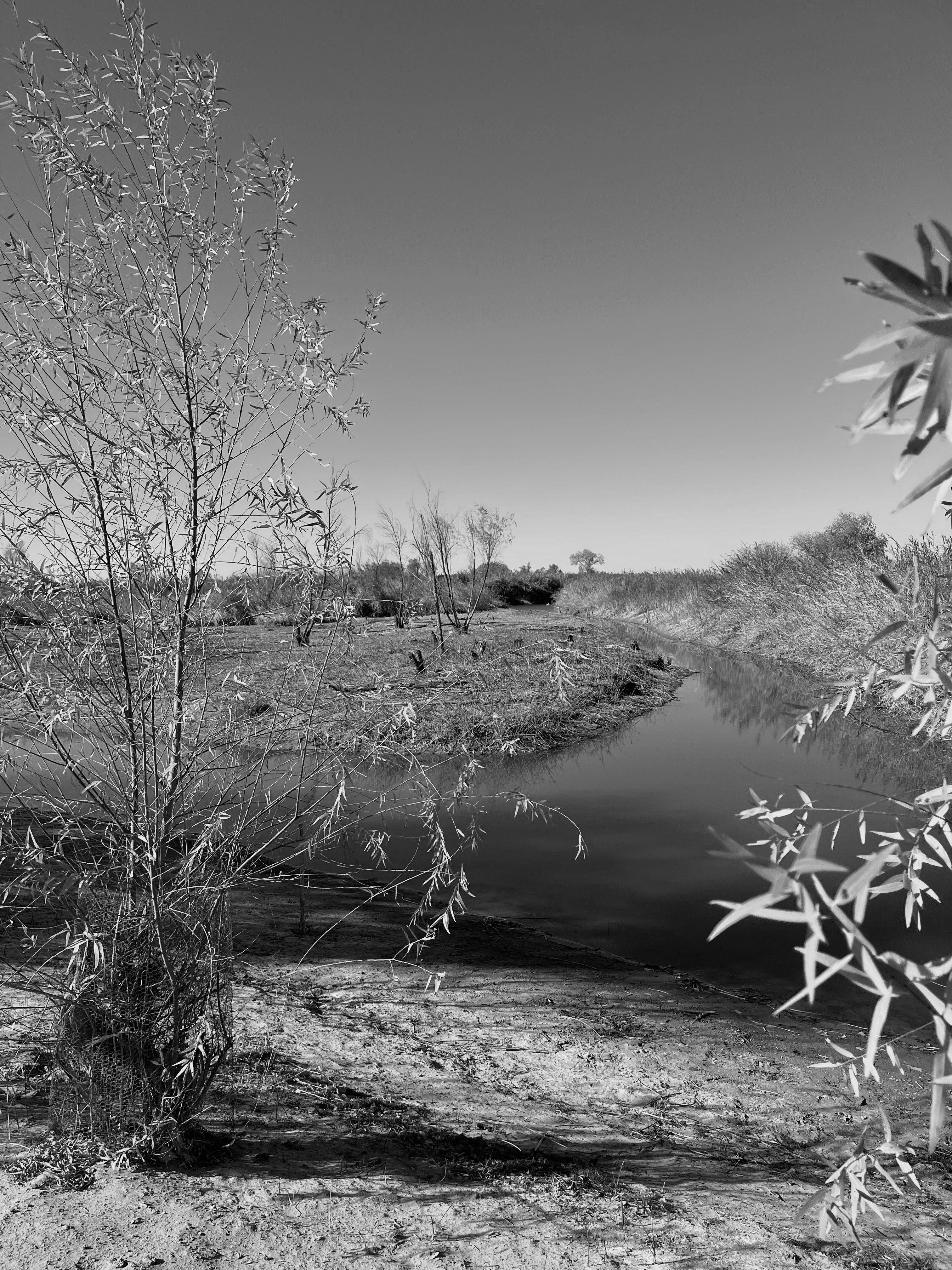
The restoration site at Laguna Grande. Photo by Abigail Keel.
After the fat years came the Lenten and the lean. Starting in 2000, we entered what is now, rightly and apocalyptically, referred to as the megadrought. Climate change reduced snowpack, then dried the ground the snowpack once watered. Reservoir levels at lakes Powell and Mead plummeted and kept plummeting. Whenever we thought we’d reached the floor, we found a cellar underneath. By 2022, no one could ignore the facts. There was no snow, and none coming. By the spring, the dams could stop functioning, and water would no longer flow downstream. Taps in L.A., Las Vegas, and Phoenix could go dry.
Reading the news, I was terrified. My hometown of Salt Lake City could become a dusty miasma in my lifetime, its salty lake reduced to rime, the Colorado River dry and panting. I wanted to know what was happening to this river, why no one seemed interested in stopping it, and why—despite the worsening water crisis—we were so intent on destroying what we depended on. And so I got on a boat. For the next two years, my best friend and fellow journalist Abigail Keel and I would raft every section of the Colorado we could, starting in the mountains of Wyoming and ending in Mexico. We named our project “Mirage,” after the deluded human habit of seeing water in the desert.
There’s a photo of me at the top of the river. There’s snow on the ground, and I’m swaddled in layers of neoprene and wool. I’m holding the portable river toilet and pointing to a sticker someone has slapped on its front. “I know I like to think that my shit don’t stink,” it says. Exactly, I think. Our problem exactly.
It has taken two years of on-again, off-again rafting to make it to the US-Mexico border. We’re here to see the place where the river dies—and to meet the advocates who are trying to bring it back.
For two weeks now, Abigail and I have been traveling the southern river with two friends and river experts, Zak Podmore and John Weisheit. We started just below Hoover Dam and headed south, but wind, logistics, and forest fires have scuttled the trip. Mostly, we’ve been in casinos, gambling and talking about water. Playing craps one night, I ask Zak—kayaker, writer, and a top-shelf water thinker—to explain why we killed an entire river delta and now seem intent on killing the river itself. Are we playing craps with our future? I joke.
But Zak thinks that’s the wrong comparison. We’re not gamblers, he says; we’re gambling addicts. A gambler takes stupid risks out of greed. But what the addict wants, beneath all the other wanting, is to lose everything—to know, as Zak puts it in one of his books, “that the game, however destructive, has been carried through to its absolute conclusion.” We want to dig a pit and then we want to hit its bottom. We want to kill things because we want, on some level, to die.
Now our trip is almost over. Zak is headed home to Utah but has offered to chauffeur us to the border. Here, the desert has been shocked into green hysterics by a vast system of irrigation ditches that pull water out of the Colorado and onto fields. Zak explains that from the its source to Hoover Dam, the Colorado is getting bigger—fed by snowmelt and tributaries. But Hoover Dam is the fulcrum. After that, the river gets smaller. Some of it is sucked away by Las Vegas, Los Angeles, and Phoenix. Three-quarters of it goes to agriculture, most of which is used to grow alfalfa to feed cows that will be slaughtered for meat or milked for dairy. By the time it nears the border, it runs mainly in ditches and long concrete funnels, feeding brassicas and lettuces near Yuma. Death by a thousand canals, Zak says.
I ask Zak if he thinks the states will ever part with enough water to truly restore the delta. Zak shrugs. The problem is that no amount of water is enough. If we had double the river, we’d use double the water, he says. We’re like that.
Zak drops us off in front of a dusty McDonald’s. Somewhere in the heat, Linda Ronstadt is playing: “I’m going back someday, come what may, to Blue Bayou.” I laugh because, come on, seriously? Then Zak hands us the leftover peanut butter, and he’s gone.
At the border, we’re waved through by armed guards and into the city of San Luis Río Colorado. A news alert flashes on my phone. As climate cranks up the heat across the globe, fossil-fuel companies are quietly investing in the coolant industry. As we wait for our driver, David, I realize that I, too, would like to invest in the coolant industry: it is spring, but here that means 100 degrees. Then David appears, motioning us toward the car. As we drive, we talk through Google Translate. Did he grow up here? Yes. When the river was big? No. What are those fields? Cotton. Date palms. Mile after mile of lettuce.
¤
We first meet Francisco Zamora at the Marriott’s continental breakfast bar in Mexicali. A small, spry man, he looks like a guy who might prefer the company of animals—not someone who badgered two often-at-odds nations to negotiate a first-of-its-kind treaty to give one percent of a threatened river’s water back to the environment. When he speaks, it’s hard to hear him over the news on the TV above us. There, the ticker metes out the latest treacheries of the Trump administration. Harvard has just capitulated on DEI. A barely-adult known as “Big Balls” is acting as the spearpoint at the end of the Department of Government Efficiency’s stick, cutting federal jobs and slashing philanthropic funding. Zamora confirms that it’s been hard to get the usual grants for restoration and worries his toast with butter. But the biggest news here lately is, as always, about water. The week before, Mexico had defaulted on its water deliveries to the United States. In response, Trump had threatened them with tariffs and claimed—tit for tat—that he would refuse to deliver Colorado River water to Tijuana. The move touched on an old desert terror: that dwindling water could spark a resource war. Still, the drought-stricken Mexican farmers said, you can’t deliver water that doesn’t exist.
Zamora’s restoration efforts rest entirely on whether the United States and Mexico will continue to dedicate part of the Colorado’s flow to the delta. In 2026, the two countries will come together with federal agencies, states, and tribes to renegotiate that treaty. Abigail and I are partly here to see what Zamora has done with his first decade of delta water deliveries. But we’re also here because we’re worried. At a time when farmers are defaulting on water agreements and US states are refusing to make government-mandated cuts, can Zamora and his fellow visionaries count on people valuing the river for its own sake?
But we’re not talking about that yet. Last month, the government released another flow of water to the delta. This one wasn’t as big or dramatic as the first one, but for weeks, water has been finding its way southward. And today we’re going to try to find it. Zamora grabs a napkin and starts sketching. The Colorado used to fan out as it approached where we are now, he says. You didn’t have to look for it because it was everywhere. But today we will be looking for it. We’re going to the upper estuary, he tells us—the place where, historically at least, the freshwater river mixed with the incoming tides and created a fertile liminal zone full of fish, dolphins, and birds. He makes a mark on the paper halfway between Mexicali and the Gulf of California. Somewhere around here, he says.
¤
For more than five million years, the Colorado River flowed from the high country of modern-day Wyoming and Colorado, down the red rock canyons of the Utah desert, flooding the future site of our Marriott and its continental breakfasts, and on toward the sea. For five million years, it pushed sediment in front of it and left fertility in its wake, food for the fish and animals that swam and skulked in its reaches.
I’m trying to tell you something important. I’m trying to tell you that this river has existed 16 times longer than Homo sapiens has walked the earth, and that the places that remember its youth are way beyond our oldest memories. I am trying to say that for five million years, this river made the conditions of its own survival, and in doing that, it made a world.
It took humans just 100 years to unmake what nature had created. In 1922—the same year Aldo Leopold drifted through the delta and wrote of the human urge to destroy what we love—a group of white men met in a lodge in New Mexico and divided the river among themselves. Guided by a water doctrine as blunt as it was enduring—first come, first served—they parceled out flows that did not exist, in quantities the river could not sustain, and claimed them as rights. There was no allocation for Mexico. None for the dozens of tribes who lived along its banks. None for the river itself. As Jennifer Pitt, Zamora’s colleague and the Colorado River program director at the National Audubon Society says, Western water law has always been a machine for extraction: a way to move water out of the river and into pipes, out of Indigenous hands and onto settler lands. In this worldview, a river has no value beyond its use. And so, as Leopold warned, the river itself has been sacrificed completely.
There’s a saying about Mexico, Pitt says. So far from God, so close to the United States. Down here, people have to live with what people do north of them. Consequences, Pitt says, accrue downstream.
As we leave the hotel, the sun is so hot, my body feels like a ringing bell. I understand what Pitt means: this is consequence country.
¤
The mark that Zamora put on the map is, it turns out, an estimate. In the parking lot outside our hotel, we climb into Zamora’s work truck and head south. A Sonoran Institute field scientist is at the wheel. This man knows this place better than anyone. But knowing it one day is not the same as knowing it the next; the river isn’t the river it used to be. And even with the latest water delivery, it is hard to know if the river will reach the estuary at all. For decades, Zamora said, the river and the sea were like two fingers trying to touch but rarely succeeding. Even when they did succeed, the river picked its own course among the otherwise-devastated landscape, making channels, then changing its mind and making more.
We drive one direction, then reverse and drive another. The field scientist checks the GPS, and checks again. When we see water, we point excitedly. Is that the river? we ask. No, just seepage, he says. What about that? we say. Zamora looks hard into the distance. It could be, he says. It could be.
The truth is, no one knows where the river is on any given day. More often than not, delta scientists measure connectivity rather than observe it. They sample water at different points around the estuary. If the water is too salty, it means the river hasn’t arrived yet. If it’s medium salty, it means the river and the sea have met.
I’ll admit, when I heard that advocates were restoring the delta, I imagined a lush network of wetlands—not a mudflat with pockets of water that may or may not be the river. And I’ll admit the question crossed my mind: If most people don’t even remember the river, and the people who have fought so hard to restore it don’t even know if it’s here—does it matter that it is?
I think of a paper I read recently about a team of Australian scientists who were trying to determine if the red handfish—a clown-like creature nearly exterminated by warming oceans and industrial dredging—was still alive off the coast of southern Australia. To find out, the scientists collected vast samples of seawater and scanned them for trace DNA left behind by fish scales and bones. If the water contained traces of red handfish, the species might still be alive. Finding the Colorado River Delta felt like that too. If you cannot find the actual thing, look for its ghost.
So you’re a river detective, I joke to Zamora. Yes, he nods, a river detective.
¤
As we search for the river, I ask Zamora if he thinks that the treaty will be renewed. Zamora nods so hard that he seems to reconvince himself. Yes, he says, the people need this river. But what about climate change? I ask. The failed negotiations? The population boom in Mexicali? Will people really share water with the river?
Zamora smiles. He admits he is an optimist, maybe even delusionally so. When his colleagues send him reports on the millennium drought, he says, he waves them away. Who knows, he says, maybe the drought will end. It’s the sort of thing that exasperates realists and climate modelers in equal measure. But it’s the exact sort of mentality someone would need to sell a living river to people who have a hundred more pressing reasons to suck it dry. Sometimes when people see him coming, Zamora says, they run and hide. Oh no, they say. Here comes Francisco with another crazy idea!
¤
Jennifer Pitt was there the day they lifted the headgates at Morelos Dam and sent water back into the delta for the first time in decades. Alongside Zamora and other colleagues in a coalition called Raise the River, she’d been working for this moment most of her adult life. Part of the obsession had come from a lifelong enchantment with nature. She is, she tells us one day over the phone, continually besotted with the physical world. But she’d also fought to bring back the delta because she had to. Seventy percent of the delta’s wildlife depends on this river system, she says. Losing it was never an option.
On the morning of the first big water delivery—what Raise the River calls the “pulse flow”—Pitt stood near the dam with a crowd of longtime friends and river advocates, their champagne glasses glinting in the sun. When the first gate opened, she says, there was a froth of bubbles, and everyone started hooting and hollering. Pitt considered pinching herself. It’s real, she kept thinking. It’s really happening.
The scene itself wasn’t all that dramatic, though. To protect the dam, managers could only release a little of the water at a time, and a lot of the water they did release was sucked right back into the parched desert sand. There was a woman who was monitoring the river as it moved using a handheld device, Pitt says. Let’s just say she wasn’t running.
The reality of what she and her colleagues had accomplished didn’t hit Pitt until a few days later when the water reached the border town of San Luis Río Colorado. The town had been named for the river when there was still a river to be named for, but water hadn’t flowed here in any meaningful way for decades. Pitt and her crew had planned to kayak the river as it moved through town. But when she got there, something else was already happening. Raise the River had a saying about restoring the delta: they were connecting people to the river and connecting the river to the sea. It had always sounded like a nice idea. In San Luis, Pitt saw what it meant.
Unbidden, the entire community had come to the river to celebrate its return. Kids played and shouted in the water. A girl lay on her belly as water foamed around her. Rumor had it that there were beavers around, which meant that there had been beavers here all this time, surviving somehow in the dryness and the heat, waiting, like everyone else, for the water to return. There were vendors selling tacos and families barbecuing and music blaring from stereos. Pitt saw a man walk by in waders with a fishing net. Good luck with that, she thought. An hour later, the same man walked by again, his net bulging with fish.
Pitt saw a family approach the river, dressed in nice clothes. They stood there for a moment, watching. Then the grandfather went to the bank, knelt, and put his hands in the water, Pitt said. It looked like prayer.
That was exactly what Pitt felt like doing. The river was back, she says. I just wanted to touch it.
That’s when Raise the River’s slogan clicked. People needed this river, she realized—not simply for drinking or for farming but for its own sake. Most of the people at this spontaneous festival had never seen the Colorado River. Some didn’t know it had ever existed. But like the beavers now playing in the shallows of the pulse flow, they had been waiting for the water to come and make sense of them again.
There’s a saying in the New Testament, Pitt says, that all rivers run to the sea. And what she saw in San Luis helped her understand something. When rivers don’t run into the ocean anymore, people feel it, she says. They feel the injury.
¤
The nature writer Barry Lopez wrote that existential loneliness and purposelessness are directly linked with a lost relationship to place. Conversely, he notes, committing to knowing a place “undermines the feeling that one is alone in the world, or meaningless in it.” This is not the same love that Leopold wrote of—a love that destroys the thing it loves. It is a process in which a person determines to know a place, Lopez writes, and so “begins to sense that they themselves are becoming known, so that when they are absent from that place they know that place misses them.” Here, love is an act of reciprocity. The reward, according to Lopez, is the feeling “that one is necessary in the world.”
It is hard to write a report about why we need living rivers, but it is obvious to anyone who has ever stood by one. What wrecks that utterly obvious knowledge is the story we tell ourselves after we stand by the river. The belief that love is possession.
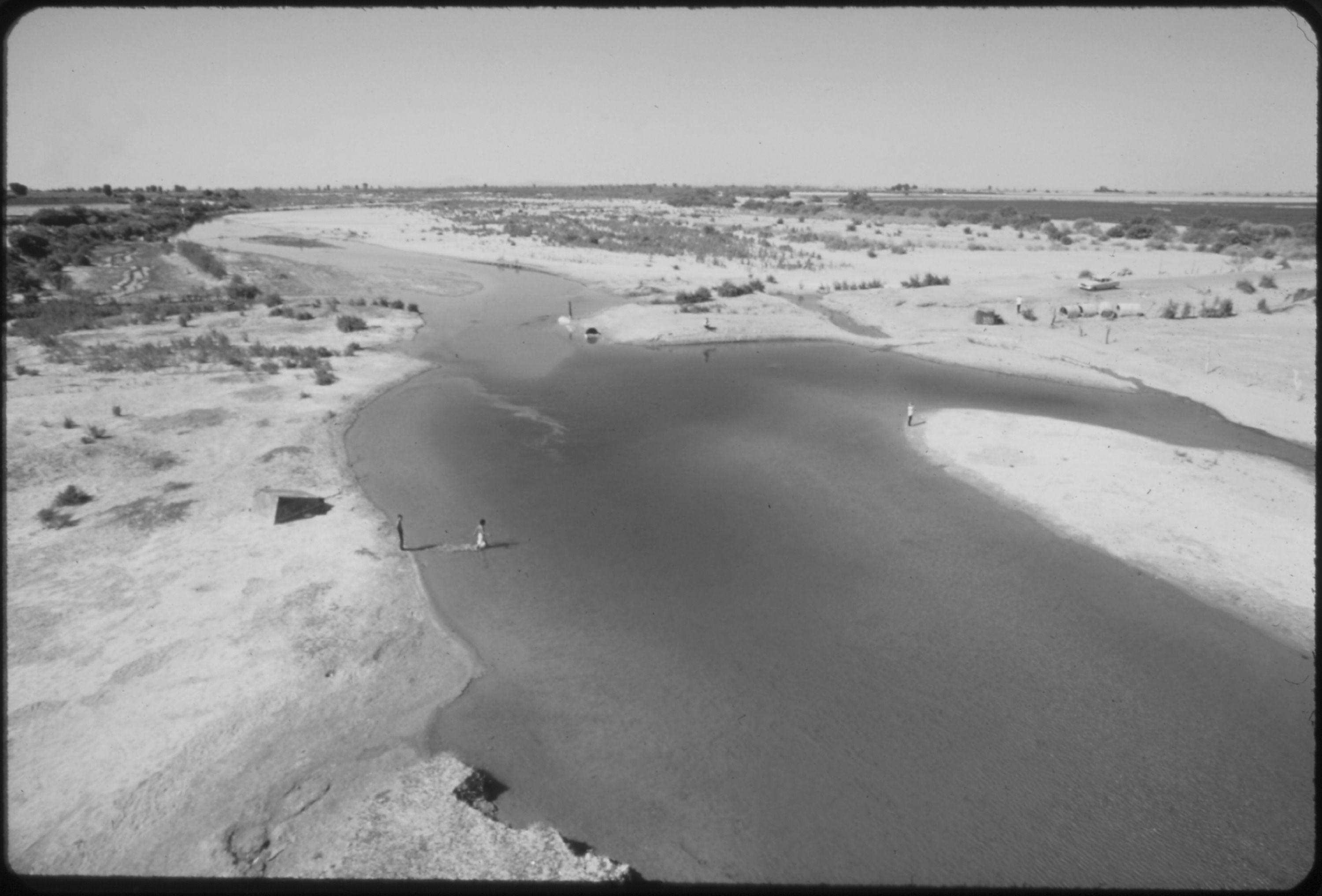
Charles O’Rear, Colorado River at Mexican Border, 1972, for the Environmental Protection Agency, public domain. Originally in color.
Enrique Villegas once hid from Zamora’s insistent door-knocking. Villegas works for the Sonoran Institute now, but in those days, he was a government official with sway over what happened in the delta. He knew Zamora and respected his work, but when Zamora popped in and proposed a massive restoration of an effectively dead ecosystem, Villegas balked. If Zamora is an inveterate optimist, Villegas describes himself as a realist. It’s not so much that he sees that the glass is half empty; he sees the glass as it is, which, in the case of this arid desert, is empty.
Still, Villegas knew Zamora from back in the day, and he knew his science was good. So Villegas was confused. I wanted to think he was crazy, he says, but I knew he wasn’t crazy. So I didn’t know what to think. At that moment, Villegas gave Zamora what amounted to a pat on the back. He told him he’d do what he could, and he did. But he didn’t expect much.
We’re driving on a dusty desert road when Villegas tells us this—on our way to visit the Sonoran Institute’s restoration site at Laguna Grande. Earlier that morning, Abigail and I had met Villegas at the Sonoran Institute headquarters. The grounds had been quiet, even shady, but when we drove out of the gate, the sun hit us like a gavel. It was 9:00 a.m. and already 95 degrees. And this was only April.
We ask Villegas if he hates the heat. He tells us you get used to it. If you’re human, you can sit inside all summer and crank your AC. It’s the animals he worries about. The birds and the beavers. Insects too.
The word “insect” surprises me. We talk about climate change in terms of water, heat, and charismatic megafauna. Rarely do we fret for small, innumerable lives that make a place function. It must be awful, I think, to care about things no one notices and no one sees disappearing. But that’s the work in the delta: to care about the invisible and the unimportant, the places already lost to memory.
Villegas is a scientist, but the speed and scale of the climate crisis here caught him off guard despite his training. The models predicted crises both hot and dry, but seeing them land was altogether different. It happened little by little, Villegas says, like the story about those frogs who were boiled one degree at a time. Now temperatures are soaring, the population is booming, and the promised water cuts have arrived. In 2023, the water levels at Lake Mead dropped to record lows, triggering shortages in Mexico. We thought this day would never come, says Villegas, but now the wolf is at our door.
I understand the subtext. Just as this river is coming back to life, it could die again. But I’m also thinking about all his animal metaphors. The frogs boiling. The wolves sniffing. Do these metaphors betray our deepest fears: that what we have done to the natural world will finally be done to us?
As we drive to Laguna Grande, Villegas describes what would have been here before, when the river was free and full. No one alive today has seen that river, he says, but there are photos. Giant boats used to chug 60 miles up from the mouth of the river all the way to what is now Yuma, Arizona. There was a port there, he says. A port. We all shake our heads.
We cross a small bridge, with a small slosh of water moving under it. That’s the river, Villegas says. That’s what’s left of the delta. He points toward a tired old sign. “El Faro,” it reads. El Faro means lighthouse. We are looking at what used to be a lighthouse.
None of us can imagine it, and so we start laughing. And that’s standard. Climate change, after all, hasn’t just devastated landscapes. It has also devastated our sense of history and our understanding of place. It’s hard to think about what was here before, we all agree, which makes it harder to imagine what could be here again. For Villegas, this is the entire point. As a kid growing up in Mexicali, the only thing he’d ever known was a dry delta. The river was just an abstraction, a line on an outdated textbook map. And so when Zamora came to him and talked about a river, he couldn’t grasp it. How was I supposed to imagine something I’d never seen before? he asks us. Something that had never been done?
This is one of the big reasons Villegas quit his government job to work for the Sonoran Institute. For him, the demonstration sites are aptly named. They are places where you can show people another world—where you can show people what is possible. When he gives people the facts and figures behind the delta restoration, Villegas says, people respond like he used to. We need water for crops and cities, they say. What does the institute want it for—beavers and birds? But when you enter a site—when you see it and smell it, when a vermilion flycatcher flits around in the cottonwoods surrounding you, you understand it in your body: you need this river.
Villegas hangs a hard right and we enter Laguna Grande, and I understand what he means about the power of demonstration. For the last hour, we’ve been driving through the usual exhausted geography of the delta—dust, tamarisk, fields, heat. And suddenly, almost without warning, we’ve stepped through a portal. From the road, I might have sworn this place was nothing but dust. Now we’re looking at a stand of cottonwood trees 50 feet high. There is shade here, and birdsong. The air smells sweet. And at the end of the road is a river: not the mighty one that once existed, but a languid stretch of water nonetheless. The place feels both wounded and holy, like a chapel hidden inside a ruin.
We get out of the car and watch a blue heron land in a stand of reeds. Once the water came back and the cottonwoods took hold, Villegas said, everything else began to arrive: beavers, birds, bobcats—all the furtive, shaggy life that had been waiting on the edges. Now part of his job is, ironically, to manage the abundance he helped create, fighting back the life a little so it doesn’t overrun the site. He points to mesh wire wrapped around the base of a tree: beaver prevention. He laughs: We can’t let them get everything! People come from Mexicali just to see the beavers, Villegas says, like it’s beaver Disneyland. They walk the trails, sit in the shade, trying to catch sight of something wild. But even if they don’t, the place makes its case.
Mostly, though, Villegas’s job is to keep this place going. The pulse flow was sexy. Weed management, though? Decidedly less so. But that’s what it will take to keep this place alive. Patience. Quotidian care. Weed philanthropy.
All those years of binational negotiation—the treaty, the pulse flow, the extirpation of invasives, the daily uprooting of weeds—had turned into this: a moving channel, a stand of cottonwoods, trunks gnawed by beavers, families coming to marvel at a forest no one under 80 has ever seen. The story sounds bloodless from far away: a percentage point here, an environmental allocation there. But this was what one percent looked like. Shade. Birdsong. A place that could convince people that they needed a river they didn’t even know was there. And not just for water, but also for the older, stranger human need that rises up in the presence of living things: a need for beauty and relief, for some reminder that the world is not made for us alone and that we are not alone in it. That there is a place where we fit perfectly. Small, specific, snug.
¤
Laguna Grande is beautiful, without a doubt. But driving back to Mexicali, I find myself suddenly angry. Because despite all the work, intelligence, and care of these conservation organizations, the river is not back. Not even close. The Sonoran Institute’s flagship site isn’t even on the main channel, but in a place where water once pooled. It stretches only a few miles in either direction. Zamora has admitted this plainly. There is no bringing the river back to what it was—not now, not with 40 million people depending on it, not with the climate crisis pressing in. What he and his colleagues are building instead is something looser: a scattering of restored places connected with small flows moving between them—and a river that might reach the sea without you knowing about it.
Pitt is just as clear-eyed about the goals here. After the pulse flow, she and her colleagues realized that sending water down the old riverbed wouldn’t work. The land was too dry, and the delivery too small. The water disappeared into the ground before it could get anywhere. So now they channel most of the water into pipes and direct it toward key sites, stitching together a patchwork of green. We’re not exactly talking about a visual river anymore, she says.
I think about that idea—a “nonvisual river”—as we pass a fentanyl checkpoint. An officer in camo inspects vehicles in the shadow of a border wall, on orders that came from the other side of it. So far from God, I think. So close to the United States. A few miles later, we drive past an industrial plant. Villegas brightens, pointing: we filter their wastewater and use it to build wetlands! I know what he’s describing matters, for the environment, for birds, for insects. For all the small lives Villegas worries about, this wetland could be the difference between life and death. Still, knowing what this place was, and seeing what it is now, is hard. The landscape here feels engineered, assembled—a strange syncretism of industrial and natural. These are the landscapes in consequence country: a palimpsest of mistakes with hope layered carefully on top.
Restoration implies return. A shuffling back toward Eden. But there is no going back. We made this world, and now we must live in it. What’s happening here isn’t exactly restoration. It’s more like salvage.
And maybe everything is salvage now.
The next day, Abigail and I visit another site, where the work is just beginning. The heat is emphatic, and we stand inside of it, arms slightly away from our bodies, cooling ourselves like lizards while someone talks for roughly 45 minutes about a mesquite sapling at our feet. Under normal circumstances, I can’t give a sapling that kind of attention. In this case, it is impossible. What has been done here is immense—bulldozers, thousands of acres cleared of salt cedar, careful planting, irrigation lines maintained day after day. I am impressed by the labor, by the refusal to give up on a place like this. But the result, in this moment, feels more like an idea than a living thing.
Everyone I talk to—Pitt, Villegas, Zamora—is quick to stress that they don’t need much to do their duty. What we’re asking for is so modest, Pitt says. And of course, Villegas says, human needs come first. We’re just asking for one percent, Zamora says. Just one percent. I understand why they feel the need to say this. After all, they’ve spent their lives persuading skeptical people to give water back to a river in a way that doesn’t economically benefit them. And now that water is getting scarcer and scarcer.
But still, it bothers me. I wonder if they know they’re talking to a friend, not a foe. I wonder if they know that they could lean in, sotto voce, over a beer in San Luis and say, Goddammit, I want the whole thing back. No one does that, though, and so I keep pestering. How did you land on one percent, I ask, again and again, fraying their patience. Do you think you will ask for more next time?
Zamora is unrelentingly positive with his answers. We would like to see the whole river flow, he tells Abigail and me. But that’s a dream. So you have to take what you can get and try to make it work. Besides, imagine if you were a bird flying south for the winter, hungry and searching for food. And then you see Laguna Grande—that’s food. That’s shelter. To a bird, it doesn’t matter if the delta is perfectly restored, or even if it’s natural. It matters that it’s here.
So no, Zamora tells us. The fact that it’s not enough doesn’t change his commitment to continue working. Even a small version of this river is needed, and will be good to have, he says with characteristic optimism. I’m not discouraged by the fact that it will be almost impossible to do that.
I want to share Zamora’s optimism. I want to believe that salvage is enough, and that people can change. But temperamentally, I am a Leopold. Too often, man kills the thing he loves. A few days before we came across the border, Abigail and I had met with an alfalfa farmer in the United States. The man had been spiky, already defensive. We farmers already gave our water to the cities, he said. What’s left for us? I sympathized with him but had to press. Isn’t this whole system sort of broken, though, if one country can dry up another? Hell, he said, this is my water. Let Mexico go dry.
Before our trip ends, we take a small plane out of Yuma to see the delta from the air. Below us is the geometry of agriculture: tight, martial rows of green, winter vegetables that I eat and you eat and so we can’t complain. There is still a river here, if you can call it that, so narrow and managed it barely earns the name. Next to it is the All-American Canal, bringing water to everything but the environment. From the air, the comparison is immediate. The canal is bigger.
Then we cross the border, and the water disappears. For an hour, we fly over dust. Mountains like poured cement. A landscape so brown it seems cruel. I point once—water! That’s effluent, the pilot says. Oh.
At what used to be the mouth of the river, a thin, uncertain thread inches toward the sea. I think about the work that brought even this much back—the negotiations, the flows, the years of persistence—and then I think about Leopold and his green lagoons, and I almost cry.
A little water can do many things. I’ve seen that. But from up in the air, it was impossible not to notice the scale of what had been lost, the vastness of the devastation, the 99 percent that no negotiation could recover.
I guess I’d wanted it to add up to something larger. I guess I’d wanted, against my better judgment, for all that work to resolve into something I could recognize from above. A line of blue. A wetland. A delta. But it doesn’t.
When the plane touches down, the pilot looks at me in the mirror. She’s airsick, he says, and I nod and let him believe that. In the bathroom after, I sit very still, the enormity of the exhaustion hitting me. For two years, Abigail and I have rafted down this disappearing river. We have seen it thin and die. We’ve met people like Zamora and Villegas and Pitt, who have fought beautifully on the damaged land they’ve been handed, and have, against all manner of odds, succeeded at their quixotic act of salvage. Now there is water here where there wasn’t before. There is life.
But upstream, the reservoirs are still failing. The water negotiations persist, acrimonious and forever stalled. Because most people are not Zamora or Pitt or Villegas. Most are trapped in a murderous logic they didn’t create but are willing to continue. Happy to kill a river and call it love. Over the course of my river adventure, I’ve found myself increasingly unable to hold the two things together: the care and the harm.
I am having a hard time believing in my fellow man.
¤
This sense of doom has been following us, mounting over the course of the whole trip. It had started in earnest two weeks earlier, when Abigail and I were at Hoover Dam with Zak. At the dam, we paid good money for a tour. Our guide was solicitous and full of facts. He did not betray fear. But when we stepped out into the harsh sunlight afterward, I asked him what I really wanted to know. Did he live here? He did. We looked down at the water, which was two-thirds empty, mere feet above the level at which the dam would cease to function. Are you ever scared? I asked. He looked at me in the heat. I am scared every day, he said.
After that, the wind kicked up. It was driving, relentless, and coming from the south. That night, we sheltered in a roadside casino. It appeared that we were the only lodgers. The casino was full of wings, each one themed. You could get bourbon from Bourbon Street, eat tacos under the thatched roof of La Villita, or sing karaoke in a private booth at Red Dragon Gaming & Spirits. Except you couldn’t do any of that, actually. At Bourbon Street, the bartender told us they didn’t get much food delivered anymore. So what do you eat? I asked. She shrugged. Sometimes there were chicken fingers she could defrost. In the karaoke rooms at the Red Dragon, the microphones had been ripped off their hooks. There was whiskey and beer, though, which we kept being handed and which we kept drinking until we were drunk. We went back to Bourbon Street and took in the news from the big-screen TV. A man had blown up his Cybertruck in front of Trump Tower Las Vegas. We watched, buzzed, as it flamed.
When we got back on the river, it was meeker. The untamable rapids up north had become channelized routes and riverside casino towns, their ferryboats shining in the water. In one town, they had dammed the river into a lake and spanned it with an old version of the London Bridge, which they ordered from England and rebuilt in the desert. The message was clear: whatever the river used to be, it wasn’t that anymore.
After we left Las Vegas, we headed south toward Bullhead City, Arizona. We were there to meet Helen Howard, a birder and an expert on the southern stretch of the Colorado River. That night, in a Motel 6 held together by spite, the wind blew so hard that it threw Adirondack chairs across the lawn. The next morning, we ate limp hash browns at a McDonald’s when the texts started coming in. You’re not in L.A., are you? my friend asked. We opened our phones and immediately regretted it. Altadena in flames. Smoke stacked in the sky. A major American city ashing itself to the ground.
Howard arrived and we tried to get on the river, at a place designed to look like a jungle lodge, its plastic palms damp green against the desert. After two hours, we had traveled maybe 50 feet and landed on a blowing sand dune. We gave up and got off the boat.
Howard offered to take us to a nearby bird refuge instead. But like most things in these parts, it didn’t look like its name. A train rattled past on a rusted bridge. Concrete buildings sat low and square in the dust.
As we sat in the car waiting for the wind to die, Howard started talking about birds. She had been doing counts for decades. This year, she said, there were almost no birds at all. I used to wake up to the dawn chorus, she said. Now it’s silent. We realized she was crying. These birds are my friends, she said, and then said it again. They are my friends.
We walked the boardwalk and Howard pointed birds out as we went—a grackle chattering in the reeds, a flycatcher darting out and back, a cormorant diving again and again into the narrow water. Birds, Howard said, are looking for three things: food, shelter, and other birds. The smallest change can break that pattern. One lightning strike, one lost tree, one temperature spike. This place is already on the edge of bearability, she told us. One of the hottest in the country, and nearly unlivable in summer.
We stood there, between a cannabis shop and a bar, watching them move. I thought of Enrique Villegas and his insects again, and what it must be like to track the disappearance of things most people never see, to grieve for animals most of us barely register.
My phone buzzed again. A photo from a friend in Los Angeles: a black sky, a line of flame on the horizon. Why do I live here? he said. And I understood something, then: the winds pushing those fires were the same winds pushing us off the river. The river disappearing in front of us would eventually dry up taps in L.A. What happened to the delta would happen upstream. What happened to the birds would happen to all of us.
Howard watched the water. Then she turned and faced us. Did you know the Getty Villa burned today? she said. She looked back at the water. A whole way of life is dying around here, she said. An entire way of life. And maybe it won’t fully happen for 100 more years, but it is happening and we can’t go back.
That night, we stayed at a casino near Parker, Arizona, owned by the Colorado River Indian Tribes—some of the few tribes to have had their water rights adjudicated. It was clear they had spared no expense. There was a marina outside the hotel. Inside, a giant swim park with twisting tube slides and a lazy river. But the water park was empty. Drained for the season. At the buffet, I ordered something called “the Slopper,” and so found new contours for the experience of regret.
There was nothing to do, and so we gambled and waited. When the wind lifted briefly, Zak and Abigail and I sat on our giant red rubber boat in the parking lot and Zynned. Is this what we will look like when the river dries up completely? I asked. Just a bunch of fools sitting on a landed rubber raft?
Later, I asked Zak the question I’d been circling around for days. Will any of these efforts—the restoration sites, the negotiations, the one percent—actually change the facts of the river? Everything around us seemed to be collapsing. And here we were, caught inside the gravity of that collapse, living under the terms of the world we’d like to leave behind. Is it possible to escape the event horizon of history, I asked—to go back to what was or forward to what has never been?
In response, Zak told me about the Wobblies, early labor radicals who formed their union in the early 1900s, determined to build an international workers’ movement across trades, race, gender, and country. For years, the Wobblies marched. For years, they were beaten bloody and then beaten again. They were imprisoned, they were laughed at, they were feared. And by all accounts, Zak said, they lost. The international labor movement they dreamed of did not emerge.
But the reason they lost was important, Zak said. They were imagining something that wasn’t even imaginable yet, in a world that had no stories for what they were trying to do.
After the Wobblies faded, the US labor movement seemed at sea. Adrift. But then, just a few decades later, a surge: The eight-hour work week. Labor safety laws. The AFL-CIO. Wins built on losses. Movements built with salvage.
You can’t imagine something you don’t think can be done. And so you must do something until you can imagine it.
On the raft in the casino parking lot, the wind kept trying to push us backward, against the direction we wanted to be going. For a long time, we sat immobilized, the powers before and behind us roughly equal.
¤
A week later, after Zak drops us at the border, after we meet with Zamora, Pitt, and Villegas, Abigail and I finally make it to the delta. We drive down an endless dirt road, turning and turning, finding no water at all. Then we crest a low bank and there it is—or something like it. A wide mudflat stretching toward the sea. Dead salt cedar all around. Somewhere out there, if you know how to find it, a thin, hidden finger of water is moving seaward. But from where we stand, you wouldn’t know that.
We stand by an old wooden boat now stranded on the sand. Abigail asks me what I’m thinking.
The truth is, I don’t know. I don’t know exactly what an estuary is supposed to look like, but I know it isn’t this. There’s supposed to be a braiding river here, and there isn’t. The place could be beautiful, if you chose to see it that way. There’s light curving on the water, and a swallow dipping and rising, over and over again. The air is quiet—more with absence, perhaps, than with peace.
I tell Abigail about a man I’d read about who lived in an old-growth forest that had been razed down and replanted. The new trees were uniform, thin, all the same age—a forest in the technical sense. The man had loved this forest when it was whole, and so took little comfort in the imitation. To him, it was a record of violence. But one day he brought a group of schoolchildren there, and they were mesmerized. They ran laughing between the trunks and climbed on old stumps. To them, it was a forest through and through. The man said he wanted a word for that feeling: the knowledge that what is dead for you can be alive for another.
Standing there, I felt something like that.
If Leopold were to see this place, he would probably tear his shirt. His green lagoons gone. His wetlands dead. To him, it would have confirmed what he already believed: that man kills what he loves.
But Zamora saw this same devastation and concluded something different: this place needed defenders. And so he showed up. Not once, but over and over again. He stayed with the land, worked on it, cultivated it. His version of love was closer to what Lopez meant. He was getting to know a place so well that it was starting to know him back. If he stopped visiting, the delta would miss him.
This sort of love doesn’t bring back the dead in full. It brings back a stand of cottonwoods, or a wetland built from wastewater, a few miles of river clear and free. To outsiders, it might look like almost nothing. But that is what a relationship always looks like from the outside.
This delta didn’t look like what I’d wanted it to. There isn’t a river I can follow as it flows confidently toward the sea. No reprieve from history, no retreat to before. Time doesn’t work like that, and neither do mistakes.
I guess I want to say I’m sorry, I say finally. Not because I destroyed this delta, exactly. But because I live inside the culture that did. Because my life is braided into the same logic that emptied this place, and because I don’t yet know how to refuse the violent dependency we too often call love.
An apology can be a form of salvage, making change out of the past’s questionable materials. I did what I did, we say, when I didn’t understand how not to. I will try not to do it again.
The world goes on, and history repeats itself: the same wars, the same greed, the same petty tyrannies. We kill a river and we kill it again. We build homes in the ashes of our mistakes. Birds fall from the sky, and we do not heed the omens. Maybe love doesn’t save us from that. Maybe love is simply the decision to stay. To return. To pay attention. To let yourself be claimed, however imperfectly, by both the past and the future.
¤
Featured image: Pete McBride, Megadrought in the Colorado River Delta, 2009, for US Geological Survey, is in the public domain.
LARB Contributor
Ash Sanders is a writer whose work has appeared or is forthcoming in The New Yorker, The Baffer, Atmos, Dark Mountain, Rolling Stone, BuzzFeed, Stitcher, Atlas Obscura and elsewhere.
LARB Staff Recommendations
Fakes of the Future
Literary credibility in the age of AI.
How Does a Country Sound?
Reading Robert Frost in a newly independent South Sudan.