Lone Geniuses in Political Worlds
Comparing Andy Weir’s and Jules Verne’s political visions of science.
By Anastasia KlimchynskayaAugust 7, 2026
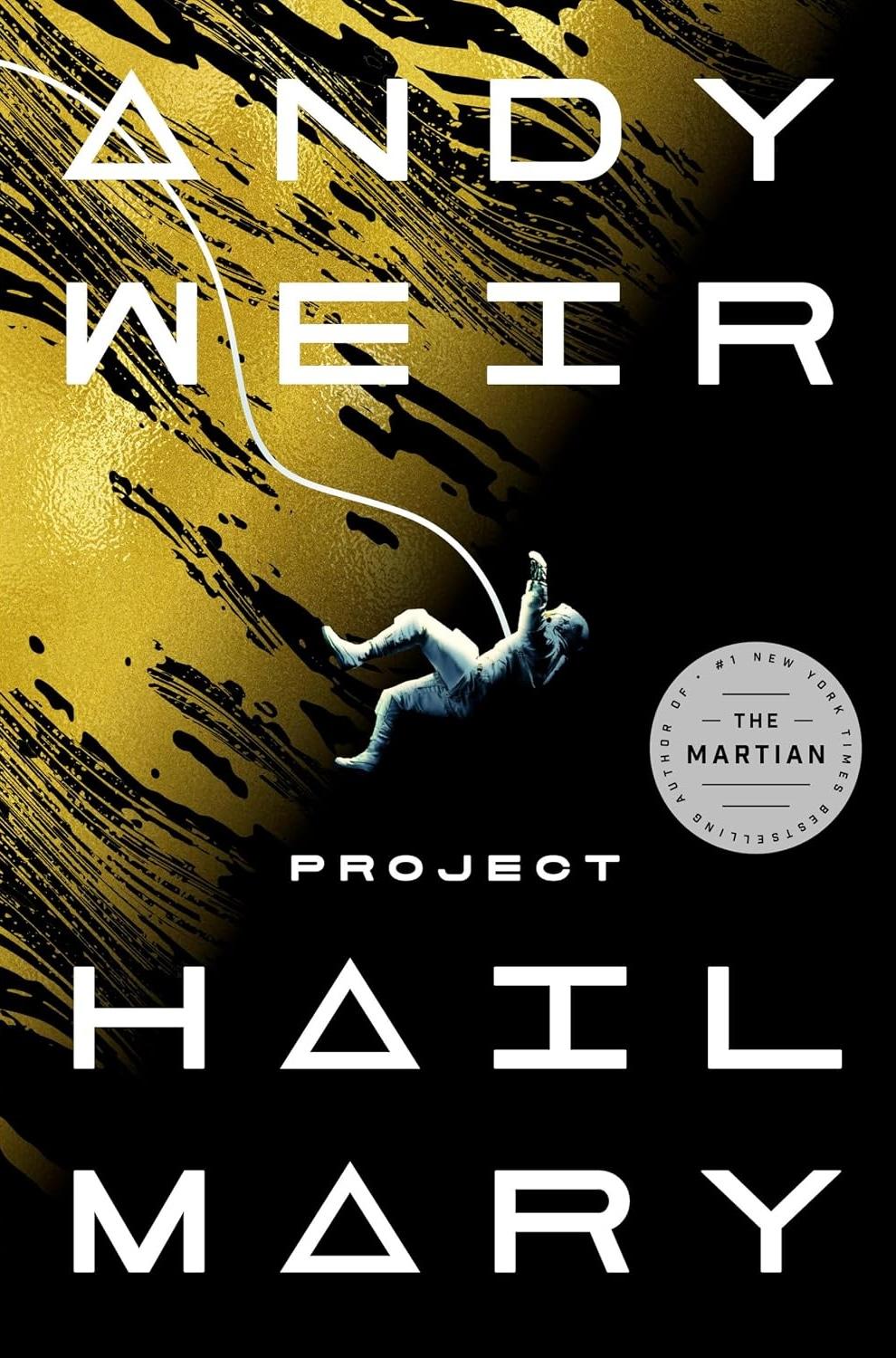
Project Hail Mary by Andy Weir. Ballantine Books, 2021. 496 pages.
Did you know LARB is a reader-supported nonprofit?
LARB publishes daily without a paywall as part of our mission to make rigorous, incisive, and engaging writing on every aspect of literature, culture, and the arts freely accessible to the public. Help us continue this work with your tax-deductible donation today!
ANDY WEIR’S 2021 NOVEL Project Hail Mary, whose film adaptation broke box office records in the summer of 2026, might accurately be described as 400 pages of physics problems strung together by narrative. It was also a New York Times bestseller. One explanation for the novel’s popularity, of course, is the touching human-alien friendship at its core; another is the role science plays in its story.
Project Hail Mary, like Weir’s other works, falls into the subgenre of hard science fiction, which prioritizes scientific accuracy and technical detail. Usually, this focus serves the goal of world-building or establishing the story’s horizons of possibility. Scientific problem-solving might form part of the story, but the technically accurate innovations are just as important in enabling a larger social and political narrative. For example, James S. A. Corey’s much-lauded novel series The Expanse (2011–21) is premised on the invention of a direct fusion drive based on entirely sound physics principles. The speed of travel it permits within the solar system sets the stage for a sociopolitical saga that stretches across planets rather than nations.
Weir’s novels, however, are unique even in this subgenre because the active solving of scientific problems is not merely part of the narrative; it is the narrative. In Project Hail Mary, for example, a lone astronaut named Ryland Grace embarks on an interstellar mission to save the human race, which is being threatened with extinction due to a microscopic alien life-form—Astrophage—that feeds on the sun’s energy. Like Weir’s first novel, The Martian (2011), in which a lone astronaut is stranded on Mars, the primary driver of the plot involves a singular protagonist solving one science problem after another.
To those who have not read the books, it’s difficult to describe the level of scientific minutiae involved: at a certain moment in Project Hail Mary, for example, we’re treated to an extensive explanation of what specific type of link a chain must use so that Grace can collect a sample from a planet’s atmosphere without the chain being torn apart by atmospheric drag. The solution: orbiting the planet at a 30-degree angle, which allows him to approach the atmosphere closely while also compensating for gravity and atmospheric drag. Such scenes challenge the reader to draw a mental free body diagram in order to grasp exactly what’s happening.
And certainly, a reader might be forgiven for skipping the effort involved. But to invest in a story, it is necessary to grasp its stakes. And in Project Hail Mary, understanding the stakes requires understanding the science. The whole chain scenario is essentially a physics word problem—how to ensure that all the different forces acting upon the spaceship balance out to zero. And what will happen if they don’t? (The answer: excessive centrifugal force, a decaying orbit, a melting spaceship.) In short, developing a mental free-body diagram of the scenario is essential to grasping this major plot point. (The movie simplifies this scene into the sci-fi cliché of “gravity’s tearing the ship apart!”) Weir’s mode of hard SF is thus deeply dedicated to the elaboration of scientific minutiae.
One might expect that a fiction so predicated on scientific problem-solving—and on making the reader devote extensive mental energy to doing physics problems in their head in order to understand the narrative—would have little investment in politics. Indeed, according to Weir himself, his approach to SF offers an entirely apolitical vision of the world. In fact, Weir recently made headlines for insisting that politics are entirely absent from his fiction: “I put no politics or social commentary into my stories at all. Anyone who thinks they see something like that is reading it in on their own. I have no point to make, and I’m not trying to affect the reader’s opinion on anything. My sole job is to entertain, and I stick to that.”
Contrary to these comments, however, Weir’s oeuvre portrays scientific endeavor as a profoundly human enterprise, and therefore one that is inextricable from a social and political context. His work cannot help but imagine a highly political vision of science, grounded in a mix of nationalism, international cooperation, and anthropocentrism, in which the actions of a larger-than-life hero, solving scientific problems light years away, have profound effects on the human world.
Weir is thus reminiscent of one of the founding fathers of the SF genre, who is often profoundly misunderstood: French novelist Jules Verne. Verne wrote his stories during the age of industrialization, in the latter half of the 19th century, when regular people were encountering novel technologies on an unprecedented scale. Educating the public about the scientific and technological novelties permeating society became a pressing need. And so, while he was not the first sci-fi author, Verne was one of the first to meld storytelling with careful, accurate science in order to teach while entertaining. His storytelling, like Weir’s, is often highly technical. Unlike his British contemporary H. G. Wells, who dreamed up things like the mythical metal Cavorite (of which Verne flippantly said that was all quite nice, “but show me this metal. Let him produce it”), Verne’s novels give the exact measurements of fictional submarines and provide diagrams of the orbits of celestial bodies. They are chock-full of statistics, calculations, and lists of flora and fauna. Verne was likely the first author to calculate Earth’s escape velocity and incorporate it into a story (his 1865 novel From the Earth to the Moon).
This rigorous quasi-scientist is not the version of Verne that exists in the popular imagination, however, particularly in the English-speaking world. Thanks to a long history of bastardized translations that excised his novels’ scientific content, and adaptations that foregrounded their more dramatic and adventurous components, Verne has entered the cultural consciousness as a teller of tales about extraordinary individuals who use marvelous machines to bravely go where no one has ever gone before: Captain Nemo in his submarine Nautilus, Michel Ardan in his space capsule, Phileas Fogg via trains and steamers (although we associate him with the hot-air balloon, that mode of transport was introduced in the 1956 film adaptation, not in the novel).
Due to these heroic scientists and the author’s meticulous technical accuracy, Verne’s oeuvre has consequently often been regarded as apolitical—as merely stories of wonder, science, exploration, and discovery, perhaps best suited for younger audiences. In fact, Verne’s editor Pierre-Jules Hetzel famously pressured Verne to cut any overtly political content in order to make his stories appealing to the widest possible audience. Despite Hetzel’s pressure, Verne’s stories still offer a political vision of scientific endeavor or, rather, of science as the product of a social and political world. Writing at a time when industrialization fundamentally transformed the roles science and technology played in human life, Verne intuited that there was no way to realistically portray scientific endeavor except as social and political. Verne’s stories and Weir’s oeuvre are thus strikingly similar—including their prioritizing of technical accuracy and their grandiose heroes—and a comparison between the two is deeply revelatory of just how political Weir’s stories really are.
Verne’s From the Earth to the Moon, for example, is not really a story about going to the moon. Instead, it focuses on solving every technological, logistical, and economic difficulty that stands between humanity and a moon shot, from securing a launch site to building a high-altitude telescope. Only in the penultimate chapter does the launch itself take place. Yet one of the core truths about scientific and technological innovation, which Verne so insightfully grasped in the midst of a changing world, is that even when it’s inaccessible to the general public, science has a profound effect on society.
In the case of the moon shot, only three exceptional figures would go on this voyage—including Barbicane, the innovator of the daring project, and Michel Ardan, the imaginative dreamer modeled on Verne’s friend Félix Nadar—while the rest of Earth’s population could only watch, just as it watched three men go to the moon in 1969. Yet Verne presciently realized that it would take the entire world to put them there. From the project’s inception, the population carefully follows “every aspect of the operation.” Tampa, chosen as the launch site, becomes Moon-City, its economy booming and its population exploding. The funds for the endeavor are raised by the populations of the world’s nations, and the “political consequences” and “implications for civilization” of the moon shot are immediately examined by every publication in existence. (Note: All English translations from Verne’s works are my own.)
Similarly, though only a minuscule handful of people have ever left the confines of Earth’s atmosphere—the Apollo program largely put white male fighter pilots on the moon, and the first woman to orbit it has just returned—the story of human space exploration is the story of thousands of hidden figures who calculated, programmed, and realized this dream. More than that, the space program is responsible for many of our modern-day technologies, from smartphone cameras to scratch-resistant lens coatings. NASA’s highly selective, often secretive, nationalist project has quite literally shaped how regular individuals interact with the material world on a daily basis.
Many of Verne’s most famous works follow this pattern—particularly those known for their lonely heroes embarking on unprecedented voyages. Twenty Thousand Leagues Under the Seas (1870), for example, opens with the appearance of the Nautilus, an electric submarine designed and helmed by the enigmatic Captain Nemo. Nemo is the epitome of the Romantic hero who has rejected humanity and fled from civilization to a place no human hand has meaningfully touched or tamed: the depths of the sea. Thanks to his innovative submarine, he has access to a “land of marvels” that will be seen by no other human eyes, maintains painstaking oceanographic observations that will never be shared with a scientific community, owns incomparable collections of specimens of natural history rivaling the greatest museums on Earth, and has mastered scientific knowledge beyond that possessed by the most renowned institutions.
Yet when the Nautilus appears, this “inexplicable phenomenon” affects the entire world. It excites the public at large, threatens transoceanic communication and trade, and becomes a matter of international concern. It sinks ships, actively undermining Western empires at a time when the military applications of submarines were a major topic of technological speculation and concern for Western nations. In Nemo, Verne dreamed up an astounding character, a solitary scientist whose technological prowess poses the same threat to the geopolitical status quo as a technologically advanced nation-state. A world unto himself, Nemo reveals how crucial scientific and technological might is to nations and their interests, both in Verne’s time and today.
Weir’s oeuvre offers this same Vernian vision: Mark Watney (the botanist in The Martian) and Ryland Grace are the distant literary descendants of Verne’s special figures who possess scientific and technical abilities far beyond the average, embarking on journeys of exploration to places where (almost) no one has gone before. And like Verne, Weir has stumbled his way into offering a political vision of science: a highly optimistic and idealistic one that sees science as a solution to human problems, albeit one that operates on a strange mix of anthropocentrism, national unity, and intergovernmental collaboration.
This is evident in the very premise of Project Hail Mary: in the face of a worldwide crisis and potential human extinction, all the nations of the world come together, put their trust in scientific expertise, ignore existing law and precedent because of the dire nature of the emergency, and commit themselves to a project that will cost at least $10 trillion. This vision was directly at odds with the reality in which the novel appeared in 2021, when a not-insignificant portion of the world’s population was rejecting scientific expertise while vocally insisting that a global pandemic was a hoax and vaccines were a nefarious government conspiracy. Reading the novel the day it was published, mere weeks after I received my first COVID-19 shot while watching lifesaving measures such as mask mandates get dragged into lengthy court battles, was a strange experience because of the aspirational vision of the world it held up. It felt analogous to the original Star Trek’s hopeful 1960s vision of the future amid the divisions of the Cold War and the Civil Rights Movement, a future in which the people of the world had laid aside their differences to improve human life. Moreover, the film adaptation of Weir’s novel—which is very closely based on the book—portrays, in 2026, an American man, a Chinese man, and a Russian woman crewing the space mission that is humanity’s last hope for survival; in the real world, meanwhile, these nations are locked in a new space race. This setup feels at least as daring a choice as what Star Trek was doing in the 1960s, which is why it’s so strange to read claims that Project Hail Mary’s box office success is the result of its creator’s unique approach of “not being political.”
Though the core of the story centers on an exceptional individual, his daring voyage is only made possible by a global scientific community working to understand the issue, develop the technologies his crew will need, and buy Earth time. It is concerned with how a crisis can transform the nature of scientific practice, because science does not exist as pure and abstract knowledge-seeking in a vacuum. As Grace narrates:
The scientific community had moved into overdrive in a very unscientific way. Gone were the days of careful peer review and published articles. Astrophage research was a free-for-all where researchers posted their findings immediately and without proof. It led to misunderstandings and mistakes, but we just didn’t have time to do things the right way.
This is a description reminiscent of Verne’s 19th century, when science was beginning to professionalize, journalistic standards were being established, and hoaxes abounded alongside legitimate scientific reporting, all fueled by excitement over the processes of innovation and discovery. (We might draw an analogy to misinformation today, in the age of AI slop, and to how difficult it has become to ascertain what is valid scientific information: even as NASA shared high-quality, easily accessible images from the recent Artemis II mission, absurd AI-generated views spread like wildfire.) Verne frequently concerned himself with dramatizing this process: every time his novel opens with an “inexplicable” technological phenomenon, “scientific societies” and “scientific journals” seize upon the question, journalists “profess to be scientific experts,” and the phenomenon is “hotly debated”—yet no one has the answer because the phenomenon is so new, because speed has been prioritized over accuracy, and because, amid all the excitement, it is difficult to differentiate qualified experts from those who simply feel they have something important to say. Who, his work asks, has the authority to shape what we believe to be true about the world?
Then there are the assumptions about what the very nature of science is that are so deeply embedded in Weir’s books. His work is beloved for its celebration of science for science’s sake, epitomized by Mark Watney’s now-iconic line from The Martian’s film adaptation that he must “science the shit out of this.” But that attitude comes with baggage that is, again, best grasped through an analogy with Verne. In Twenty Thousand Leagues Under the Seas, Captain Nemo is not only a scientist but also an explorer, even a conqueror. Originally intended to be a Polish nobleman who was rebelling against the Russian Empire, Verne ultimately transformed him into a more nebulous figure when Hetzel put his foot down, concerned about the novel’s popular appeal—particularly in Russia, a lucrative market for Verne. Nemo became an Indian prince instead, opposing the European empires that had destroyed his homeland and family, sinking European vessels, and funding rebellions.
And yet Nemo replicates the imperialist logic of his enemies. His submarine brims with technology that he uses to transform the undersea world into his own personal empire, taking from it all that he needs—food, water, oxygen, energy—just as European powers were conquering and extracting the resources of colonized peoples. He uses his submarine to reach the South Pole and plant his own flag of conquest. Writing at the height of European imperialism, Verne found its essential paradigm of conquest seeping in even as he critiqued its historical practices.
These paradigms stem from the 17th-century Scientific Revolution, when Francis Bacon first articulated the idea of science as a means of exerting human willpower over the natural world. Rather than operating as mere observation geared to satisfy curiosity, scientific practice, in Bacon’s view, should strive to conquer and shape the natural world to serve human needs. This is essentially how we have come to understand scientific practice ever since. The explorers in From the Earth to the Moon aim to become the “Columbuses of a new world.” Every rocket scientist, engineer, and astronomer responsible for humanity’s spacefaring accomplishments—from Robert H. Goddard and Konstantin Tsiolkovsky to Carl Sagan—firmly believed that humanity’s destiny lies in the stars, that our continued progress into the “final frontier” is as indisputable as a law of physics.
But the actual process of braving the unknown in the name of science and humanity has, historically, involved nationalist and even imperialist impulses. “[O]ne giant leap for mankind,” Neil Armstrong said before planting an American flag on the moon, just as Nemo planted his own at the South Pole. Similarly, Weir’s work, even as it holds up science as a source of wonder and a fundamentally human endeavor, is not exempt from this history. The Martian and Project Hail Mary have gained a passionate following because they celebrate scientific problem-solving, rationality, and a belief that the universe’s mysteries can be understood through human ingenuity. At the end of The Martian, for example, Weir (in Watney’s voice) insists that humans had come together to save the stranded astronaut not only because humanity is essentially good but also because of what he represents: “progress, science, and the interplanetary future we’ve dreamed of for centuries.”
Yet Watney—a descendant of explorers like Nemo—colonizes Mars. The University of Chicago, his alma mater as well as my own (our admissions office proudly boasts a picture of him on the wall alongside other famous fictional alumni like Indiana Jones), emails to inform him that since he has grown crops on Mars, he can be said to have colonized it. This achievement is held up as a triumph of pure science and human determination rather than a fossilized imperial practice surviving from Verne’s time. In the same breath, Watney boasts that, with this act, he’s outdone Neil Armstrong. As in From the Earth to the Moon, where the moon shot is simultaneously “an affair of national honor” that must launch from the United States and an international cooperative effort, the question arises: in whose name has Watney laid claim to this planet—humanity’s or America’s?
Meanwhile, back on Earth, the entire world is riveted by the fate of a lone astronaut on Mars. In the film adaptation, crowds in Times Square and all around the world watch his rescue, displaying a level of enthusiasm for space exploration that goes far beyond that mustered when human beings flew to the moon mere months ago. (It is another jubilant Vernian vision of the embrace of science: at the end of From the Earth to the Moon, news of the launch explodes “like a flash of lightning,” electrifying the world’s population as it speeds “along all the telegraph lines of the globe.”) Yet there’s also a small mention that China has given up their own Martian lander project to save a single American human because they have been promised that, in return, there will be a Chinese astronaut on NASA’s next Mars mission. NASA spends the novel concerned about public relations, congressional funding, and what they’ll look like on the world stage if one of their astronauts dies. Nationalist logics are well at work on Earth while a solitary astronaut figures out, using only the most rigorous and purportedly apolitical science, how to make water out of rocket fuel on Mars.
Meanwhile, Project Hail Mary is underpinned by a deeply anthropocentric attitude: humanity’s survival must be ensured at all costs, no matter the devastation to other species or the planet itself. Eva Stratt, the de facto ruler of Earth in its moment of crisis, ruthlessly nukes Antarctica and paves the Sahara with solar panels (this, we learn in a throwaway line, will fundamentally change the balance of power on Earth by making African countries the leaders in energy production), disregarding the vast ripple effects of these acts. The world is ours to mold, and in the face of human extinction, she overtly admits, “I don’t care about morality.” An ideology of science as a practice of human empire is the prelude to a belief in anthropocentrism—in the idea that human existence and human needs are more important than morality in regard to other species, the environment, and the Earth around us. The novel simultaneously celebrates science as an act of wonder and an exercise of willpower—specifically, the exertion of the human will on the world, which is inevitably a political act with political consequences.
Even when we imagine extraordinary, interplanetary voyages, we take our baggage with us.
LARB Contributor
Anastasia Klimchynskaya is a visiting assistant professor of English at Illinois Wesleyan University. A scholar of science fiction, she is the author of Science Fiction and the Modern World: The Emergence of a Genre in a Literary Age (2026) and editor of Jules Verne’s From the Earth to the Moon: Annotated for Our Spacefaring Age (2026).
LARB Staff Recommendations
How to Create an Alien
Andy Weir discusses the pleasures of world-building, the promise of AI, and the coolness of humanity.
On the 192nd Anniversary of the Birth of Jules Verne
Howard A. Rodman looks back on the legacy of Jules Verne and his most powerful narrative creation, Nemo.