Female Power Versus Toxic Masculinity
The three newly translated novellas in Belgian author Jacqueline Harpman’s ‘We Were Forbidden’ display a storytelling skill that seems magically effortless.
By Kaya GençAugust 6, 2026
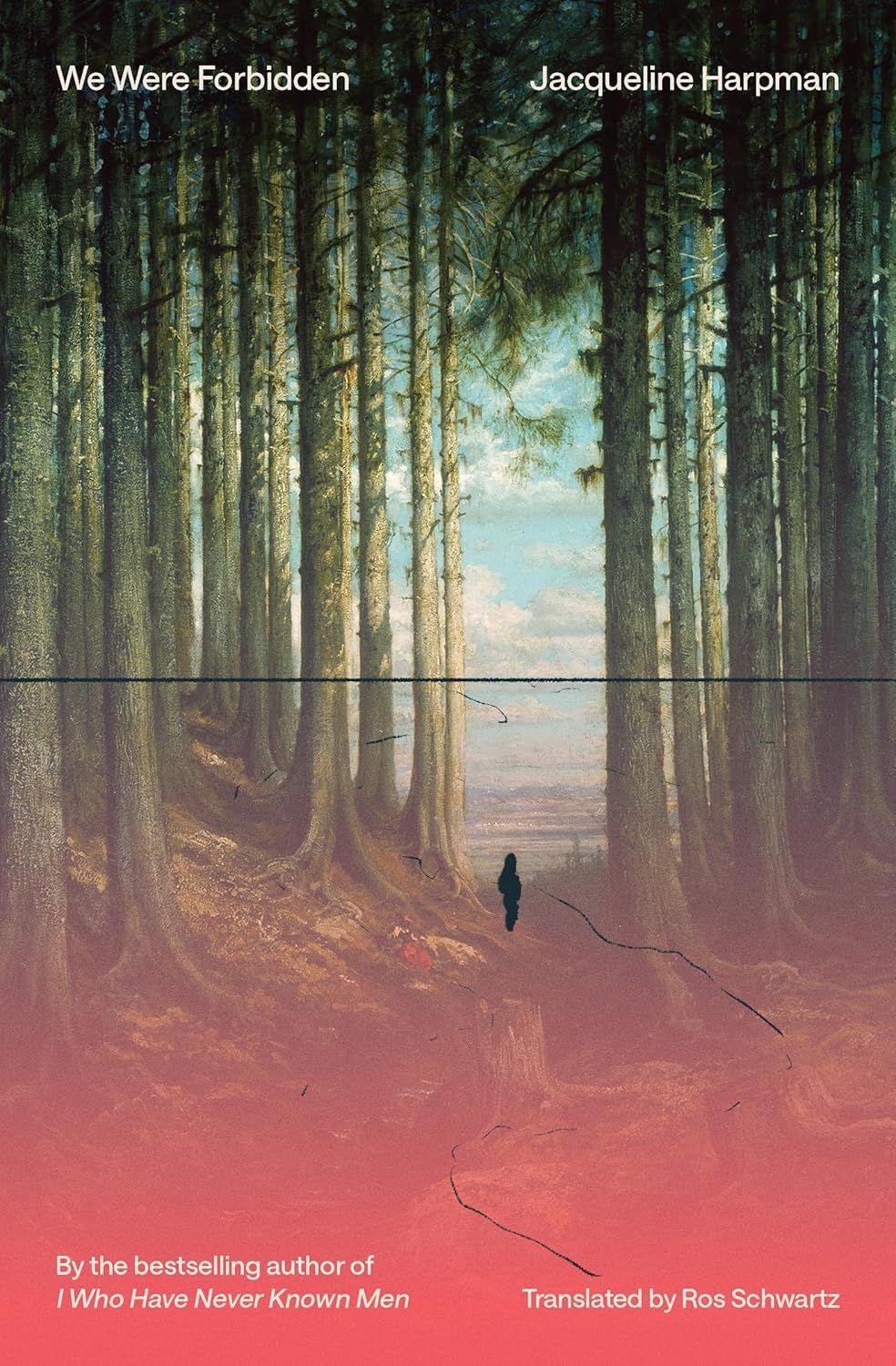
We Were Forbidden by Jacqueline Harpman. Translated by Ros Schwartz. Transit Books, 2026. 112 pages.
Did you know LARB is a reader-supported nonprofit?
LARB publishes daily without a paywall as part of our mission to make rigorous, incisive, and engaging writing on every aspect of literature, culture, and the arts freely accessible to the public. Help us continue this work with your tax-deductible donation today!
IN 2022, A DECADE after her death, Jacqueline Harpman, the Belgian psychoanalyst and novelist, went viral on TikTok. Harpman’s 1995 speculative fiction novel I Who Have Never Known Men describes the liberation of a group of women from male captivity. That uncanny, dreamlike novel first appeared in English in 1997 in Ros Schwartz’s fine translation. In 2024, the novel found new resonance in an era of toxic masculinity unleashed by Donald Trump’s first term in office, and sold 100,000 copies in the United States. Now, as toxic masculinity becomes the modus operandi of Trump 2.0, comes We Were Forbidden, a slim volume of three novellas (also translated by Schwartz) in which Harpman showcases her remarkable storytelling skills, with female characters who derive their power from rational inquiry and artistic imagination while fighting narrow-minded bullies.
A large section of Harpman’s paternal family was killed in Auschwitz, and the trauma seeped into her fiction. The child heroine of I Who Have Never Known Men grows up in a bunker with 39 adult women, enduring physical and emotional violence committed by nameless men. The book’s UK title, The Mistress of Silence, reflects the subtle beauty of its wise narrative voice. In the absence of her male captors, the narrator builds a new, humane life. Yet it takes time to process her trauma: only literature can allow that to happen. After a long period of denial, she realizes that her “story was as important as that of King Lear or of Prince Hamlet that William Shakespeare had taken the trouble to relate in detail.” This is how you become a writer.
“The Ardennes Forest” (2004), the opening novella in We Were Forbidden, is set in that same world. A group of survivors talks, walks, and muses. They’re a peaceful crowd who never fight. They’ve survived a brutal war: “We had no idea whether the enemy had left or whether they’d won a resounding victory, wiping out all their opponents, but none of us believed we had won.” On rainy evenings, they make shelters out of branches and huddle together for warmth; one day, they reach the Ardennes, a region of vast forests. There, the prose takes on an oneiric quality as they take nocturnal walks to find a place to light a fire and roast hares. “Sometimes, one of us would go off to die alone in a thicket,” we learn at one point. And later on: “We were easily tired, or was it bored?—we could no longer tell the difference—and we would lie down to sleep.”
Are they the sole survivors, and if so, would humanity die out with them? They ask what the point of their strict compliance with rules is “if the world where the decisions had been made no longer existed.” These existential questions, posed in dreamlike sequences, are typical of the author’s style. Harpman wrote philosophical page-turners: in Orlanda (1996), her only other novel available in English, we follow a 35-year-old scholar who struggles with a passage in Virginia Woolf’s 1928 novel Orlando. To resolve the interpretative conundrum, she jumps into the skin of a nearby man to see what it is like being a man and a woman at once. Both in that Prix Médicis–winning novel and in “The Ardennes Forest,” Harpman writes experimentally: her characters think with the reader as their fates take shape; nothing is defined; everything is in the act of becoming.
Among the “thirty-seven exhausted souls” are a primary schoolteacher, an architect, two doctors, a lawyer, two dressmakers, and a pharmacist. Other than eating and walking, they have nothing to do: “[T]here were no laws to apply, no medicines to prescribe, no children to educate.” Coming across a town relieves their boredom. They pick the lock of a house, amazed at the sunlight falling on the black-and-white floor tiles inside: “Everything was very clean beneath the layer of dust deposited by time.” They come upon dresses hanging from hooks; in the kitchen, they find sugar, coffee, oil, tinned green beans, carrots, peas, and red cabbage. In another room, they discover thread, needles, scissors, and tape. Harpman handles the scene in which the survivors share a meal in awed silence with panache. They kindle fires in the stoves, roast a young boar, and bake bread. As their bottles empty, they grow merrier.
The tale of these survivors basking in luxury is touching in its descriptions of subtle, mundane details: a comfortable bed, an oven, a television set. Every evening, they gaze at the cloudless sky, eat al fresco, drink wine, and prepare coffee for the next morning. After spending a week in the house, they reminisce about before, “when it was normal to sit at a table to eat and to sleep in a bed.” A pervasive sense of sadness envelops the tale, as its survivors recall the good times when they used to read books or go to the cinema with friends.
One day, they leave the village and trudge on wearily. Now the narrator’s voice suddenly sounds older. Harpman has the magician’s skill of displaying a character’s aging in just a few sentences. “One of these mornings, I’ll be the one who can no longer get up, and they’ll leave, turning around once or twice.” Gradually, she muses, “the houses will become ruins, the roofs and walls overgrown by the vegetation, destruction will rule and one day it will rain on the paper and dissolve its shape.”
The second novella, “The Outcast” (2001), is rooted in Harpman’s time in Casablanca as a Jewish refugee. The author’s family had moved to Morocco after the Nazis invaded Belgium. As a client state of Germany, Marshal Philippe Pétain’s collaborationist Vichy France administered French colonial possessions, including North Africa. Harpman, aged 13, was required to attend an antisemitic lecture delivered by Jacques Doriot, a French fascist politician. Though his “torrent of vile remarks directed at Jews” infuriated her, she lacked “the courage to stand up and shout at the abomination.” This story is Harpman’s attempt to reverse that.
The 15-year-old narrator of “The Outcast” is confused: after American forces conducted amphibious landings near Casablanca in November 1942, Morocco’s official allegiance suddenly switched to the forces of General Charles de Gaulle. How could her teachers at school praise Vichy France one day and sing prodemocracy songs the next? Harpman sets her tale at a liminal moment when the fate of the war is unknown. She explores the friendship between the Jewish narrator and her bestie, Henriette Serrano. The two talk nonstop about literature, discuss the meaning of life, compete at writing alexandrines, and admire each other’s work: “I was already good at prose; she’d be a poet, and I a novelist.” The narrator loves their conversations but is also annoyed by Henriette, who switches her allegiance from the collaborationist Pétain to the anti-Nazi de Gaulle after the American landing. She decides to expose her friend’s unethical behavior and inability to think rationally.
Henriette is concerned for her older brother, who is fighting in the Ardennes during the Battle of the Bulge. For six weeks, there is no news from him. But the narrator feels she is misusing her brother’s story and is disgruntled by how Henriette “put[s] on the airs of a tragedy queen.” Watching other girls shower Henriette with “little kindnesses” infuriates the narrator. In a homework assignment on Charles Péguy, a romantic socialist who died in World War I, the girls are asked to reflect on the line “Heureux ceux qui sont morts pour la terre charnelle” (“Happy are those who were slain for this mortal land”). The narrator despises such sentimentalism while Henriette, much to her surprise, admires Péguy. If Péguy had glorified sacrifice and died on the battlefield, the narrator writes in a school essay, then, “according to his own logic, he had had an excellent end.”
There is much to love in this narrator, a stickler for grammar and syntax who has sleepless nights when her mistakes are pointed out and who detests preconceived ideas. Unsurprisingly, her way of thinking is judged subversive and mean-spirited. Things get worse when, on the way home, she asks Henriette why she makes such a fuss about her brother if she’s so convinced there’s a “Heaven where people are very happy and that it’s enough to die for one’s country to get there.” To punish the narrator, teachers bar her fellow students from speaking to her for 40 days. The experience of being ostracized allows her to discover solitude and pride, “two monsters that happily marry and then devour their host.” After that experience, she writes, she never found herself tongue-tied when she wished to speak: “[T]hat’s because I had stopped lying to suit others, because I wasn’t capable of doing so.”
The last story in the collection, “The Broom Closet” (2003), is the least political but the most imaginative. It starts in autofiction mode: “I was traveling back from Paris, where I’d signed a few books, drunk a glass of champagne and made intellectual-sounding comments under the fond gaze of my publisher.” Fifteen minutes later, the narrator moves to the front of the train, where “a quaint dining car” strikes her with its “old-fashioned charm,” its wood paneling, and the “little lamps with pink lampshades.”
That’s where the magic starts, and Harpman transports us to the 1920s. A deferential waiter shows her a suitable seat, and she feels like a woman from bygone days. The novelist imagines a self into being before our eyes: “I had just said goodbye to a lover who I may never see again. We had spent a heartbreaking night together, and my soul was still in shreds.” She makes up details as she goes: “I was twenty-two and had been married for six tedious years to a polite man who twice a week left my belly damp and sticky.” This fantasy firms up to become the story of a character named Madame d’Afflighem, who is married to a judge who sentenced a famous killer to death. The story’s themes slowly surface: adultery, social justice, sexual passion. Madame d’Afflighem is smitten with the beauty of a certain Ulrich, who reminds her of the men depicted in Giorgione’s Young Man with Arrow (1505) and Antoine-Jean Gros’s Bonaparte at the Pont d’Arcole (1796).
The couple make love in the broom closet in the Hôtel Métropole, “the place for prestigious celebrations in those glorious, heady 1920s.” Harpman negotiates with the reader what she should do next with Madame d’Afflighem: “I gave her a lover in a broom closet, and it looks as if I was attempting the risqué genre, which is not something I am accustomed to, I told myself.” She decides that her heroine should be a widow. That will demand a murder and a murderer. We watch, in real time, how she figures out a way, a story, to serve that purpose.
How does Harpman juggle all these elements yet make her storytelling seem so effortless? She leaves the scaffolding with the building, and there is great joy in watching the workings of a novelist’s mind in these pages. At one point, she notes: “I am unable to imagine lives that are different from mine unless I lend them to imaginary women.” Elsewhere, she speculates that “Flaubert envied Emma” to explain why the French novelist condemned his heroine, Emma Bovary, to such an awful death after her sexual adventures.
Harpman’s heroines get somewhat happier endings. Toward the end of “The Broom Closet,” the narrator imagines a future where her book lies in a bookcase, “yellowing, dried up, likely to crumble to the touch,” and her great-grandson’s new girlfriend reads a few lines from it and says: “Whoa! That style of writing is so outdated!” We needn’t fear such a fate for Harpman. As the centenary of her 1929 birth nears, her works—she wrote more than 15 novels in French—remain as fresh and exciting and inviting as when she first wrote them.
LARB Contributor
Kaya Genç is the author of three books from Bloomsbury Publishing: The Lion and the Nightingale: A Journey Through Modern Turkey (2019), Under the Shadow: Rage and Revolution in Modern Turkey (2016), and Istanbul Anthology: Travel Writing through the Centuries (2015). He has contributed to the world’s leading journals and newspapers, including two front page stories in The New York Times, cover stories in The New York Review of Books, Foreign Affairs, and The Times Literary Supplement, and essays and articles in The New Yorker, The Nation, The Paris Review, The Guardian, Financial Times, The New Statesman, The New Republic, Time, Newsweek, and the London Review of Books.
LARB Staff Recommendations
Toxic Masculinity Is a Deep Sort of Loneliness: A Conversation with Ben Purkert
Katya Apekina speaks with Ben Purkert about his debut novel “The Men Can’t Be Saved.”
A Young Life Tragically Lost
Mark Athitakis reviews Lily Tuck’s novel “The Rest Is Memory.”