Did you know LARB is a reader-supported nonprofit?
LARB publishes daily without a paywall as part of our mission to make rigorous, incisive, and engaging writing on every aspect of literature, culture, and the arts freely accessible to the public. Help us continue this work with your tax-deductible donation today!
This essay is a preview of the summer issue of our print journal, the LARB Quarterly, no. 49: Traffic, out now. Become a member for more essays, criticism, poetry, fiction, and art—plus the next four issues of the Quarterly in print.
¤
STEPPING OUT INTO Steve Collins’s garden in a suburb of Nairobi, we’re immediately met by an array of sights and sounds. Grasshoppers the size of sparrows are flying from tree to tree with a helicopter-like whirring, while emerald-colored sunbirds are busy sucking the flowers dry of nectar. Somewhere, a rhythmical do-re-mi is sung by a red-chested cuckoo, commonly known as the rainbird, because it sounds like it’s singing it-will-rain, it-will-rain.
And, of course, there are butterflies. Some are bright blue, some are yellow, some have a black-and-white pattern that makes them look like a half-solved Sunday crossword. Some fly slowly and unhurriedly; some chase each other in erratic maneuvers. Frantically leafing through my copy of Butterflies of East Africa, written by Collins and his colleague Dino Martins, I try, and fail, to identify them. Maybe I’m looking at an azure hairstreak, a fig-tree blue, a yellow splendor, a Ngong Zulu, a topaz Arab, a brilliant gem, a grass jewel, a beautiful tiger, an African albatross, or the unfortunately named woolly legs. Or perhaps we’re dealing with a monk, a layman, a chief, a garden inspector, or a black-and-orange playboy? There are way too many species, in the leaves of the book and on the leaves of the bushes, and they rarely sit still long enough for me to get a good look at them.
Collins, on the other hand, barely notices them. He’s wearing a short-sleeved safari shirt, and as he walks, he is closely followed by his two small terriers, Dudu, which means “insect” in Swahili, and Boris, who, due to his dim-wittedness, was named after the former British prime minister. “This whole business of chasing after the most colorful butterflies is a young man’s game,” Collins remarks with an old-fashioned Essex accent inherited from his parents, who came to Kenya in the 1940s, back when it was still also known as British East Africa. “What you have to realize is that everything is wonderful if you take the time to look at it. Look at these little chaps, for example,” and he points to a swarm of small, burnt-orange butterflies. “They probably hatched just this morning. I planted this bush just for them. They use the leaves to build nests that shield them from birds.”
During the course of a single day, Collins might see 75 different butterfly species in his garden, and in total, he’s observed about 200 on this small plot of land alone. Such is the variety of butterflies in the Afrotropics. While the US has 750 species of butterflies, Kenya, a country roughly the size of France, boasts 950—and widening the scope to the entirety of sub-Saharan Africa, we’re talking more than 4,500 different species. Collins knows them by heart, Latin names and all.
“It’s really not that remarkable when you think about it,” he assures me. “Other people know the names and faces of hundreds or maybe thousands of Hollywood actors—I can’t do that. If I go to the movies, the next day I may be able to tell you roughly what it was about, but I wouldn’t remember a single actor. But when it comes to butterflies …”
It’s not for nothing that Collins, as the French entomologist Gilbert Lachaume told me, is also known as “The King of African Butterflies.” We’re walking through his garden, ducking under tree trunks and stepping over columns of marching safari ants, to get to the building that houses his butterfly collection, the greatest not just in Africa, not just in the world, but in the history of the world. He is also unlikely to be superseded because, as he remarks, “being called ‘The King of African Butterflies’ is very funny, because it’s not really a kingdom with many people these days. Butterfly collectors are going extinct faster than the butterflies themselves.”
Some would say it’s for the better. Since the 1960s, butterfly numbers have been steadily decreasing all over the world, and as they have become scarcer, butterfly enthusiasts have been encouraged to photograph rather than kill, and legislation against collecting has been put in place in several countries. The same goes for many other kinds of natural history. Europe has perhaps some of the strictest laws. In Germany, you can be fined 50,000 euros for collecting wasps. If caught with 20 wild birds’ eggs, you can risk a prison sentence of up to a year, roughly equivalent to being caught with 20 pills of ecstasy or five grams of cocaine. In Croatia, you need a special permit from the state to collect insects. In most of the United Kingdom, it’s illegal to collect fossils, or eggs, and to be in possession of a dead bird, or any part of it—meaning, theoretically, that it would be criminal to pick up a feather from the side of the road. Increasingly, the same type of legislation has been cropping up in Africa as well, despite the fact that collecting, especially with regard to insects, has little to no effect on the species’ well-being. The question of collecting is a moral one more than anything else. Attitudes have changed. As the literary scholar Andrew Hui wrote recently, the old-fashioned natural history collection “destroys what it loves and loves what it destroys. […] To bring the specimens of earth into a small space necessitates deracination and exploitation.”
If Collins is, then, to be the final great butterfly collector, he will be the last of an illustrious cast of adventurers and eccentrics. Not very long ago, chasing and collecting butterflies was a fairly common and respectable activity, notably widely practiced by the middle classes, women, and virtually anyone who had access to nature and time to spare. The history of butterfly collectors also boasts many familiar faces, such as Winston Churchill, Neville Chamberlain, Vladimir Nabokov, Tsar Ferdinand I of Bulgaria, and the son of Nikita Khrushchev. Certain personalities loom particularly large in the lepidopterology world. The magnificent Margaret Fountaine, said to be the most well-traveled lepidopterist in history, was a Victorian femme fatale who crossed the Syrian desert, trekked the Himalayas, dived out of crashing trains, flew in some of the earliest airplanes ever built, survived earthquakes in Cuba and cholera in Beirut, flirted with barons and outlaws alike, and was, for a brief spell, kidnapped by a gang of Circassian highwaymen. The legend goes that Fountaine, refusing to be intimidated, told them off so thoroughly that they blushingly released her and sent her on her way. A more recent figure of note was Torben Bjørn Larsen, sometimes known as “the Indiana Jones” of lepidopterology, a drunkard from Denmark who, in his never-ending hunt for butterflies, jumped out of helicopters and faced firing squads in Nigeria and interrogations by the Syrian secret police.
The butterfly collector known as “the greatest of them all” was Lord Walter Rothschild. He was, in many ways, almost a caricature of the eccentric Victorian gentleman: he would ride around in a carriage drawn by zebras, and when he was in less of a hurry, he would sit on the back of his Galápagos tortoise, Rotumah. Lord Rothschild came from one of the world’s most successful banking families, so he could afford to employ hundreds of agents, running around with butterfly nets and kill jars, in the jungle, in the tundra, on desert islands, and in the desert proper, often risking their lives. Some went mad in the wilderness, some died from tropical diseases, one expedition team was almost totally eradicated by hostile tribes in Papua New Guinea, and one agent got his arm torn off by a leopard. Spending astronomical sums and nearly squandering away the family fortune, Lord Rothschild managed to amass a collection of 2.25 million butterfly and moth specimens, at the time the greatest private natural history collection anyone had seen. Steve Collins, who is neither a lord nor a banker, has just about double that amount, with 4.4 million specimens in his collection, representing between 95 and 98 percent of all butterfly species in the Afrotropical region.
Collins’s family settled on the slopes of Mount Elgon in Western Kenya shortly after the war, and he grew up on a coffee farm surrounded by nature. “It was a very hard and primitive life,” he says, “but it was also wonderful. My papa had to put out big heaps of maize for the elephants, so they wouldn’t trample the coffee. We didn’t have dogs or cats, but we would adopt wild animals as pets, so there would usually be a monkey, an antelope, or a mongoose running around somewhere. One of my friends even had a hippo, until it got so big it couldn’t fit in the corridor anymore and was sent into exile in their garden fishpond.”
Collins’s interest in butterflies was first sparked when he was five, and his parents went away on vacation in the eastern part of what was then the Belgian Congo: “They were completely mesmerized by all the butterflies, little flashes of red, blue, and yellow between the trees.” Soon after their return, the whole family started collecting butterflies, but for Collins, the interest stuck. Luckily, there were plenty of mentors in the area, “wonderful chaps” such as the eccentric Victor Van Someren, who lived in a small house in the forest, along with his dachshund and his pet vulture Jane: “He was an absolute genius, especially regarding the Charaxes genus. My mother would drop me off at his place and we would spend a day walking around, talking about butterflies. I was as happy as a pig in mud.”
Later, Collins dabbled with academia and the safari industry, but for most of his working life, he’s been a consultant with a multinational corporation. The job took him on assignment all over the continent, which he saw as an opportunity: “That really got the collection going—and if I didn’t have time to go out with the net myself, I would train someone locally to do it for me.” With time, Collins was able to start his own institute, the African Butterfly Research Institute (ABRI), which soon became a powerhouse for entomological scholarship. The holdings are the result of not just Collins’s hard work but also that of the 40 or so other enthusiasts who have dedicated their lives to enriching the collection.
We arrive at a large bungalow hidden deep in Collins’s private jungle. He opens the doors, and we step inside. At first glance, it looks like a huge library, but instead of books there are wood and glass cases, each shelf containing about 2,000 specimens.
“These are like hens’ teeth,” Collins says as he stands up on his toes and pulls out a case containing 12 long-winged, orange butterflies, the biggest I’ve ever seen. These are Papilio antimachus, also known as the giant African swallowtail. It’s the biggest butterfly in Africa and one of the great mysteries of entomology. Although it’s distributed from Ghana to Uganda, it only lives in the treetops, so it’s hardly ever visible to people. Nothing is known about its early life stages, but it is presumed that it doesn’t have any natural predators, as it is also the most poisonous butterfly in the world, containing enough cardiac glycosides to kill two cats. “I’d like to know how they found that out,” Collins remarks.
An enthusiast’s best chance of seeing a giant African swallowtail are the rare occasions when it flies down to ground level to suck nutrients from mud puddles. But really, you just have to be in the right place at the right time. “I caught one in southwestern Uganda in 1975,” Collins recalls. “I was washing at the side of a river when it flew right by me. I was completely in the raw, so I had no net, no nothing, and just had to smack it with the palm of my hand.” Looking a bit closer at the case, I do notice that one of the butterflies looks a bit mutilated, missing part of its wing.
There have been many such adventures in Collins’s time as a butterfly collector. At the height of the Cold War, he snuck into communist South Yemen to get to the island of Socotra—culturally and nationally a part of the Middle East but zoologically part of Africa—and spent a week collecting butterflies and drinking sour goat milk with nomads. On the Comoros, he caught an extremely rare species in the crater of Mount Karthala, an extinct volcano, but on returning to his car, he found the window broken, and his wallet, passport, and travel documents gone—“a bloody nuisance.” Collins did what any quick-thinking butterfly man would do and went on the local radio station threatening to hire a witch doctor from Pemba, who would curse the thieves if his stuff wasn’t returned. The next morning, all his things lay at the front door of his hotel room.
There have been some pleasant surprises as well. A few years ago, Collins went to Angola, where a remarkable butterfly called Alaena rosei was discovered in the 1970s. The Alaena rosei can only be found in one place in the world: the granite rocks surrounding the town of Gabela. Collins had little hope of finding it again. Angola had gone through a brutal, almost 30-year civil war, as well as many smaller conflicts. The country had been devastated. He explained: “Even though the civil war ended in 2002, they still have a lot of land mines to clean up. When we were driving around, you couldn’t pull over most places for fear of getting blown up. We saw elephants with horrible lesions, and in the places that had been cleared, the forest was being cut down for development.”
Nonetheless, he says, “we managed to find Alaena rosei within an hour of reaching the habitat. Those kinds of experiences are very gratifying, and nature is so logical.”
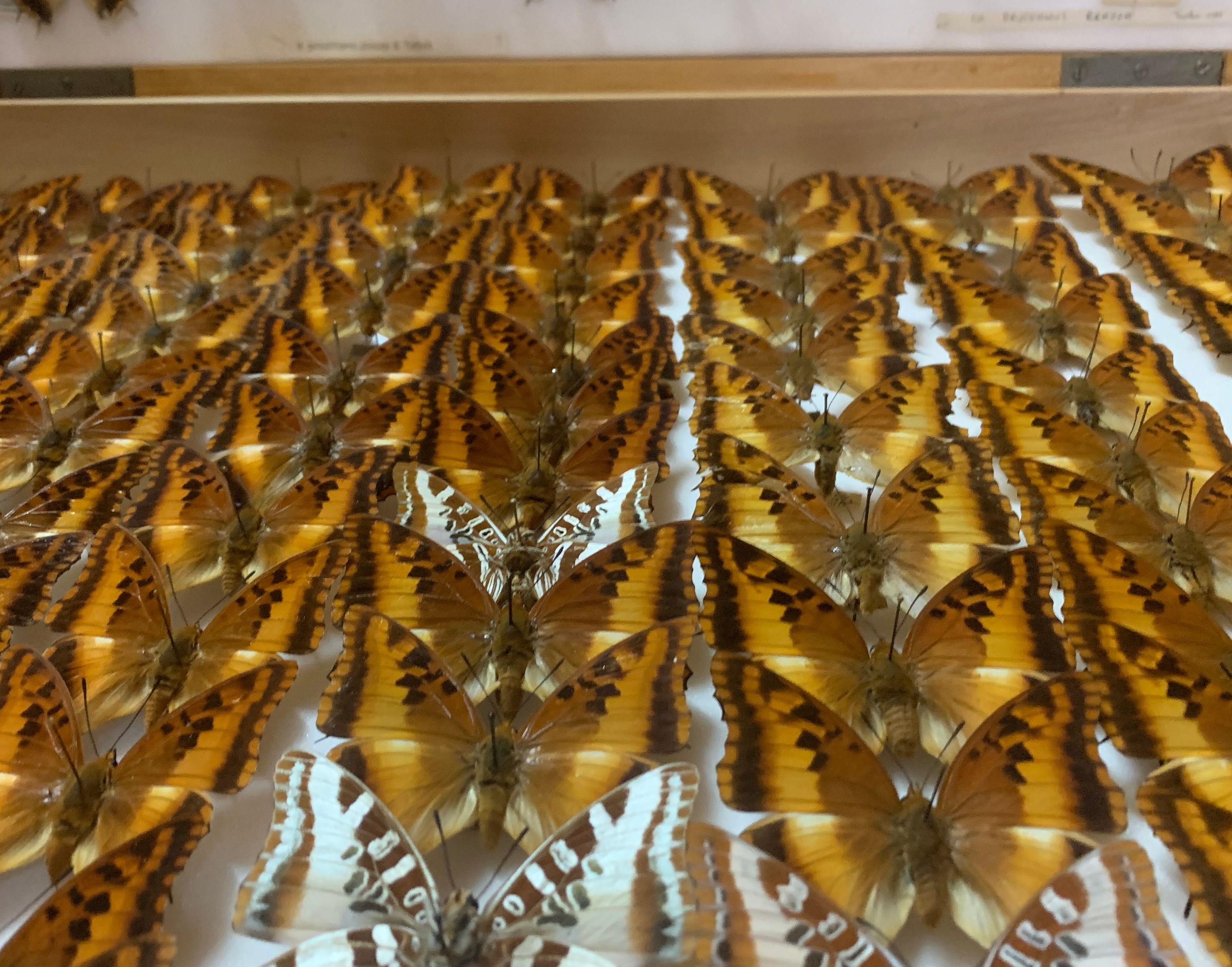
A sudden, violent rain shower starts to beat down on the roof. We walk down the many aisles, Collins absentmindedly pulling out cases from the shelves. There are butterflies that look like the night sky, butterflies that look like lemon pies, butterflies with delicate, marble-like patterns that you would otherwise only encounter on the endpapers of old books. One case contains 104 specimens of the same species, arranged so close together that one gets the impression of looking at a single, glowing sheet of amber-colored paper. There are also large cases with gynandromorphs, more commonly known as hermaphrodites, distinguishable by their asymmetrical wings: charcoal opposite aquamarine, gray opposite orange, yellow opposite white. They’re so rare that a very diligent lepidopterist might only see one in his whole lifetime. ABRI holds about 400. If anything were to happen to the collection—fire, flood, a parasite infestation—it could never be recreated. Not just because of the legal obstacles, but also because so many biozones have vanished across the continent. “I remember a special area in Western Ethiopia, where I did fieldwork in the seventies,” Collins tells me. “When you flew over it back then, it was one big forest. Today, it’s all fields with some small islands of trees here and there.”
Habitat destruction—this is the real threat to butterflies. When Kenya gained its independence a little over 60 years ago, it had a population of around eight million. Today, it’s 58 million and growing by about two million a year. Independence brought about industrialization and a population explosion; indeed, the right to self-determination in many places also meant the right to determine allocation and use of resources. Kenya was free to do to nature what we in the West have done in our own countries. Collins did not lament this: “Animals, even small animals, need a lot of space, but so do humans. And then there is the added factor of climate change, which impacts us in the tropics much harder. If, for example, there is a drought, herders from Somalia will naturally seek southwards to Kenya to find grazing for their animals. Do you then think they’re going to care if some shrubbery has been designated as a butterfly habitat? Of course not: If the animals don’t eat, they die, and the herders will starve. That’s just how it is. I’m not a pessimist lamenting all that was lost; I’m just happy that I got to see these places before they were destroyed.”
So, if we’re not really gaining anything by outlawing private insect collecting, perhaps it’s worth considering what we’re losing. Before visiting Collins, I spoke with Michael Stoltze, a Danish lepidopterist who campaigned against collecting butterflies in the 1990s but has since changed his mind. “When I first started out, the worst that could happen if you saw a rare species was that you didn’t catch and kill it,” he tells me. “When butterflies became rarer, collecting seemed like a luxury we couldn’t afford anymore. Today I would actually advocate that people who are interested in butterflies try their hand at collecting physical specimens as well. When you patiently prepare a butterfly and feel how fragile its wings are, you gain a real appreciation of how amazing these animals are.”
Perhaps, Stoltze suggests, a solution could be to establish a kind of “hunting season” for collecting insects or birds’ eggs from the most common species. “Because really, who’s going to miss a few blackbirds or cabbage butterflies?”
David Attenborough has expressed a similar sentiment, telling Radio Times in 2012 that he would never have become a naturalist with current collecting laws. Attenborough noted that fewer children going out into nature is “a disaster in waiting,” and “part of the reason for that is easy to identify, and that is because it’s no longer allowed—no longer legal—to be a collector.” Attenborough’s colleague Chris Packham backed him up, saying to the BBC: “I can’t believe that future generations will learn their trade on television, on the internet and in libraries, because the passion has to come from the heart. […] I wouldn’t reprimand a young boy that I found climbing to a nest these days. I’d give him a bunk up into the tree.”
This is all part of a significant paradox in our relationship to nature. As we’ve become aware of our impact on the environment, we’ve also become more and more estranged from it. Laws against collecting reflect a belief that the right thing to do, the tasteful thing to do, is to stay away from nature, lest we destroy what we love. This environmental awareness has come at a cost—what one might call our sensibility for nature. How many environmentalists, who can speak at length on greenhouse gas emissions, agriculture reform, and sustainable energy sources, would also be able to identify the birds outside their window?
“Well, they’ve got the right idea,” Collins says as we look out on the rain, “and I understand why you want to have this type of legislation to protect nature, especially in the temperate world where the natural world is better described, but it’s often misplaced and ends up being counterintuitive.” As he explains, “What these laws really do is discourage people from having any type of physical relationship with nature, and if you do that, they’re never going to develop a real interest in it. If you want more naturalists, more people who truly care about nature, then you need them to have that Mihi itch, that collector’s itch, at least in the early stages when they’re still children.”
Suddenly, the rain stops, and we start to walk back toward the house. The sun has just broken through, shining so brightly that the water barely has time to soak the earth before it starts rising again in clouds of vapor. There are butterflies about, flashes of orange, azure, and yellow. The birds are at it again; a boubou is whistling, ibises are yelling, the rainbird is singing it-will-rain, it-will-rain—a little late, it seems.
We sit down on the porch with a tray of afternoon tea. While we chat, he sees a butterfly in the reflection of the window and calmly remarks: “Papilio nobilis, male.”
Before it becomes too dark, Collins goes for a final walk round the garden. Half an hour later, he comes back with two butterflies, holding them by their wings, careful not to break them. One is midnight blue, almost the color of ink: Charaxes berkeleyi, male. “Haven’t seen one of these in the garden for many years. And a perfect specimen as well—he’ll go right into the collection.”
And the other is a no-less-beautiful butterfly the color of amber: “Charaxes candiope, we’ve got plenty of those.” Collins takes the butterfly, which I was convinced was dead, and throws it up in the air. At once, it comes back to life, traces a spiral in the air, flies toward the darkness of the jungle—and then, like a good idea on the tip of the tongue, it’s gone.
¤
Featured image: Charaxes druceanus, also known as silver-barred emperor butterfly, native to sub-Saharan Africa. Photo by author.
LARB Contributor
LARB Staff Recommendations
Consequences Accrue Downstream
The ongoing fight to restore the Colorado River Delta.
A Brief History of Flow
What the internet learned from television.